
Mahad Satyagraha centenary
Introduction
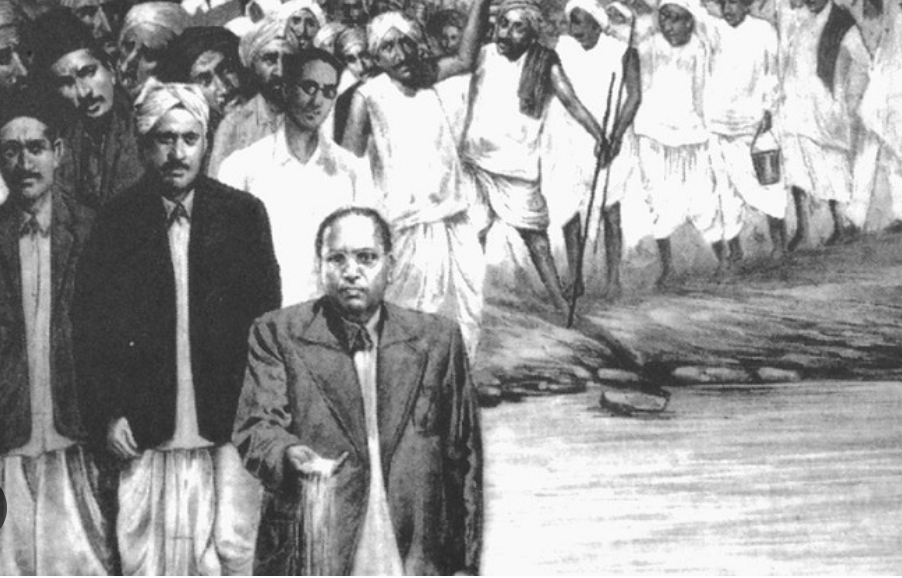
On March 20, 1927, Ambedkar led a procession of thousands through the streets of Mahad. This marks the centenary of the Mahad Satyagraha
No peon, no water
Ambedkar’s childhood experience
Could not drink water directly in school,Peon poured water from height.Prevented “pollution” of vessel.
That was the rule that governed the childhood of Bhimrao Ramji Ambedkar. He wrote about it with quiet, devastating precision in his autobiographical essay Waiting for a Visa, and in the fragment known as No Peon, No Water.
What happened at Mahad
On March 20, 1927, Ambedkar led a procession of thousands through the streets of Mahad, a small town in the Konkan, in the Bombay Presidency. Their destination was the Chavdar Tale, a public water tank.
The Bombay Legislative Council passed the Bole Resolution in 1923, and the Mahad Municipality opened the tank to the depressed classes in 1924. The upper castes ensured that the resolution remained a dead letter.
Ambedkar walked to the tank. He bent down. He drank.
Thousands followed him — men, women, children.
Rumours spread that the satyagrahis intended to enter the Veereshwar temple. Returning delegates were attacked in the streets, in their bullock carts, in their villages. The tank was “purified” with cow dung and urine, as though human dignity were a contaminant that could be washed away.
Second phase and Manusmriti burning
When Ambedkar returned to Mahad in December 1927 for a second conference, he brought with him not just the resolve to drink water again but a deeper symbolic intent.
On December 25, 1927, the conference publicly burned a copy of the Manusmriti.
Ten years in court
On December 12, 1927, even before the second conference began, Hindu residents filed a civil suit in the Kolaba District Court seeking a temporary injunction to prevent the depressed classes from using the Chavdar tank. The injunction was granted on December 14, 1927.
Ambedkar, true to his belief in constitutional methods, chose to respect the court’s order while continuing his conference. He addressed the gathering. He burned the Manusmriti. But he did not go to the tank.
The litigation dragged on for a decade. It passed through the trial court at Mahad and then the court of the Assistant Judge at Thana. At every stage, the courts held that the plaintiffs had failed to establish any immemorial custom entitling caste Hindus to exclude untouchables from the tank.
The case finally reached the Bombay High Court, where it was decided on March 17, 1937, by Justices Broomfield and N.J. Wadia in Narhari Damodar Vaidya v. Bhimrao Ramji Ambedkar.
Justice Broomfield held that the appellants had not established the immemorial custom they had alleged. The tank belonged to the municipality. It was public property. The untouchables had every right to use it.
Salt versus water
Three years after Mahad, on March 12, 1930, Mahatma Gandhi set out from Sabarmati ashram on his march to Dandi.
The Salt Satyagraha challenged the colonial state and captured global attention.
But the demands differed:
Salt March → freedom from British rule
Mahad → freedom from fellow Indians
Dandi targeted an external oppressor; Mahad confronted internal social injustice.
Salt tax could be removed by law; untouchability required transformation of society, customs, and values.
Constitutional significance
The architecture of Part III bears the imprint of Mahad.
Article 15:
Prohibits caste discrimination
Ensures access to wells, tanks, and public places
Article 17:
Abolishes untouchability
Makes it punishable
Mahad provided the “grammar of equality” while Dandi gave the aspiration for Swaraj.
Prelims Practice MCQs
Q. With reference to the Mahad Satyagraha (1927), consider the following statements:
It was aimed at securing access to public water sources for depressed classes.
It was conducted against the British colonial government.
It involved the use of constitutional methods alongside protest.
Which of the statements given above is/are correct?
(a) 1 and 3 only
(b) 1 only
(c) 2 and 3 only
(d) 1, 2 and 3
Answer: (a)
Explanation:
Statement 1: Correct → Central issue was access to Chavdar tank
Statement 2: Incorrect → Target was social discrimination, not British rule
Statement 3: Correct → Ambedkar respected court orders
Q. Consider the following regarding the Bole Resolution:
It allowed depressed classes access to public resources.
It was effectively implemented immediately.
It was passed before the Mahad Satyagraha.
Which of the above statements is/are correct?
(a) 1 and 3 only
(b) 1 only
(c) 2 and 3 only
(d) 1, 2 and 3
Answer: (a)
Explanation:
Statement 1: Correct
Statement 2: Incorrect → Remained largely ineffective
Statement 3: Correct → Passed in 1923