
LAL DED (Lalleshwari / Lalla arifa) (c. 1320–1392 CE)
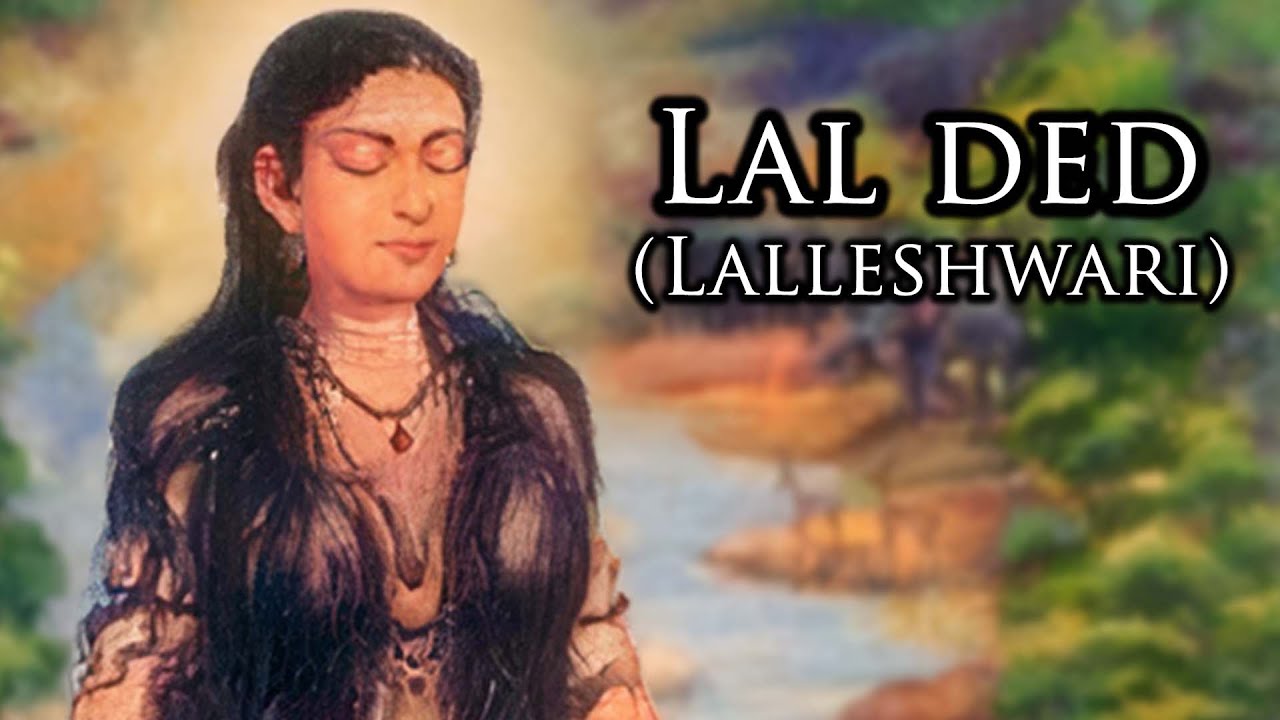
Context and Background
The Government College for Women, Srinagar, recently renamed its auditorium from ‘Lalla Arifa’ to ‘Lal Ded’ following protests from sections of the Kashmiri Pandit community.
The change was announced during the college’s 75th anniversary celebration, attended by the J&K Education Minister Sakeena Itoo, who praised the college as a “cornerstone of women’s empowerment.”
LAL DED (LALLESHWARI / LALLA ARIFA)
Historical Background
Period: 14th century CE (c. 1320–1392 CE)
Region: Kashmir Valley
Identity: A mystic poet-saint, revered by both Hindus and Muslims.
Among Hindus, she is known as Lalleshwari, a devotee of Kashmir Shaivism; among Muslims, she is remembered as Lalla Arifa, a precursor to Sufi mysticism.
Life and Early Years
Born in Pampore (Pulwama district, Kashmir) to a Brahmin family.
Married at an early age but later renounced worldly life to pursue spiritual realization.
Became a wandering ascetic, rejecting rigid social norms and ritualistic orthodoxy.
Her life reflects the fusion of Bhakti and Sufi movements, embodying the spirit of syncretism that characterized medieval Kashmir.
Philosophy and Teachings
Deeply rooted in Kashmir Shaivism, particularly the Trika philosophy.
Emphasized inner purity, self-realization, and unity with the Divine.
Rejected caste barriers, ritualism, and hypocrisy in organized religion.
Advocated for love, compassion, and direct personal experience of God over external worship.
Key Ideas:
Atma as Shiva: The divine resides within every individual.
Rejection of Dualism: There is no separation between the devotee and the Divine.
Inner Awakening: True realization comes through self-awareness, not rituals.
Equality of Faiths: Promoted universal brotherhood and spiritual unity.
Literary Contributions
Her poetic sayings, known as “Vakhs” (literally meaning “utterances”), are among the earliest specimens of Kashmiri literature.
The Vakhs were composed in vernacular Kashmiri, making spiritual knowledge accessible to the common people.
These verses later inspired Sufi poets like Nund Rishi (Sheikh Noor-ud-din Noorani), forming the Rishi-Sufi tradition of Kashmir.
Comparison with Other Bhakti-Sufi Figures
Like Kabir, she condemned ritualism and emphasized inner devotion.
Like Mirabai, she expressed mystical love for the Divine.
Like Rabia al-Basri, she embodied the feminine dimension of spiritual realization in a male-dominated society.
Lalleshwari and Hamdani were contemporaries
Lalleshwari (Lal Ded) lived during the 14th century (c.1320–1392 CE), a time when Kashmir was undergoing deep spiritual, cultural, and intellectual transformation.
Mir Sayyid Ali Hamdani (1314–1384 CE), also known as Shah-e-Hamdan, was an Iranian Sufi scholar, poet, and missionary of the Kubrawiya Sufi Order.
He visited Kashmir three times during the 14th century and had a lasting influence on Islamic spirituality, art, and craft traditions in the Valley.
The Persian chronicle Waqiati-e-Kashmir (1746) mentions that Lalleshwari lived during the reigns of Sultan Alau-ud-din (1343–1354) and Sultan Shihab-ud-din (1354–1373) — the same period when Hamdani visited Kashmir.
Prelims Practice MCQ
Q. Consider the following statements about Lalleshwari (Lal Ded):
She was a Shaivite mystic whose Vakhs are among the earliest literary compositions in the Kashmiri language.
She directly inspired the Rishi-Sufi tradition through her association with Mir Sayyid Ali Hamdani.
Her verses primarily emphasize ritual worship as a means to attain liberation.
Which of the statements given above are correct?
(a) 1 only
(b) 1 and 2 only
(c) 2 and 3 only
(d) 1, 2, and 3
✅ Answer: (b)
Explanation:
Statement 1: Correct — Her Vakhs mark the beginning of Kashmiri literary expression.
Statement 2: Correct — She lived during Mir Sayyid Ali Hamdani’s visits to Kashmir and influenced Nund Rishi, a key figure in the Rishi-Sufi order.
Statement 3: Incorrect — She rejected ritualism, focusing on direct realization and inner purity.
Q. With reference to the Rishi–Sufi Order in Kashmir, consider the following statements:
It evolved as a fusion of Shaivism and Sufism.
Its philosophy emphasizes inner spirituality, simplicity, and social service.
It was founded by Nund Rishi but drew inspiration from Lal Ded’s teachings.
Select the correct answer using the code below:
(a) 1 and 2 only
(b) 2 and 3 only
(c) 1 and 3 only
(d) 1, 2, and 3
✅ Answer: (d)
Explanation:
The Rishi–Sufi synthesis is unique to Kashmir, merging Hindu Shaivism and Islamic Sufism.
Lal Ded’s mysticism inspired Nund Rishi, who institutionalized these ideals into a lived community model emphasizing humility, equality, and peace.
Q. Which of the following pairs is correctly matched?
Mystic | Region | Tradition |
1. Lalleshwari | Kashmir | Shaivite mystic with Sufi influence |
2. Akka Mahadevi | Karnataka | Virashaiva Bhakti poet |
3. Andal | Tamil Nadu | Alvar tradition of Vaishnavism |
Select the correct answer:
(a) 1 and 2 only
(b) 1, 2, and 3
(c) 2 and 3 only
(d) 1 only
✅ Answer: (b)
Explanation:
All three are women mystics from different Indian regions, each representing spiritual devotion transcending orthodoxy.