
Kazakhstan to Join the Abraham Accords
Context
Kazakhstan is set to join the Abraham Accords, according to a senior U.S. official.
Nature of move: Largely symbolic, as Kazakhstan already maintains formal diplomatic relations with Israel since 1992.
Kazakhstan will formally sign the understanding, aligning itself with the U.S.-backed peace framework that promotes normalisation of ties with Israel.
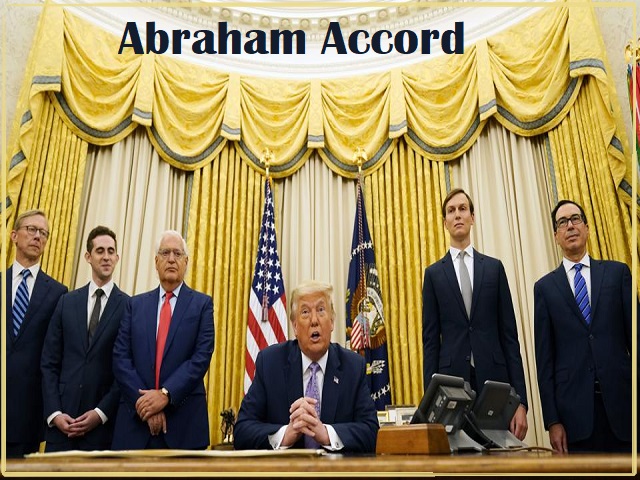
Background: The Abraham Accords
Component | Details |
Origin | Initiated under the Trump Administration in 2020, brokered by the U.S. |
Initial Signatories (2020) | UAE, Bahrain, Sudan, and Morocco |
Purpose | To normalize diplomatic and economic relations between Israel and Arab or Muslim-majority nations. |
Facilitator | United States |
Name Reference | “Abraham” a patriarch common to Judaism, Christianity, and Islam, symbolizing interfaith cooperation. |
Core Goals | Promote peace, investment, technology collaboration, counter Iran’s regional influence, and expand regional stability. |

Kazakhstan’s Relations with Israel
Kazakhstan, though not an Arab state, is a Muslim-majority Central Asian republic.
Maintains diplomatic relations with Israel since 1992.
Cooperation spans agriculture, technology, defense, and water management.
Israel imports oil from Kazakhstan and assists in irrigation and desalination projects.
Thus, joining the Accords formalizes and strengthens existing bilateral ties and signals alignment with U.S. Middle East policy.
Strategic Significance
1. For Kazakhstan
Enhances Kazakhstan’s image as a moderate Muslim nation engaging in peace diplomacy.
Bolsters relations with the U.S. and Western allies, especially amid increasing Russian and Chinese influence in Central Asia.
Strengthens access to Israeli technology and innovation, especially in agriculture, energy, and cybersecurity.
2. For Israel
Expands its diplomatic outreach in the Muslim world beyond the Arab heartland.
Provides a foothold in Central Asia, a region strategically located between Russia, China, and South Asia.
Strengthens Israel’s legitimacy and breaks further taboos around relations with Muslim-majority countries.
3. For the U.S.
Reinforces Washington’s Middle East and Eurasia strategy.
Counters the growing China-Russia influence in the Central Asian republics.
Revives momentum of the Abraham Accords, especially after a slowdown in new signatories post-2021.
4. For the Broader Region
Reflects evolving geo-economic pragmatism in the Islamic world.
Central Asian states may increasingly see normalization with Israel as compatible with national interests.
Abraham Accords Participants
Country | Year Joined | Nature of Agreement with Israel | Significance |
UAE | 2020 | Full diplomatic normalization | UAE was the first Arab country to formally announce its normalization of relations with Israel under the Abraham Accords. |
Bahrain | 2020 | Diplomatic normalization | Gulf partner in peace |
Sudan | 2020 | Commitment to normalize (post sanctions) | Tied to U.S. incentives |
Morocco | 2020 | Resumed ties (existed before 2000) | U.S. recognition of Western Sahara |
Kazakhstan | 2025 | Already had ties; symbolic accession | Expands Accords beyond the Arab world |
Prelims Practice MCQ
Q. Consider the following statements regarding the Abraham Accords:
The Abraham Accords were signed in 2020 under U.S. mediation to normalize relations between Israel and several Arab and Muslim-majority nations.
The Accords were initially signed between Israel, the United Arab Emirates (UAE), and Bahrain, with Sudan and Morocco joining later.
The Accords are named after Prophet Abraham, revered in Judaism, Christianity, and Islam, symbolizing interfaith harmony.
Which of the statements given above is/are correct?
A. 1 only
B. 1 and 3 only
C. 1, 2 and 3
D. 2 and 3 only
✅ Answer: C. 1, 2 and 3
Explanation:
The Abraham Accords were indeed brokered by the United States in 2020 under the Trump administration.
UAE and Bahrain were the first signatories; Sudan and Morocco joined later the same year.
The name “Abraham” signifies the shared patriarch across Judaism, Christianity, and Islam, highlighting the spirit of interfaith peace.
Hence, all three statements are correct.
Q. With reference to Kazakhstan’s decision to join the Abraham Accords (2025), consider the following statements:
Kazakhstan’s joining marks the first inclusion of a Central Asian nation in the Accords.
Kazakhstan previously did not have any formal diplomatic relations with Israel before joining the Accords.
The move is largely symbolic, as Kazakhstan already maintains bilateral cooperation with Israel in technology and agriculture.
Which of the statements given above is/are correct?
A. 1 only
B. 1 and 3 only
C. 2 and 3 only
D. 1, 2 and 3
✅ Answer: B. 1 and 3 only
Explanation:
Statement 1 – Correct: Kazakhstan is indeed the first Central Asian country to join the Abraham Accords.
Statement 2 – Incorrect: Kazakhstan has had formal diplomatic ties with Israel since 1992, shortly after its independence from the USSR.
Statement 3 – Correct: The move is symbolic, reinforcing already strong cooperation in agriculture, irrigation, defense, and technology.