
Karnataka's Groundwater Crisis
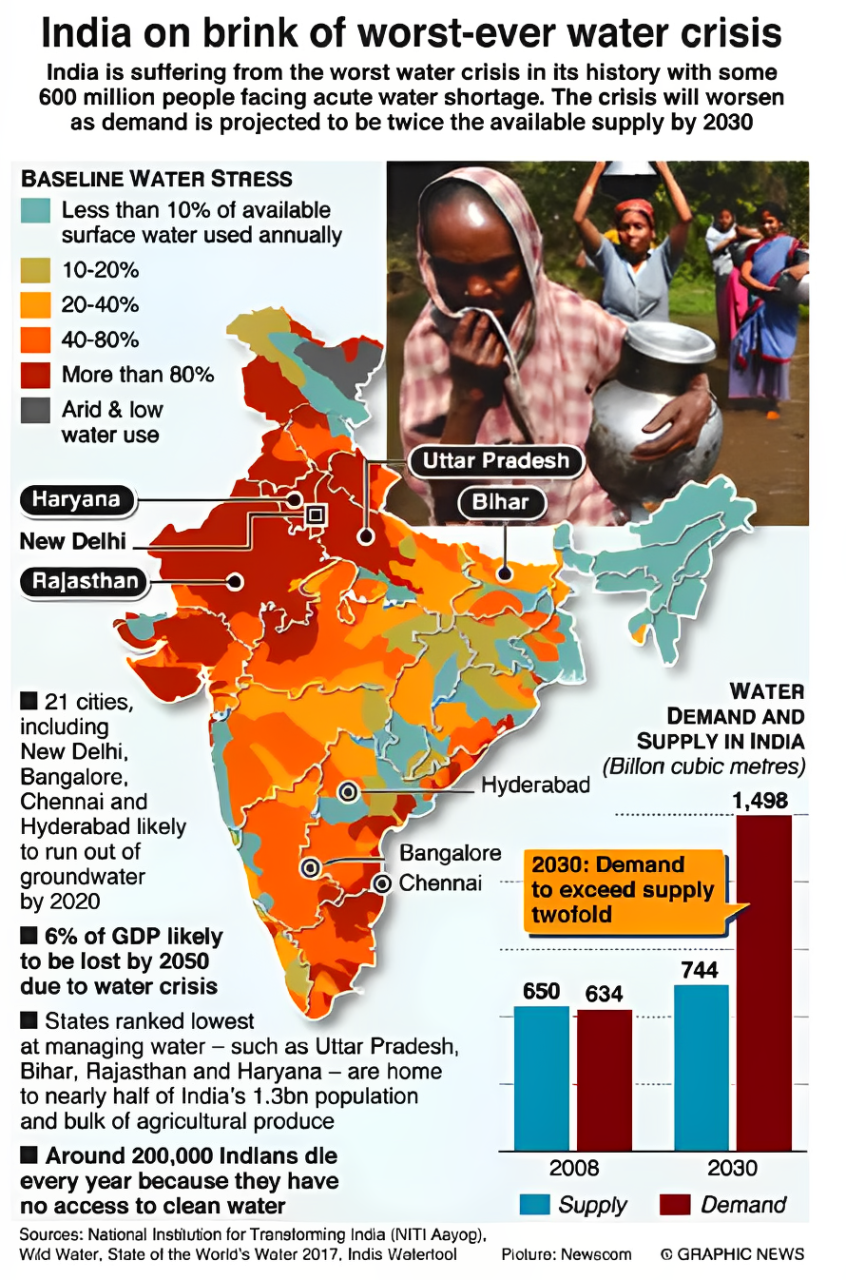 Click to view full image
Context: A recent study by WELL Labs, Chennai, highlights a deepening groundwater crisis in Karnataka’s hard rock terrain, particularly in the Upper Arkavathy watershed (Aralumallige and Doddathumakuru gram panchayats).
Key Issues Identified:
-
Geological Constraints: Karnataka relies on hard rock aquifers (granite and basalt) with limited porosity. These depend on narrow fractures and weathered zones to store water, making them inefficient compared to sedimentary aquifers.
-
Borewell Overuse: Farmers drill deep borewells into granite, creating microfractures that push rainwater deep underground, bypassing shallow aquifers. This disrupts recharge and weakens water retention.
-
Rapid Depletion:
-
Average borewell depth increased from 183 m (2001–11) to 321 m (2011–21).
-
70% of drinking water wells failed within 10 years due to falling water tables.
-
55% of wells failed in the Aralumallige sub-watershed.

Economic & Social Impact:
-
Free electricity for agriculture has led to massive debts for gram panchayats, diverting funds from development.
-
Borewell costs (₹4–5 lakh) are unaffordable for small farmers, forcing many to lease land and migrate.
-
Labour costs, pump installation, and recurring failures are eroding the rural economy.
Water Quality Concerns:
-
High nitrate levels in water (often above 50 mg/l), but groundwater depletion remains the primary reason for abandoning wells.
Governance and Policy Challenges:
-
Poor water resource management is seen as the biggest threat to sustainable rural water access.
-
Programmes like Jal Jeevan Mission and the Sujala Project focus on infrastructure but overlook root causes like over-extraction.
-
Lack of local-level quantitative data makes it hard to anticipate borewell failures or manage drinking water risks effectively.
Recommendations:
-
Promote sustainable farming and reduce water-intensive cropping.
-
Introduce incentives for less water and electricity use.
-
Improve local governance, recharge infrastructure, and resource monitoring.
-
Restore traditional recharge systems like tanks and lakes.
Without urgent shifts in agricultural practices and governance, large parts of the Deccan Plateau may lose usable groundwater within 3–4 years, according to study authors.
This crisis underscores the need for an integrated approach combining technological, ecological, and institutional reforms to ensure long-term water sustainability in semi-arid regions of India.