
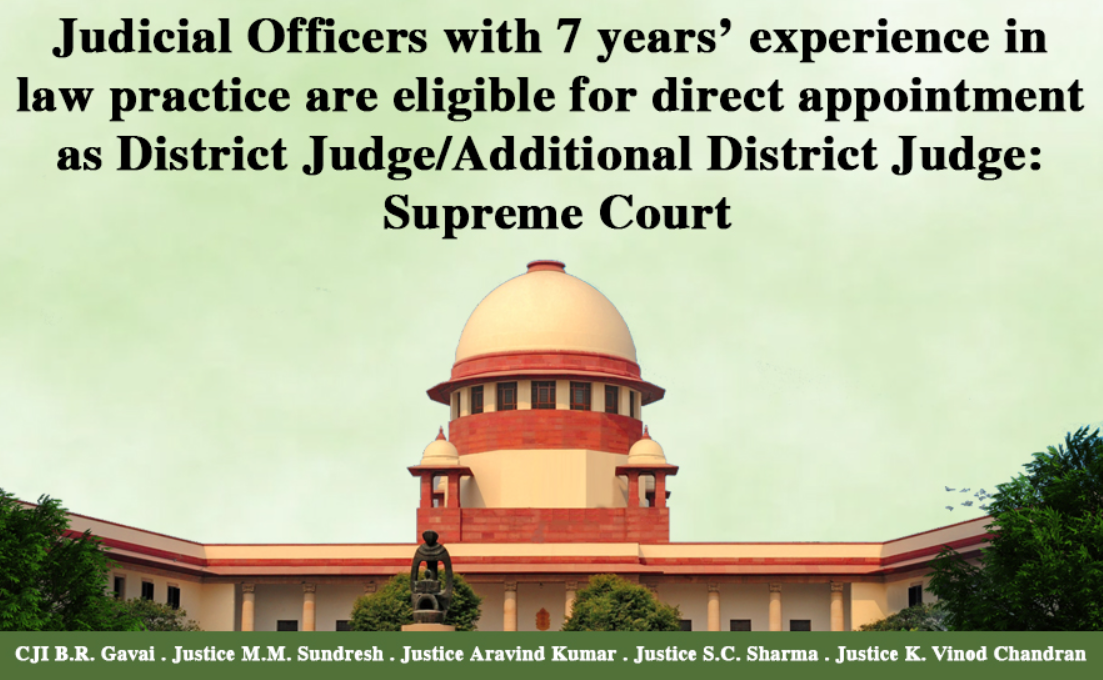
Judicial Officers with Seven Years’ Bar Experience Eligible for District Judgeship - Supreme Court (2025)
Context
Case: Constitution Bench judgment.
Bench Headed by: Chief Justice of India B.R. Gavai
Issue: Eligibility of judicial officers with prior Bar experience to be appointed as District or Additional District Judges under Article 233(2).
Key Judgment Highlights
Eligibility Expanded:
Judicial officers who had 7 years of Bar experience before joining judicial service are now eligible for appointment as District Judges (DJ) or Additional District Judges (ADJ).
Earlier Rule:
Only practising advocates with 7 years’ experience were eligible for direct recruitment as District Judges.
In-service judicial officers (even with previous Bar experience) were excluded.
Court’s Reasoning:
“A lawyer does not cease to be one upon joining judicial service.”
The Constitution does not bar a person already in judicial service from being considered if they meet the combined experience requirement.
Constitutional Interpretation —> Article 233(2):
Article 233(2) states that a person not already in the service of the Union or the State shall be eligible to be appointed a District Judge if:
He/she has been an advocate or pleader for not less than seven years, and
Is recommended by the High Court for appointment.
The SC expanded the scope by allowing combined experience (Bar + Judicial).
Age Criterion Fixed:
Minimum age: 35 years (for both advocates and judicial officers)
As on: Date of application.
Significance of the Judgment
Aims to infuse young, dynamic talent into the district judiciary.
Addresses stagnation and delay in lower courts by opening higher positions to experienced judicial officers.
Strengthens the pipeline for High Court appointments (District Judges are feeder posts).
Constitutional Provisions for Appointment of Judges (All Levels)
1. District and Subordinate Judiciary
Level | Constitutional Provision | Appointing Authority | Eligibility / Process |
District Judge | Article 233 | Governor of the State, in consultation with the High Court | - (1) Appointment, posting, promotion by Governor in consultation with HC. |
Other Subordinate Judges (Civil, Munsiff, Magistrates) | Article 234 & 235 | - Appointments: Governor in consultation with State Public Service Commission & High Court. | - Selection process as per State Judicial Service Rules. |
Note: The standard retirement age for District Judges varies by Indian state.
Andhra Pradesh: In November 2024, the state government raised the retirement age of judicial officers from 60 to 61 years.
Madhya Pradesh: The Supreme Court has clarified that the retirement age for District Court judges can be enhanced to 61 years
2. High Court Judges
Position | Constitutional Provision | Appointing Authority | Eligibility / Conditions |
Chief Justice & Other Judges of a High Court | Article 217(1) | President of India | - Must be a citizen of India; and either: |
Consultation Required | President must consult Chief Justice of India, Governor of the State, and Chief Justice of the concerned High Court (if appointing a puisne judge). | ||
Tenure | Until 62 years of age (Art. 217(1)). |
3. Supreme Court Judges
Position | Constitutional Provision | Appointing Authority | Eligibility / Conditions |
Chief Justice of India and Other Judges of the Supreme Court | Article 124(2) | President of India | - Must be a citizen of India, and either: |
Consultation Required | President must consult judges of the Supreme Court and High Courts as deemed necessary (now via Collegium System). | ||
Tenure | Until 65 years of age (Art. 124(2)). |
4. Key Constitutional Articles
Article | Subject |
233 | Appointment of District Judges |
234 | Recruitment of persons other than District Judges to the judicial service |
235 | Control over subordinate courts vested in High Court |
217 | Appointment and conditions of High Court Judges |
224 | Additional and acting Judges of High Court |
124 | Establishment and appointment of Supreme Court Judges |