
International nuclear liability regime
Vienna Convention on Civil Liability for Nuclear Damage
What is the Vienna Convention?
The Vienna Convention on Civil Liability for Nuclear Damage is a foundational international treaty governing civil liability and compensation for nuclear accidents.
It establishes uniform legal principles to ensure victims receive compensation.
Key facts
Adopted: 21 May 1963
Entered into force: 12 November 1977
Depositary: IAEA
Amended by: 1997 Protocol
Background and purpose
Developed during the early expansion of civilian nuclear power
Sought to:
Prevent legal chaos after nuclear accidents
Ensure victims are compensated without complex litigation
Provide certainty to operators and insurers
Core liability principles
The Vienna Convention is based on three key principles:
Strict liability
Victims do not need to prove fault or negligence
Exclusive operator liability
Only the nuclear operator is liable
Suppliers are excluded
Mandatory financial security
Operators must maintain insurance or financial guarantees
Ensures availability of compensation
States may raise liability limits under domestic law.
1997 Protocol: Modernisation
The 1997 Protocol updated the Convention by:
Expanding the definition of nuclear damage to include:
Environmental damage
Preventive measures
Increasing liability limits
Extending jurisdiction
Making the regime compatible with CSC
Relationship with other conventions
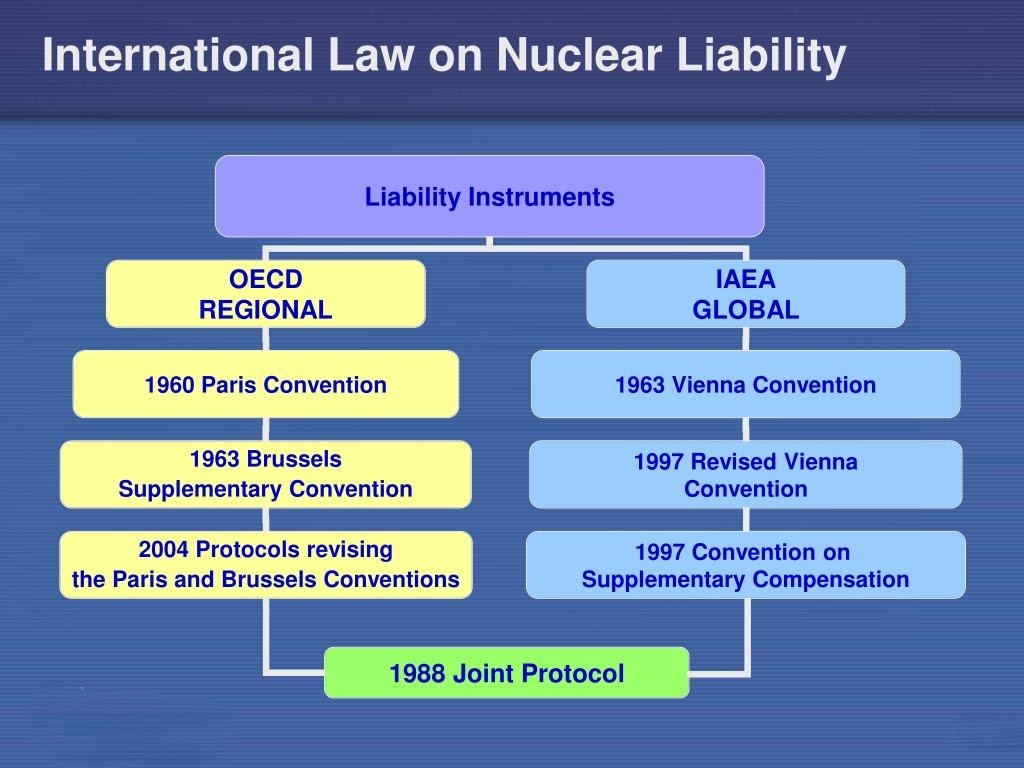
Along with:
Paris Convention (1960)
Brussels Supplementary Convention
Forms the core of international nuclear liability law
Paris Convention mainly applies to OECD countries
Vienna Convention allows broader global participation
Paris Convention (1960) – What is it? The Paris Convention on Third Party Liability in the Field of Nuclear Energy is an international treaty adopted in 1960 that lays down uniform rules for civil liability and compensation in case of nuclear accidents. It primarily applies to Western European countries and operates under the framework of the Organisation for Economic Co-operation and Development, administered through its Nuclear Energy Agency (NEA). | ||
Convention on Supplementary Compensation for Nuclear Damage (CSC)
What is CSC?
The Convention on Supplementary Compensation for Nuclear Damage is an international treaty that creates a global framework for liability and compensation in case of nuclear accidents, especially those causing transboundary damage.
It was adopted under the auspices of the International Atomic Energy Agency (IAEA).
Key facts
Adopted: 12 September 1997
Entered into force: 15 April 2015
Depositary: IAEA
Parties (2024): 10+ countries
Includes United States, Japan, Canada
Purpose: Provide supplementary compensation for nuclear damage, including cross-border damage
Background and objective
CSC was created to complement existing nuclear liability treaties:
Vienna Convention
Paris Convention
Aim:
Harmonise national nuclear liability laws
Ensure prompt, adequate, and equitable compensation
Encourage international nuclear cooperation
Compensation structure
CSC follows a two-tier compensation system:
Tier 1: National compensation
Each member state ensures compensation from:
The operator of the nuclear installation
Up to a nationally fixed liability limit
Tier 2: International supplementary fund
Additional compensation through an international pool
Contributions based on:
Installed nuclear capacity
Gross Domestic Product (GDP)
➡️ Ensures coverage for large-scale accidents exceeding national capacity
Relationship with other regimes
CSC acts as a bridge between:
Vienna Convention states
Paris Convention states
States outside both regimes
Advances IAEA’s goal of a universal nuclear liability framework
CSC vs Vienna Convention
Component | Vienna Convention | CSC |
Year | 1963 | 1997 |
Nature | Primary liability treaty | Supplementary compensation treaty |
Liability | Operator-only | Operator + international fund |
Compensation | National | National + global pool |
Scope | Member states | Transboundary/global |
Role | Core legal principles | Financial reinforcement |
How many nuclear liability conventions has India ratified?
Answer: One (1) convention
India has ratified only one international nuclear liability convention.
Convention ratified by India
Convention on Supplementary Compensation for Nuclear Damage (CSC)
Adopted: 1997
India ratified: 2016
India joined the CSC to align its nuclear liability framework with global norms and enable international nuclear cooperation, while retaining its domestic law.
Conventions India has NOT ratified
Vienna Convention on Civil Liability for Nuclear Damage
Adopted: 1963
India: Not a party
Paris Convention on Third Party Liability in the Field of Nuclear Energy
Adopted: 1960
India: Not a party
Why liability norms matter
India’s earlier supplier liability clause (CLND Act, 2010):
Was stricter than global norms.
Discouraged foreign suppliers, especially U.S. firms.
Global nuclear commerce prefers:
Operator-only liability
Predictable, capped compensation
SHANTI Bill reduces legal uncertainty and risk for suppliers.
CLND Act, 2010 – Key feature
Operator had the right of recourse against suppliers if:
Explicit contract allowed it
Accident was due to faulty supplier equipment
Accident involved deliberate intent
➡️ Clause (2) worried foreign suppliers (U.S., France), who feared massive liability.
What changes does SHANTI bring in liability rules?
Removal of supplier liability
SHANTI removes clause (b) (faulty equipment)
Even the word “supplier” is deleted
Effect:
Foreign reactor manufacturers are no longer exposed to legal liability
Addresses concerns raised since the 2008 Indo–U.S. Nuclear Deal
➡️ This is aligned with global norms such as:
Convention on Supplementary Compensation for Nuclear Damage
Prelims Practice MCQs
Q. Which of the following principles are common to both the Paris Convention (1960) and the Vienna Convention (1963)?
Strict liability of the nuclear operator
Exclusive liability of the supplier
Mandatory financial security by the operator
Unlimited liability in all cases
Select the correct answer using the code below:
A. 1 and 3 only
B. 1, 2 and 3 only
C. 2 and 4 only
D. 1, 3 and 4 only
Correct answer: A
Explanation:
Both conventions follow:
Strict liability (no need to prove negligence)
Operator-only liability
Mandatory insurance/financial security
Supplier liability and unlimited liability are not part of these conventions.
Q. With reference to the Convention on Supplementary Compensation for Nuclear Damage (CSC), consider the following statements:
It establishes a two-tier system of compensation.
The second tier is funded entirely by the operator of the nuclear installation.
It applies only to countries that are party to the Vienna Convention.
Which of the statements given above is/are correct?
A. 1 only
B. 1 and 2 only
C. 1 and 3 only
D. 2 and 3 only
Correct answer: A
Explanation:
Statement 1: Correct – CSC has national + international tiers.
Statement 2: Incorrect – Second tier is funded by member states, not operators.
Statement 3: Incorrect – CSC bridges Vienna, Paris, and non-member states.
Q. Arrange the following nuclear liability instruments in chronological order of adoption:
Paris Convention
Vienna Convention
Convention on Supplementary Compensation
Select the correct answer:
A. 1–2–3
B. 2–1–3
C. 3–1–2
D. 1–3–2
Correct answer: A
Explanation:
Paris Convention – 1960
Vienna Convention – 1963
CSC – 1997