
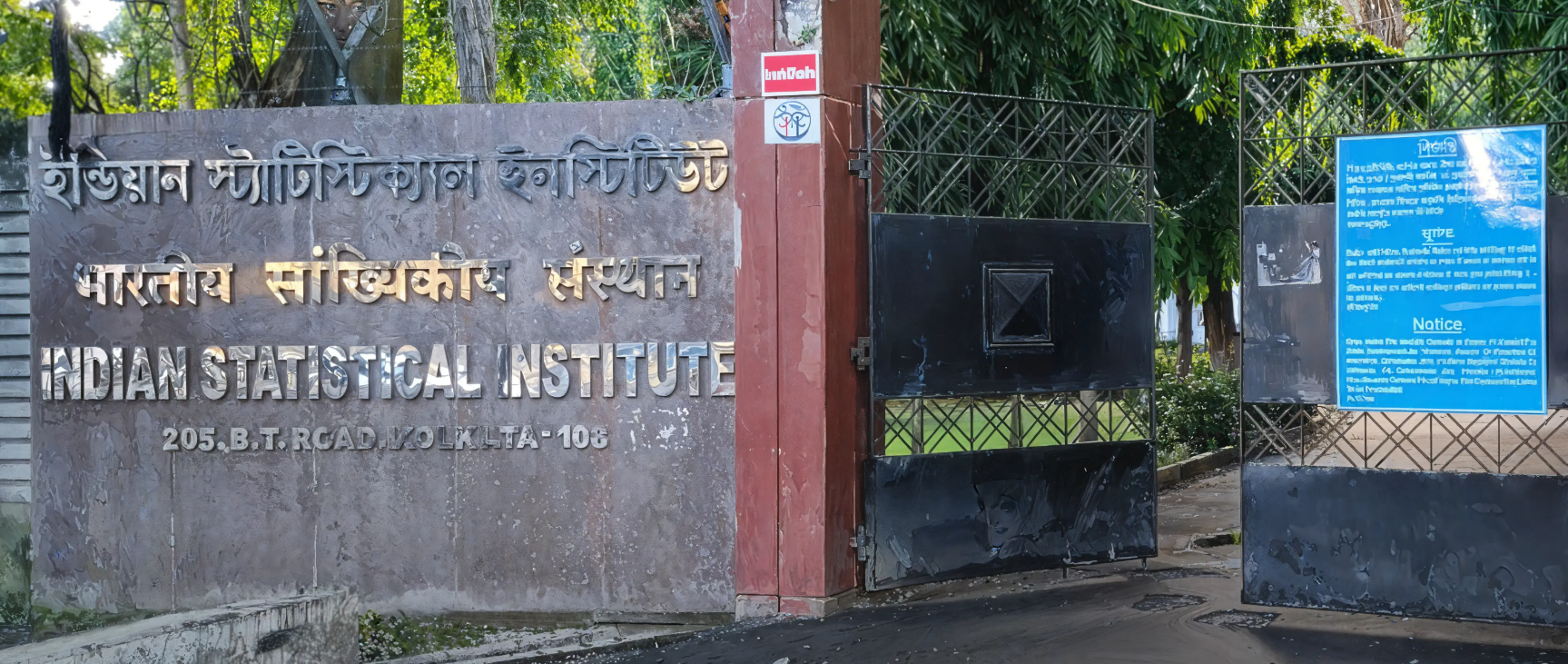
Indian Statistical Institute (ISI)
Context
Over 1,500 academics have protested in Kolkata against a Union Government proposal to repeal the Indian Statistical Institute Act, 1959.
The government plans to replace the existing Act with a new Bill that would restructure the governance and functioning of the Indian Statistical Institute (ISI).
Academics claim the Bill will curtail academic autonomy, undermine ISI’s heritage, and centralise control.
Why Is This Significant?
ISI is an Institute of National Importance under the ISI Act, 1959.
Founded in 1931 by P. C. Mahalanobis, it is globally respected for research in statistics, mathematics, computer science, economics, cryptology, operations research, and information science.
It pioneered the National Sample Survey (NSS) and introduced modern statistical methods in India.
It functions under the Ministry of Statistics and Programme Implementation (MoSPI).
What Does the Proposed Bill Aim to Do?
The exact draft is not public, but concerns raised reveal major provisions:
1. Repeal the ISI Act, 1959
Replace it with a new legislation re-defining governance and oversight.
2. Restructure Governance
Board of Governors given wider powers.
Academic Council’s authority reduced or made advisory.
Presently, the Academic Council is the statutory authority for academic decisions, run mostly by professors.
Critics argue: This overrides academic decision-making.
3. Increased Central Government Control
Petitioners say the Bill:
“Disturbs spirit of cooperative federalism.”
Violates the original agreement between the ISI Society and the Government.
Suggests greater administrative and financial oversight by the Centre.
4. Lack of Consultation
Faculty claim:
No discussion was held with them.
No justification provided for replacing the current legal and governance framework.
Key Concerns Raised by Academics
1. Threat to Academic Autonomy
Reducing Academic Council to a minor advisory body weakens ISI’s autonomous character.
Board of Governors may override academic decisions.
2. Centralisation of Power
More control with the government reduces institutional independence.
Seen as part of a larger trend of tightening control over higher education institutions.
3. Disruption of Heritage and Identity
ISI is globally respected for independent academic tradition.
Critics fear loss of academic freedom, international prestige, and research quality.
4. Violation of Cooperative Federalism
ISI has centres across the country (Kolkata, Delhi, Bengaluru, Chennai, Tezpur).
Faculty argue that the proposed structure disregards state-level autonomy and the original federal spirit.
Why Was ISI Created?
Founded to promote research and training in statistics, after Mahalanobis recognised the importance of statistical methods.
It introduced:
Multivariate analysis
Large-scale sample surveys
Statistical quality control
India’s first computer laboratory (by S. K. Mitra)
Played a key role in designing National Sample Survey (1950).
Current Academic Structure
ISI offers:
B.Stat, B.Math
M.Stat, M.Math, M.Tech (CS, Cryptology)
MS in Quantitative Economics
PhD programmes
Training for Indian Statistical Service (ISS) officers.
Prelims Practice MCQs
Q. The Indian Statistical Institute (ISI) was declared an “Institute of National Importance” under which Act?
A. University Grants Commission Act, 1956
B. Indian Statistical Institute Act, 1959
C. National Institutes of Technology Act, 2007
D. Science and Technology Act, 1988
Correct Answer: B
Q. Who founded the Indian Statistical Institute in 1931?
A. J. B. S. Haldane
B. P. C. Mahalanobis
C. S. S. Bose
D. Rajendra Nath Mookerjee
Correct Answer: B