
Indian Navy Warship Visit to Papua New Guinea – 50th Independence Day (2025)
Context
-
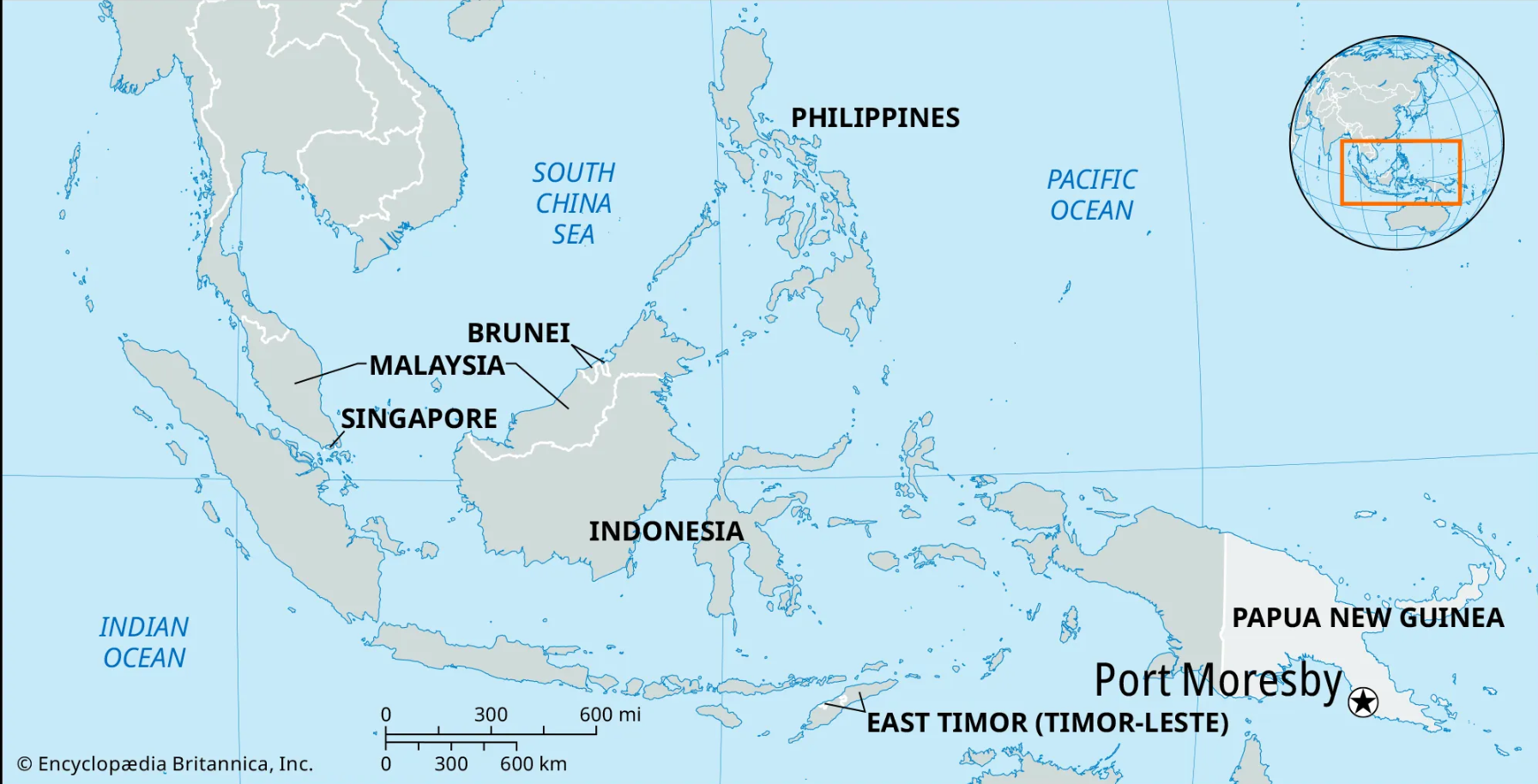
INS Kadmatt (indigenous ASW Corvette) arrived at Port Moresby, Papua New Guinea (PNG), to participate in its 50th Independence Day celebrations.
-
Significance: Strengthens India–PNG friendship, maritime partnership, and engagement under Act East Policy.
Key Highlights of the Visit
-
Symbolism
-
Represents India’s commitment to peace, stability, and inclusive growth in the Indo-Pacific.
-
Demonstrates Indian Navy’s role as a diplomatic instrument for building goodwill.
-
-
Activities
-
Participation in PNG’s official Independence Day Parade and cultural events.
-
Exploring cooperation in maritime security, HADR (Humanitarian Assistance and Disaster Relief), and defence training.
-
Hosting PNG’s Chief of Defence Forces onboard INS Kadmatt to showcase India’s ‘Aatma Nirbharta’ journey in defence manufacturing.
-
-
Diplomatic Continuity
-
Builds on PM Narendra Modi’s 2023 visit to PNG, which emphasized:
-
Deepening bilateral relations
-
Expanding development partnerships
-
Enhancing defence cooperation
-
-
Strategic Importance
-
For PNG: Recognition of its sovereignty and democratic values at 50 years of independence.
-
For India:
-
Strengthening Act East Policy and outreach to Pacific Island nations.
-
Expanding influence in the Indo-Pacific maritime domain.
-
Showcasing India’s indigenous naval capabilities.
Papua New Guinea
Physical geography
-
Extent: From just south of the Equator to the Torres Strait; mainland reaches ~820 km north–south along border with Indonesian Papua (approx. 141°E longitude).
-
Major island groups: New Guinea (mainland), Bismarck Archipelago (New Britain, New Ireland, Admiralty Islands), Bougainville and Buka, numerous small islands and atolls.
-
Coastal contrast: South coast low and swampy (Fly-Digul shelf); north coast drops sharply to sea with volcanic islands off the northern fringe.
Relief and geology
-
Tectonics: Collision zone between Australian Plate (south) and Pacific Plate (north) — young, active orogeny.
-
Highlands: Central mountainous zone (Highlands) with peaks exceeding 4,000 m; Mount Wilhelm highest at 4,509 m.
-
Karst and limestone belts: Prominent in Kikori–Lake Kutubu area with rugged karst topography and dense rainforest.
-
Enclosed upland basins at 1,370 m+ with fertile soils formed from sediment and volcanic ash.

INS Kadmatt (P29) – Indigenous Stealth Anti-Submarine Warfare Corvette

Background
-
Indigenous stealth ASW Corvette of the Indian Navy.
-
Second of four corvettes built under Project 28 (Kamorta-class) by Garden Reach Shipbuilders & Engineers (GRSE), Kolkata.
-
Commissioned: January 2016.
-
Command: Inducted into the Eastern Naval Command, Visakhapatnam.
-
Named after Kadmat Island (Lakshadweep).
Role
-
Primary Role: Anti-submarine warfare (ASW).
-
Protects naval convoys, fleets, and ports against enemy submarines.
-
-
Secondary Roles:
-
Surface warfare and limited air defence.
-
Maritime surveillance and escort duties.
-
Humanitarian assistance & disaster relief (HADR) operations.
-
Design & Stealth Features
-
Built under Project 28 (Aatma Nirbhar Bharat initiative).
-
Designed for reduced radar cross-section and acoustic signature.
-
Produces low levels of radiated underwater noise, reducing chances of detection.
-
Steel hull with advanced stealth shaping and sound-absorbing techniques.
Weapons & Sensors
-
Weapons:
-
Torpedo tubes (for submarines).
-
RBU-6000 rocket launchers (anti-submarine rockets).
-
Anti-aircraft guns for close-in defence.
-
-
Sensors & Radars:
-
Early warning radar, navigation radar, fire-control radar.
-
Hull-mounted sonar & towed array sonar for submarine detection.
-
-
Aviation Capability: Embarks Sea King anti-submarine helicopter.
Significance
-
Boosts India’s indigenous naval shipbuilding capacity.
-
Strengthens ASW capabilities in the Indian Ocean Region.
-
Enhances blue-water navy profile of India.
-
Reflects Act East Policy in deployments (like PNG visit, 2025).