
India’s 2025 Carbon Emissions – Global Carbon Project Assessment
Overview
The Global Carbon Project (GCP) reports that India’s carbon emissions in 2025 are projected to grow by 1.4%, significantly lower than the 4% growth in 2024.
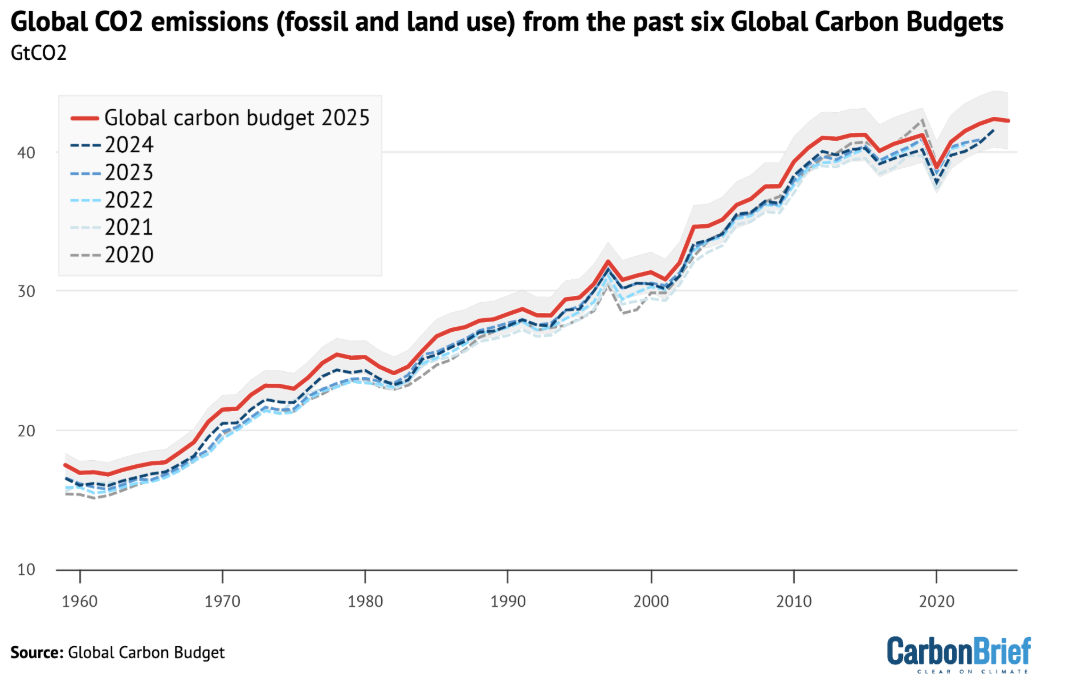
Global emissions for 2025 expected to rise by 1.1%, reaching 38 billion tonnes of CO₂.
India’s Emission Trends (2025)
Slower Growth
Growth reduced to 1.4% due to:
Favourable monsoon, which reduced cooling demand (especially power-hungry air-conditioning).
Strong growth in renewable energy, reducing reliance on coal.
Current Emission Profile
India emits 3.2 billion tonnes CO₂ annually (2024 data).
India is the third-largest emitter after:
China (~12 billion tonnes)
United States (~4.9 billion tonnes)
Per capita emission: 2.2 tonnes CO₂/person/year, second lowest among 20 largest global economies.
Coal remains the dominant contributor to India’s emissions.
Global Emission Trends (2025)
China
Emissions projected to grow 0.4%.
Growth slowed due to:
Moderate energy consumption increase.
Extraordinary renewable energy expansion.
United States
Emissions expected to rise by 1.9%.
European Union
Emissions to grow by 0.4%, despite long-term decarbonisation goals.
Fossil Fuels Worldwide
Projected rise in global fossil CO₂ emissions driven by:
Coal: +0.8%
Oil: +1%
Natural gas: +1.3%
Land-use Change and Natural Carbon Sinks
Permanent deforestation releases ~4 billion tonnes CO₂/year.
Reforestation + forest regrowth offset only half of deforestation emissions.
Land-use change emissions remain persistently high (2015–2024).
Long-term Emission Trends
Total global CO₂ emissions (fossil + land-use):
Grew at 0.3% per year in the past decade (slower).
Previously grew at 1.9% per year (2005–2015 period).
Carbon Budget for 1.5°C
Remaining carbon budget for 1.5°C: 170 billion tonnes CO₂.
Equivalent to around four years of emissions at 2025 levels.
This means the 1.5°C limit is no longer plausible, according to climate scientists.
Key Scientific Insights
Ongoing emissions continue to rise.
Land and ocean carbon sinks are weakening due to climate change.
Global warming is accelerating beyond mitigation capacity.
Global Carbon Project
Introduction
The Global Carbon Project (GCP) is one of the world’s most authoritative scientific bodies that tracks Global Greenhouse Gas Emissions, the Global Carbon Budget, and the functioning of Carbon Sinks (Land and Ocean). Its assessments are widely used by the Intergovernmental Panel on Climate Change (IPCC), United Nations Framework Convention on Climate Change (UNFCCC), and governments for climate policy.
Origin and Institutional Structure
Established: 2001
Institutional Home: Part of Future Earth, earlier under the Earth System Science Partnership (ESSP).
Nature: International scientific collaboration including climate scientists, carbon cycle researchers, and data modelers.
Mandate: To develop a complete understanding of the Global Carbon Cycle, including anthropogenic and natural fluxes.
Objectives
To quantify Global Fossil Fuel CO₂ Emissions from Coal, Oil, Natural Gas, and Cement Production.
To estimate Land-Use Change Emissions such as Deforestation, Degradation, and Peatland Disturbance.
To assess Carbon Sinks in the Ocean and Terrestrial Biosphere.
To calculate the Global Carbon Budget and identify remaining emissions allowable for 1.5°C and 2°C targets.
To provide transparent, internationally comparable data for the Paris Agreement, Nationally Determined Contributions (NDCs), and the Global Stocktake.
Key Publications
1. Global Carbon Budget (Annual)
Flagship publication estimating:
Global Fossil CO₂ Emissions
Land-Use Change Emissions
Ocean Sink and Land Sink
Remaining Carbon Budget
Released annually before UNFCCC COP meetings.
2. Global Methane Budget
Tracks CH₄ emissions from Agriculture, Fossil Fuels, and Wetlands.
3. Global Nitrous Oxide Budget
Tracks N₂O emissions from Agricultural Soils, Fertilisers, and Industrial Sources.
Major Datasets Tracked
Fossil CO₂ Emissions (Coal, Oil, Gas, Cement).
Land-Use Change Emissions (Deforestation, Forest Fire, Peatland Loss).
Carbon Sinks (Ocean Uptake, Forest Regrowth).
Atmospheric CO₂ Concentrations (in ppm).
Remaining Carbon Budget for climate targets.
Country-wise and Sector-wise Emission Trends.
Methodology
Uses Satellite Data, National Energy Statistics, Atmospheric Inversions, Earth System Models (ESMs), and Ocean Biogeochemical Models.
Peer-reviewed by international scientific teams every year.
Ensures consistency with IPCC Assessment Reports, while providing annual updates unlike the longer IPCC cycle.
Prelims Practice MCQs
Q. Consider the following statements regarding India’s carbon emission trends in 2025:
India’s carbon emission growth in 2025 is projected to be lower than the previous year.
The slower growth is partly attributed to a favourable monsoon reducing cooling demand.
India remains the second-largest global emitter of CO₂ in 2025.
Which of the statements given above is/are correct?
A. 1 and 2 only
B. 2 and 3 only
C. 1 and 3 only
D. 1, 2 and 3
Answer: A
Explanation:
India’s emission growth slowed to 1.4% (down from 4%).
Favourable monsoon reduced cooling demand.
India is the third largest emitter, not second.
Q. Which among the following is the largest contributor to India’s CO₂ emissions in 2025?
A. Oil
B. Natural Gas
C. Coal
D. Cement and industrial processes
Answer: C
Explanation:
Coal remains the major fuel type contributing to India’s emissions.
Q. Consider the following statements about land-use change emissions:
Permanent deforestation releases around 4 billion tonnes of CO₂ annually.
Permanent removals through reforestation and forest regrowth fully offset deforestation emissions.
Land-use change has become a net carbon sink over the last decade.
Which of the above statements is/are correct?
A. 1 only
B. 1 and 2 only
C. 2 only
D. 2 and 3 only
Answer: A
Explanation:
Land-use change emits 4 billion tonnes annually.
Only half of these emissions are offset, not fully.
It is not a net sink.