
India–New Zealand Free Trade Agreement (FTA)
Context
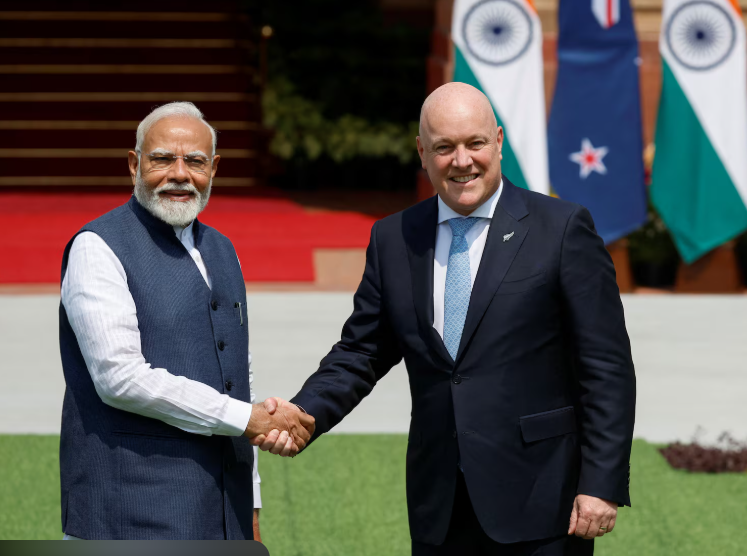
The India–New Zealand FTA was concluded in December 2025 and announced earlier in March 2025.
It is India’s third FTA this year, after agreements with the U.K. and Oman.
Aims to deepen economic ties with Oceania and diversify India’s trade partnerships.
Key provisions of the agreement
Market access
New Zealand:
Zero-duty access on 100% of India’s exports.
India:
Tariff relaxation on 95% of imports from New Zealand.
57% of products duty-free from day one.
Foreign Direct Investment (FDI)
New Zealand commits $20 billion FDI by 2030 (over ~15 years).
Includes clawback mechanisms if investment targets are not met.
FDI spread across 118 sectors, with focus on:
Services
Skill mobility
Employment generation
Services, mobility, and people-to-people links
First FTA where New Zealand agrees to facilitate trade in:
Ayurveda, Yoga, and traditional medicine services.
Easier mobility for Indian skilled workers:
IT professionals
Engineers
Healthcare workers
Yoga instructors, chefs, music teachers
Student-friendly provisions:
Work permits up to 20 hours/week during study
Extended post-study work visas
Benefits to India’s labour-intensive sectors
The FTA explicitly supports MSMEs and employment through:
Textiles and apparel
Leather and footwear
Gems and jewellery
Engineering goods
Processed food items
Significance:
These sectors are job-rich, export-oriented, and crucial for inclusive growth.
Sensitive sectors kept outside the FTA (India’s safeguards)
India excluded key New Zealand export items to protect farmers and MSMEs:
Dairy products: milk, cheese, butter, cream, yogurt
Agricultural goods: onions, sugar
Edible oils
Spices
Rubber
👉 Important because New Zealand is among the world’s largest dairy exporters.
Agricultural cooperation (non-market access)
New Zealand to assist Indian fruit growers, especially for:
Kiwifruit, apples, honey
Cooperation includes:
Centres of excellence
Improved planting material
Orchard management
Post-harvest practices
Food safety and supply chains
Why is the FTA important for India?
Economic significance
India–New Zealand bilateral trade: $1.3 billion
Target: Double trade in five years
New Zealand’s per capita income: ~$49,380, offering a high-value market.
Strategic significance
Gateway to Oceania and Pacific Island markets.
Indian diaspora in New Zealand: ~3,00,000 (≈5% of population) → soft power leverage.
Fastest concluded FTA: completed in just 9 months.
Why is India accelerating FTAs?
Trade diversification
Reduce dependence on U.S., EU, and China.
U.S.–India trade ($132 billion) affected by high tariffs and stalled FTA talks.
WTO-plus commitments
FTAs allow deeper rules on:
Services
Digital trade
Investment and mobility
Alignment with domestic policy
Supports Make in India, PLI schemes, and global value chain integration.
Geopolitical strategy
FTAs used as tools for long-term strategic alliances, not just tariff cuts.
Criticism of the agreement
In New Zealand
Strong opposition as dairy and agriculture are excluded.
New Zealand Foreign Minister called it “neither free nor fair”.
Coalition partners plan to oppose the bill in Parliament (2026).
In India
General criticism of FTAs for:
Widening trade deficits
Asymmetric gains
Government claims safeguards and manufacturing collaboration address these risks.
Way forward
Strengthen domestic competitiveness and MSMEs.
Ensure:
Strong rules of origin
Clear anti-dumping safeguards
Compliance with global quality standards
Invest in R&D, productivity, and skills to fully leverage FTAs.
Monitor implementation outcomes over time.
Prelims Practice MCQs
Q. With reference to the India–New Zealand Free Trade Agreement (FTA), consider the following statements:
New Zealand will provide zero-duty market access to all Indian exports.
India will provide zero-duty access to all New Zealand exports from day one.
The agreement was concluded within a year of its announcement.
Which of the statements given above is/are correct?
A. 1 only
B. 1 and 3 only
C. 2 and 3 only
D. 1, 2 and 3
Correct Answer: B
Explanation:
Statement 1 is correct: New Zealand grants zero-duty access on 100% of Indian exports.
Statement 2 is incorrect: India relaxes tariffs on 95% of imports, with 57% duty-free from day one, not all.
Statement 3 is correct: The FTA was concluded in nine months, making it one of the fastest negotiated FTAs.
Q. Which of the following sectors are expected to benefit directly as labour-intensive sectors under the India–New Zealand FTA?
Textiles and apparel
Leather and footwear
Gems and jewellery
Petroleum refining
Select the correct answer using the code below:
A. 1 and 2 only
B. 1, 2 and 3 only
C. 3 and 4 only
D. 1, 2, 3 and 4
Correct Answer: B
Explanation:
The FTA explicitly promotes MSMEs and employment through textiles, leather, gems and jewellery, engineering goods, and processed foods. Petroleum refining is not a labour-intensive beneficiary sector under the deal.
Q. Which of the following items has been kept outside the India–New Zealand FTA by India to protect its sensitive sectors?
A. Engineering goods
B. Processed food items
C. Dairy products
D. Information technology services
Correct Answer: C
Explanation:
India has excluded dairy and key agricultural products (milk, cheese, butter, yogurt, etc.) to protect farmers and MSMEs, given New Zealand’s dominance in dairy exports.