
India–Indonesia heritage collaboration: Prambanan restoration
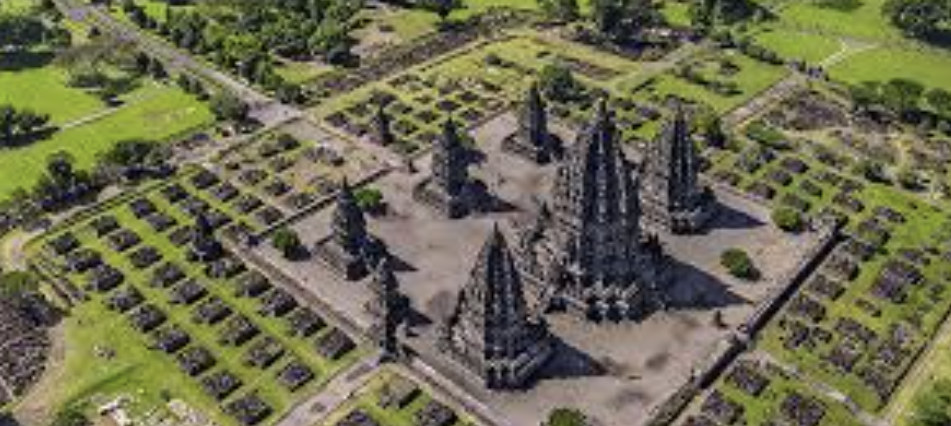
India and Indonesia have jointly initiated the restoration of the Prambanan Temple complex in Yogyakarta (Java), a major 9th-century Hindu site and a UNESCO World Heritage Site. This marks another step in India’s expanding cultural diplomacy in Southeast Asia.
Prambanan Temple, a 9th-century Hindu complex in Central Java, Indonesia, was primarily built around 850 CE by Rakai Pikatan, a king of the Sanjaya Dynasty of the Mataram Kingdom. It was later expanded by subsequent rulers, including King Lokapala and Balitung Maha Sambu, to serve as a major Hindu shrine
Key highlights
1. Integrated cultural landscape approach
The Indonesian government emphasised that Prambanan is not an isolated monument.
It forms a broader sacred and cultural zone along with Sewu and Plaosan temple complexes.
Restoration will therefore focus on ecosystem-level conservation, not just individual structures.
2. Role of Archaeological Survey of India (ASI)
ASI experts conducted a preliminary inspection and will lead technical restoration support.
India brings decades of experience in restoring similar stone temple architectures across Asia.
3. Anastylosis technique
The restoration will primarily use anastylosis:
Reassembling structures using original fallen stones.
Ensures authenticity and historical integrity.
Limited use of new materials only where structurally necessary.
Challenge: thousands of scattered stone blocks require precise identification and cataloguing.
4. Use of modern technology
Indonesia has shown openness to:
Digital mapping
Artificial intelligence-based reconstruction
This reflects a blend of traditional conservation + modern tech.
5. Religious and cultural significance
Prambanan is dedicated to the Trimurti:
Brahma (creator)
Vishnu (preserver)
Shiva (destroyer)
It is one of the largest Hindu temple complexes outside India, symbolising deep India–Indonesia civilisational links.
India’s cultural diplomacy in Southeast Asia
India has been actively restoring heritage sites across Southeast Asia as part of its broader diplomatic outreach.
Major projects
Angkor Wat (Cambodia)
ASI restored key sections (1986–1993)
Work included drainage systems and preservation of bas-reliefs
Mỹ Sơn temples (Vietnam)
Discovery of Shiva lingas linked to Champa civilisation
Bagan (Myanmar)
Restoration of temples damaged in the 2016 earthquake
Vat Phou (Laos)
Khmer-Hindu Shiva site later adapted to Buddhism
Restoration done in two phases
Prelims Practice MCQs
Q. With reference to the Prambanan Temple complex, consider the following statements:
It is a Buddhist temple complex located in Bali.
It is dedicated to the Trimurti—Brahma, Vishnu and Shiva.
It is a UNESCO World Heritage Site.
Which of the statements given above is/are correct?
(a) 2 and 3 only
(b) 1 and 2 only
(c) 3 only
(d) 1, 2 and 3
Answer: (a) 2 and 3 only
Explanation:
Statement 1 is incorrect: Prambanan is a Hindu temple complex in Java, not Buddhist and not in Bali.
Statement 2 is correct: Dedicated to Trimurti (Brahma, Vishnu, Shiva).
Statement 3 is correct: It is a UNESCO World Heritage Site.
Q. The term “anastylosis”, recently seen in news, refers to:
(a) Chemical preservation of ancient manuscripts
(b) Reconstruction of monuments using original materials
(c) Digitisation of heritage structures using AI
(d) Excavation of buried archaeological sites
Answer: (b) Reconstruction of monuments using original materials
Explanation:
Anastylosis is a scientific restoration technique involving reassembling structures using original stones.
New materials may be used minimally for structural stability.
Q. Prambanan Temple complex is located in:
(a) Cambodia
(b) Vietnam
(c) Indonesia
(d) Thailand
Answer: (c) Indonesia
Explanation:
Located in Yogyakarta region of Java, Indonesia.
Often confused with Angkor Wat (Cambodia).