
India Gets Licence to Explore Polymetallic Sulphides in Indian Ocean
Context:
-
India has secured an exploration contract from the International Seabed Authority (ISA) for polymetallic sulphides in the Carlsberg Ridge (NW Indian Ocean).
-
This is the first-ever global licence for this ridge.
Key Details
-
Signed by: Ministry of Earth Sciences (MoES), India & Jamaica-based ISA.
-
Location:
-
Carlsberg Ridge: ~3,00,000 sq. km stretch in Arabian Sea & NW Indian Ocean.
-
Forms the boundary between Indian & Arabian tectonic plates.
-
Extends from Rodrigues Island to Owen fracture zone.
-
-
Resources: Rich in manganese, cobalt, nickel, copper – critical minerals for renewable energy, electronics, EV batteries, aerospace, defence.
Legal Framework
-
UNCLOS (1982): Defines rights of countries over seas and seabed.
-
Continental Shelf Limit: Normally up to 350 nautical miles (NM).
-
Exception: Bay of Bengal countries can extend claims up to 500 NM.
-
-
High Seas / International Seabed: Beyond national jurisdiction, requires permission from ISA (an autonomous UN body).
-
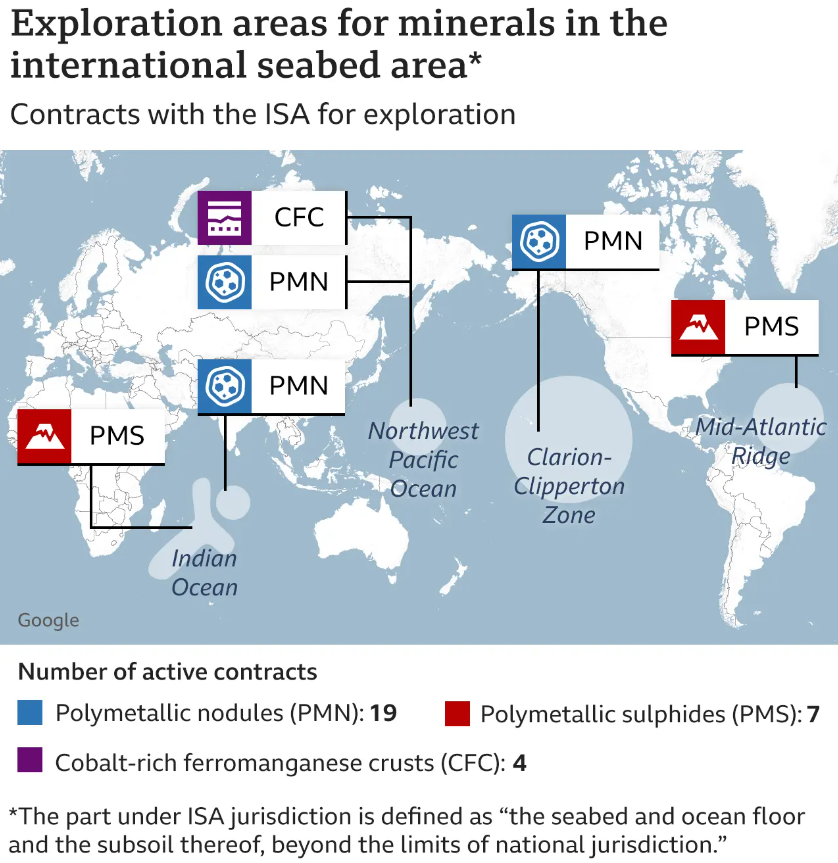
Exploration Rights: 19 countries have them; India joins as a major player.

India’s Applications (2024)
Carlsberg Ridge – approved.
![Presenttday position of the Carlsberg Ridge and segments of the Shiva crater separated by rifting (after [15], simplified).](https://www.researchgate.net/profile/Max-Barash/publication/226463090/figure/fig2/AS:339558488133643@1457968460972/Presenttday-position-of-the-Carlsberg-Ridge-and-segments-of-the-Shiva-crater-separated-by.png)
- Afanasy-Nikitin Seamount (ANS) – pending, as Sri Lanka has competing claims.

India’s Exploration Licences (ISA)
The International Seabed Authority (ISA), created under UNCLOS (1982), regulates exploration/mining in international waters.
-
2002 – Polymetallic nodules, Central Indian Ocean Basin (till March 2027).
-
2016 – Polymetallic sulphides, Indian Ocean Ridge (till Sept 2031).
-
2024 – India applied for 2 new licences:
-
Carlsberg Ridge – polymetallic sulphides (copper, zinc, gold, silver). (Approved in 2025 – first global licence here).
-
Afanasy-Nikitin Seamount (ANS) – cobalt-rich ferromanganese crusts. (Pending, Sri Lanka has competing claims).
-
-
2025 – Carlsberg Ridge licence granted; ANS still under review.
Currently, India’s count: 3 active exploration licences (matching Russia, one short of China-4).
Minerals Targeted
-
Polymetallic Nodules: Potato-shaped rocks with manganese, cobalt, nickel, copper.
-
Polymetallic Sulphides: Chimney-like deposits near hydrothermal vents; copper, zinc, gold, silver.
-
Ferromanganese Crusts: Rich in cobalt, manganese; found on seamounts.
Polymetallic Nodules: Potato-shaped rocks with manganese, cobalt, nickel, copper.
Polymetallic Sulphides: Chimney-like deposits near hydrothermal vents; copper, zinc, gold, silver.
Ferromanganese Crusts: Rich in cobalt, manganese; found on seamounts.
Strategic Importance for India
-
Energy Transition Goals:
-
500 GW renewables by 2030.
-
50% energy from renewables by 2030.
-
Net Zero by 2070.
-
Critical Minerals Demand: World Bank projects 5x increase in extraction by 2050 for clean energy.
-
Supply Chain Security: Counters China’s dominance:
-
Controls 100% of refined graphite, 70% cobalt, ~60% lithium & manganese processing.
-
Has restricted export of processing tech.
-
Geopolitical Leverage: India joined Minerals Security Partnership (2022) with US, EU, Japan, etc.
Energy Transition Goals:
-
500 GW renewables by 2030.
-
50% energy from renewables by 2030.
-
Net Zero by 2070.
Critical Minerals Demand: World Bank projects 5x increase in extraction by 2050 for clean energy.
Supply Chain Security: Counters China’s dominance:
-
Controls 100% of refined graphite, 70% cobalt, ~60% lithium & manganese processing.
-
Has restricted export of processing tech.
Geopolitical Leverage: India joined Minerals Security Partnership (2022) with US, EU, Japan, etc.
Technological Developments
-
Samudrayaan Programme (Matsya 6000): To carry humans 6000m deep.
-
NIOT (Chennai): Conducted trial mining in 2022 at 5270m depth, collecting polymetallic nodules.
-
India–Russia Agreement: Joint development of deep-sea mining tech.
Samudrayaan Programme (Matsya 6000): To carry humans 6000m deep.
NIOT (Chennai): Conducted trial mining in 2022 at 5270m depth, collecting polymetallic nodules.
India–Russia Agreement: Joint development of deep-sea mining tech.
Global Context
-
ISA Licences: 31 issued globally, 30 active .
-
China: Leading with most licences + advanced processing capacity.
-
US: Not part of UNCLOS → no ISA licences; focuses on domestic seabed + allies.
ISA Licences: 31 issued globally, 30 active .
China: Leading with most licences + advanced processing capacity.
US: Not part of UNCLOS → no ISA licences; focuses on domestic seabed + allies.
Challenges
-
Environmental Concerns: Deep-sea mining may disturb fragile ecosystems.
-
Geopolitical Disputes: Overlapping claims (e.g., with Sri Lanka in ANS).
-
Technological Hurdles: Extraction at depths >3000m requires advanced R&D.