
India as ‘Observer’ in Board of Peace for Gaza Meeting
Context
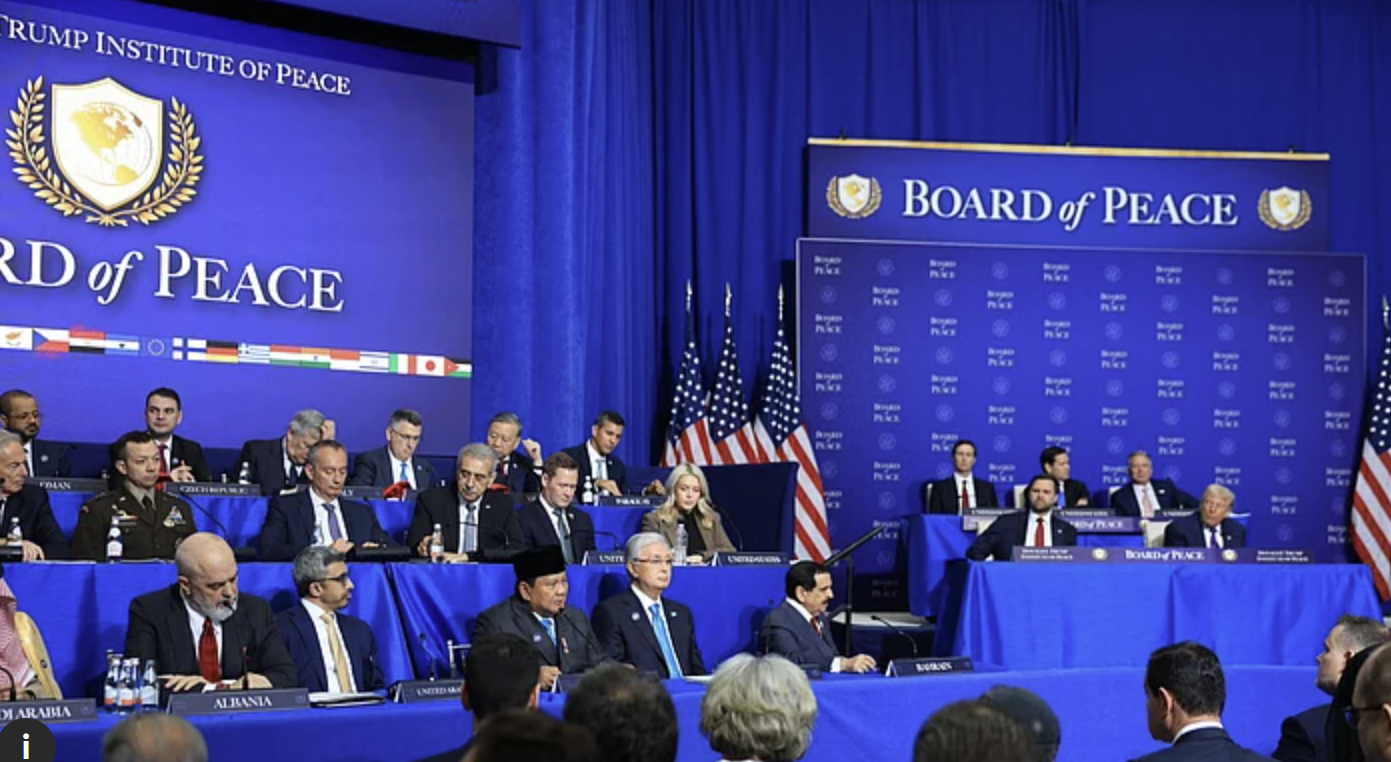
India participated as an observer in the first meeting of the Board of Peace for Gaza held in Washington D.C., as confirmed by the Ministry of External Affairs (MEA).
India was represented by Namgya Khampa, Deputy Chief of Mission at the Indian Embassy in Washington D.C.
India’s Official Position on Palestine
India reiterated its long-standing stand:
Support for a sovereign, independent, and viable State of Palestine
Based on 1967 borders
With East Jerusalem as capital (India’s traditional diplomatic position)
This reflects India's continued support for the Two-State Solution.
Reference to UNSC Resolution 2803
India stated it supports:
The Gaza Peace Plan initiative of former US President Donald Trump
Efforts underway due to United Nations Security Council Resolution 2803
This indicates India is engaging diplomatically without taking a central or mediating role.
India’s Diplomatic Balancing
India’s recent moves show calibrated diplomacy:
Initially opted out of a joint UN appearance criticising Israel’s West Bank settlement expansion.
Did not immediately sign a statement endorsed by 85 member states.
Signed the statement 24 hours later, which was read out by the Palestinian Ambassador at the UN.
This reflects:
Strategic ties with Israel
Historical support for Palestine
Effort to maintain diplomatic balance
Issue of West Bank Settlements
West Bank has witnessed:
Expansion of Israeli settlements
Requirement for Palestinian landholders to provide ownership proof
Facilitation of land acquisition by outside settlers
These actions have drawn international criticism as they are considered violations of international law under multiple UN resolutions.
Prelims Practice MCQs
Q. With reference to India’s position on the Israel-Palestine issue, consider the following statements:
India supports a sovereign and independent State of Palestine based on 1967 borders.
India has completely withdrawn support for the Two-State Solution.
India maintains diplomatic relations with both Israel and Palestine.
Which of the statements given above is/are correct?
A. 1 only
B. 1 and 3 only
C. 2 and 3 only
D. 1, 2 and 3
Answer: B
Explanation:
Statement 1 is correct — India supports a Palestinian state based on 1967 borders.
Statement 2 is incorrect — India continues to support the Two-State Solution.
Statement 3 is correct — India has diplomatic ties with both Israel and Palestine.
Q. Consider the following statements regarding the United Nations Security Council (UNSC):
It consists of 5 permanent and 10 non-permanent members.
All resolutions of the UNSC are binding under international law.
Permanent members possess veto power.
Which of the statements given above is/are correct?
A. 1 and 3 only
B. 2 only
C. 1, 2 and 3
D. 1 only
Answer: A
Explanation:
Statement 1 is correct — UNSC has 5 permanent and 10 non-permanent members.
Statement 2 is incorrect — Only resolutions passed under Chapter VII are binding.
Statement 3 is correct — P5 members have veto power.