
India and critical minerals: Strategy, partnerships and challenges
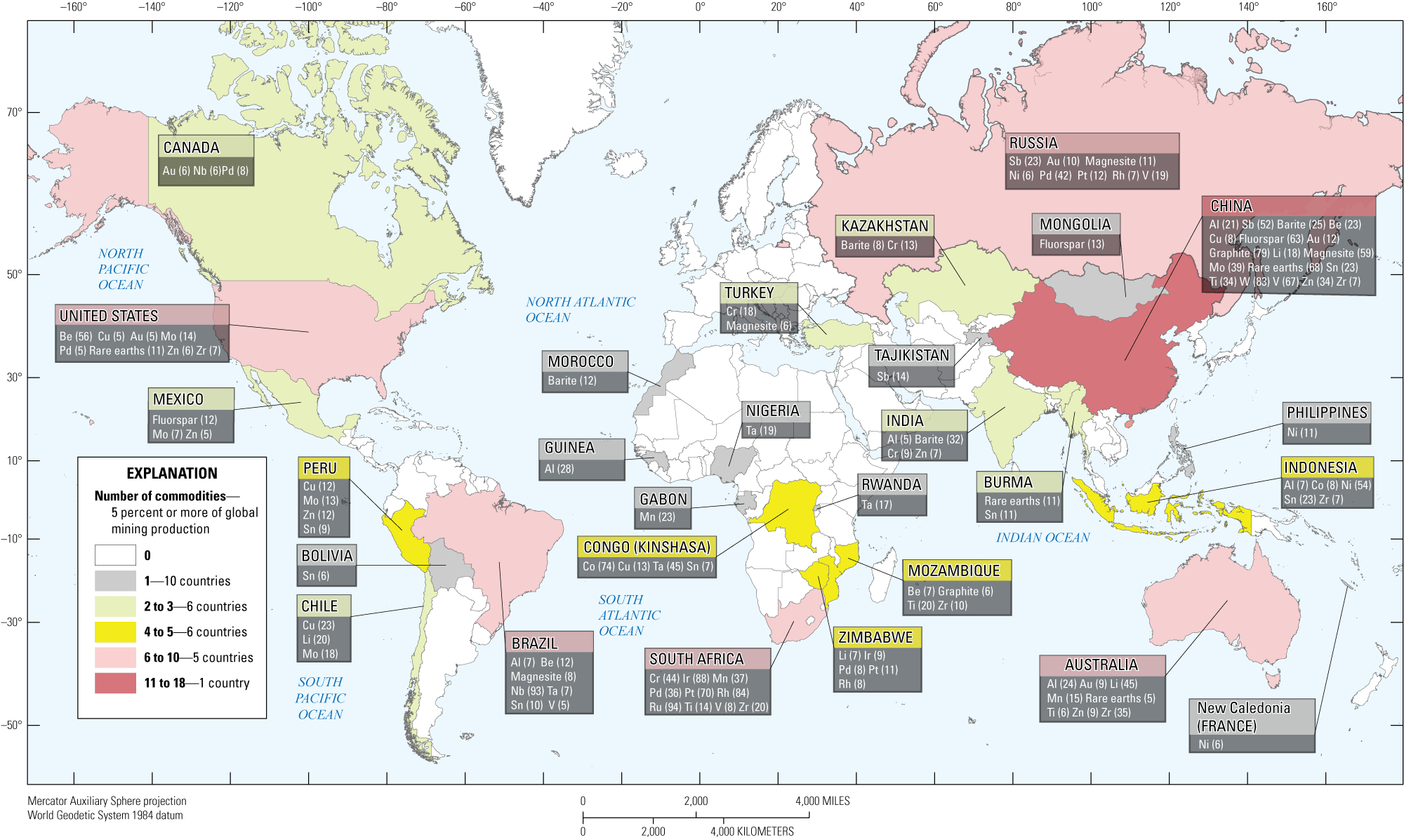
Context
India’s clean energy transition (EVs, renewables, batteries, grid storage) is highly dependent on imported critical minerals and rare earth elements.
China’s tightening export controls on critical minerals have intensified supply risks.
India is pursuing:
Diversification of mineral trade linkages
Responsible mining and production
Standards-based mineral markets
India’s clean energy transition (EVs, renewables, batteries, grid storage) is highly dependent on imported critical minerals and rare earth elements.
China’s tightening export controls on critical minerals have intensified supply risks.
India is pursuing:
Diversification of mineral trade linkages
Responsible mining and production
Standards-based mineral markets
Strategic approach adopted by India
Two-pronged strategy
Long-term domestic capability
Strengthening mineral policies
Responsible mining and ESG compliance
Short-term external security
Bilateral and multilateral mineral partnerships across continents
Long-term domestic capability
Strengthening mineral policies
Responsible mining and ESG compliance
Short-term external security
Bilateral and multilateral mineral partnerships across continents
Assessment of key partnerships
Australia
Most reliable strategic partner.
Advantages:
Political stability
Large mineral reserves
Shared strategic vision
Under the India–Australia Critical Minerals Investment Partnership (2022):
Five target projects identified (lithium, cobalt)
Focus on joint research, investments and long-term supply
Most reliable strategic partner.
Advantages:
Political stability
Large mineral reserves
Shared strategic vision
Under the India–Australia Critical Minerals Investment Partnership (2022):
Five target projects identified (lithium, cobalt)
Focus on joint research, investments and long-term supply
Japan
Acts as a model for resilience.
Lessons from Japan’s response to Chinese rare earth restrictions:
Diversification of supply
Stockpiling
Recycling
Sustained R&D
Cooperation includes:
Indian Rare Earths Limited
Joint extraction, processing and stockpiling (bilateral and third countries)
Acts as a model for resilience.
Lessons from Japan’s response to Chinese rare earth restrictions:
Diversification of supply
Stockpiling
Recycling
Sustained R&D
Cooperation includes:
Indian Rare Earths Limited
Joint extraction, processing and stockpiling (bilateral and third countries)
Africa
Offers:
Mineral abundance
Growing emphasis on local value addition
Recent engagements:
Namibia: lithium, rare earths, uranium
Zambia: copper and cobalt asset acquisition talks
Key challenge:
India must adopt a long-term industrial and developmental approach
Risk of losing ground to more coordinated competitors
Offers:
Mineral abundance
Growing emphasis on local value addition
Recent engagements:
Namibia: lithium, rare earths, uranium
Zambia: copper and cobalt asset acquisition talks
Key challenge:
India must adopt a long-term industrial and developmental approach
Risk of losing ground to more coordinated competitors
United States
Cooperation limited despite political intent.
Constraints:
Trade volatility
Tariffs on Indian goods
Inflation Reduction Act (IRA) incentives disadvantaging partners
Key initiatives:
Transforming the Relationship Utilizing Strategic Technology (TRUST) Initiative
Strategic Minerals Recovery Initiative
The Transforming the Relationship Utilizing Strategic Technology (TRUST) Initiative and the Strategic Minerals Recovery Initiative propose frameworks for joint work on rare-earth processing, battery recycling and clean separation technologies.
The India-US TRUST (Transforming the Relationship Utilizing Strategic Technology) Initiative is a bilateral program launched in February 2025 to build secure supply chains for critical technologies, with a key component being the Strategic Minerals Recovery Initiative, focused on recovering and processing critical minerals like lithium and rare earth elements (REEs) from industrial waste and mining byproducts to reduce reliance on China and support high-tech industries (AI, quantum, semiconductors)
Potential strength:
Downstream technology and innovation partner
Limitation:
Unpredictability of U.S. trade policy
Cooperation limited despite political intent.
Constraints:
Trade volatility
Tariffs on Indian goods
Inflation Reduction Act (IRA) incentives disadvantaging partners
Key initiatives:
Transforming the Relationship Utilizing Strategic Technology (TRUST) Initiative
Strategic Minerals Recovery Initiative
The Transforming the Relationship Utilizing Strategic Technology (TRUST) Initiative and the Strategic Minerals Recovery Initiative propose frameworks for joint work on rare-earth processing, battery recycling and clean separation technologies.
The India-US TRUST (Transforming the Relationship Utilizing Strategic Technology) Initiative is a bilateral program launched in February 2025 to build secure supply chains for critical technologies, with a key component being the Strategic Minerals Recovery Initiative, focused on recovering and processing critical minerals like lithium and rare earth elements (REEs) from industrial waste and mining byproducts to reduce reliance on China and support high-tech industries (AI, quantum, semiconductors)
Potential strength:
Downstream technology and innovation partner
Limitation:
Unpredictability of U.S. trade policy
European Union
Frameworks:
Critical Raw Materials Act
European Battery Alliance
Circular economy agenda
Emphasis on:
Sustainability
Transparency
Lifecycle standards
For India:
Alignment with EU norms is essential for deeper integration
Frameworks:
Critical Raw Materials Act
European Battery Alliance
Circular economy agenda
Emphasis on:
Sustainability
Transparency
Lifecycle standards
For India:
Alignment with EU norms is essential for deeper integration
European Battery Alliance (EBA)
Launched: October 2017
Initiated by: Vice President Maroš Šefčovič
Objective:
Build a competitive, sustainable and integrated EU battery value chain
Reduce dependence on external suppliers, especially China
|
European Raw Materials Alliance (ERMA)
Launched: 30 September 2020 by the European Union
Purpose:
Achieve strategic autonomy in critical raw materials
Modelled on: European Battery Alliance
Focus minerals:
Lithium
Rare earth elements
Metals used in:
Battery magnets
Electric and electronic devices
Key target:
EU to become “almost self-sufficient” in lithium for batteries by 2025
|
EBA–India Collaboration Framework
Institutional platform
Institutional platform
Cooperation primarily under the India–EU Trade and Technology Council (TTC)
|
Energy storage cooperation
Facilitated under the EU Clean Energy and Climate Partnership (CECP)
| ||
West Asia (Gulf region)
Countries such as UAE and Saudi Arabia:
Investing in battery materials, refining, green hydrogen
Sovereign wealth funds acquiring mining assets globally
Potential role for India:
Midstream processing hub, not primary extraction
Limitation:
Lack of deep institutional frameworks
Countries such as UAE and Saudi Arabia:
Investing in battery materials, refining, green hydrogen
Sovereign wealth funds acquiring mining assets globally
Potential role for India:
Midstream processing hub, not primary extraction
Limitation:
Lack of deep institutional frameworks
Russia
Strengths:
Large reserves of rare earths, cobalt, lithium
Long-standing scientific ties
Constraints:
Sanctions
Financing and logistics challenges
Strategic role:
Hedge partner, not a core supplier
Strengths:
Large reserves of rare earths, cobalt, lithium
Long-standing scientific ties
Constraints:
Sanctions
Financing and logistics challenges
Strategic role:
Hedge partner, not a core supplier
New frontiers
Latin America
Countries: Argentina, Chile, Peru, Brazil
Importance:
Copper, nickel, lithium and rare earths
Indian engagement:
Investments by public and private sector
Khanij Bidesh India Limited (KABIL) signed a ₹200 crore agreement with Argentina
Challenge:
Intense competition
Need for value-chain partnerships, not extraction-only deals
Countries: Argentina, Chile, Peru, Brazil
Importance:
Copper, nickel, lithium and rare earths
Indian engagement:
Investments by public and private sector
Khanij Bidesh India Limited (KABIL) signed a ₹200 crore agreement with Argentina
Challenge:
Intense competition
Need for value-chain partnerships, not extraction-only deals
Canada
Key minerals:
Nickel, cobalt, copper, rare earths
Positive development:
Trilateral agreement with India and Australia
Risk:
Political relations will determine reliability
Key minerals:
Nickel, cobalt, copper, rare earths
Positive development:
Trilateral agreement with India and Australia
Risk:
Political relations will determine reliability
Core lessons emerging
Processing is the real choke point
Securing ore alone is insufficient.
Without domestic refining and midstream capacity, India remains vulnerable.
Securing ore alone is insufficient.
Without domestic refining and midstream capacity, India remains vulnerable.
Value-chain based partnerships
Upstream (extraction): Africa, Australia, Canada, Latin America
Midstream (processing): Japan, West Asia
Downstream (technology, recycling): EU, United States
Diversification hedge: Russia
Upstream (extraction): Africa, Australia, Canada, Latin America
Midstream (processing): Japan, West Asia
Downstream (technology, recycling): EU, United States
Diversification hedge: Russia
Domestic reforms are critical
Strengthening:
Responsible mining frameworks
Environmental, Social and Governance (ESG) standards
Transparency and regulatory certainty
Strengthening:
Responsible mining frameworks
Environmental, Social and Governance (ESG) standards
Transparency and regulatory certainty
Khanij Bidesh India Limited (KABIL)
Overview
Khanij Bidesh India Limited (KABIL) is a joint venture company of the Government of India.
Established to secure critical and strategic mineral assets abroad.
Forms a key pillar of India’s resource security and clean energy transition strategy.
|
Key facts
Founded: 2019
Administrative ministry: Ministry of Mines, Government of India
Headquarters: New Delhi
|
Joint venture partners
National Aluminium Company Limited (NALCO)
Hindustan Copper Limited (HCL)
Mineral Exploration Corporation Limited (MECL)
|
Focus minerals
Lithium
Cobalt
Nickel
Rare earth elements
(These minerals are critical for EV batteries, renewable energy systems, electronics, and defence applications.)
(These minerals are critical for EV batteries, renewable energy systems, electronics, and defence applications.) |
Core functions
Overseas:
Exploration
Acquisition
Development of mineral assets
Securing long-term supply chains for India’s:
Clean energy transition
Electric mobility
Strategic industries
| ||
Conclusion
India has created an extensive web of critical mineral partnerships.
The next phase requires:
Deepening effective partnerships
Recalibrating weak engagements
Prioritising processing, technology and long-term certainty
Strategic minerals policy will be decisive for India’s clean energy and industrial future.
India has created an extensive web of critical mineral partnerships.
The next phase requires:
Deepening effective partnerships
Recalibrating weak engagements
Prioritising processing, technology and long-term certainty
Strategic minerals policy will be decisive for India’s clean energy and industrial future.
Prelims Practice MCQs
Q. Consider the following statements about Khanij Bidesh India Limited:
It is a Navratna Public Sector Undertaking under the Ministry of Mines.
It was established to secure critical and strategic mineral assets abroad.
It focuses on minerals essential for electric mobility and clean energy transition.
Which of the statements given above are correct?
(a) 1 and 2 only
(b) 2 and 3 only
(c) 1 and 3 only
(d) 1, 2 and 3
Answer: (b)
Explanation:
KABIL is not a PSU but a joint venture company → Statement 1 incorrect.
It was created to secure overseas critical minerals → Statement 2 correct.
Its focus aligns with EVs and clean energy → Statement 3 correct.
Q. Khanij Bidesh India Limited (KABIL) is a joint venture of which of the following entities?
National Aluminium Company Limited
Hindustan Copper Limited
Mineral Exploration Corporation Limited
Indian Rare Earths Limited
Select the correct answer using the code below:
(a) 1, 2 and 3 only
(b) 1, 3 and 4 only
(c) 2 and 4 only
(d) 1, 2, 3 and 4
Answer: (a)
Explanation:
JV partners: NALCO, HCL, MECL.
Indian Rare Earths Limited is not a partner.
Q. Consider the following statements about Khanij Bidesh India Limited:
It is a Navratna Public Sector Undertaking under the Ministry of Mines.
It was established to secure critical and strategic mineral assets abroad.
It focuses on minerals essential for electric mobility and clean energy transition.
Which of the statements given above are correct?
(a) 1 and 2 only
(b) 2 and 3 only
(c) 1 and 3 only
(d) 1, 2 and 3
Answer: (b)
Explanation:
KABIL is not a PSU but a joint venture company → Statement 1 incorrect.
It was created to secure overseas critical minerals → Statement 2 correct.
Its focus aligns with EVs and clean energy → Statement 3 correct.
Q. Khanij Bidesh India Limited (KABIL) is a joint venture of which of the following entities?
National Aluminium Company Limited
Hindustan Copper Limited
Mineral Exploration Corporation Limited
Indian Rare Earths Limited
Select the correct answer using the code below:
(a) 1, 2 and 3 only
(b) 1, 3 and 4 only
(c) 2 and 4 only
(d) 1, 2, 3 and 4
Answer: (a)
Explanation:
JV partners: NALCO, HCL, MECL.
Indian Rare Earths Limited is not a partner.