
ICMR on Notice over Cancer-Causing Chemicals in Cars
Context
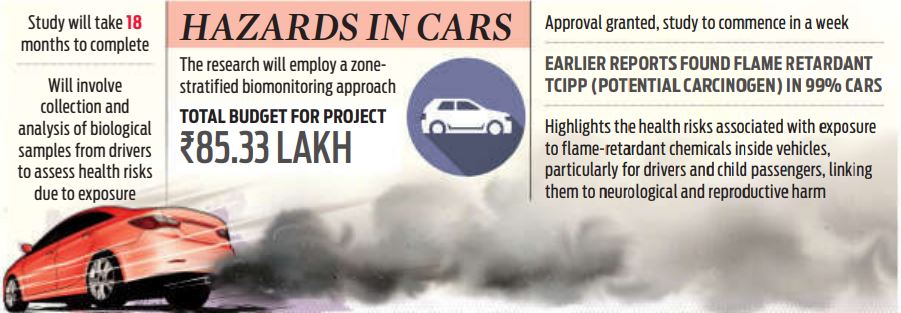
The National Green Tribunal (NGT) directed the Indian Council of Medical Research (ICMR) to expedite research on toxic flame-retardant chemicals found in cars.
Concern: These chemicals pose neurological and reproductive risks, especially to drivers and child passengers.
Background
A 2024 study revealed that 99% of cars contained the flame retardant TCIPP (tris(1-chloro-2-propyl) phosphate), flagged by the US National Toxicology Program as a potential carcinogen.
Earlier study (Environmental Science & Technology, May 2022) confirmed the presence of cancer-causing chemicals in vehicle interiors.
Findings from Earlier Research
99% of cars (2015–2022 models, electric, gas, hybrid) contained TCIPP.
Cars also contained TDCIPP ( Tris(1,3-dichloro-2-propyl) phosphate )and TCEP ( Tris(2-chloroethyl) phosphate ), both considered carcinogens.
Source: Seat foam (used to meet flammability standards).
Problem: While flame retardants prevent fires, they make smoke toxic and harder to extinguish.
Health Risks
Linked to neurological and reproductive harms.
Drivers: Spend ~1 hour daily in cars → high exposure risk.
Children: Breathe more air per unit body weight → higher vulnerability.
Summer: Toxic emissions peak due to heat increasing chemical release.
NGT’s Observations
Chemicals are added to car seats and materials for fire safety, but public health costs outweigh benefits.
Exposure inside vehicles = significant public health issue.
TDCIPP
Full Form: Tris(1,3-dichloro-2-propyl) phosphate
Use: Commonly added to polyurethane foams, plastics, textiles, and electronics as a flame retardant.
Health Concerns:
Classified as a possible human carcinogen.
Linked to hormonal disruption, neurological harm, reproductive toxicity, and developmental issues in children.
Persistent in the environment; accumulates in dust and air inside homes and vehicles.
TCEP
Full Form: Tris(2-chloroethyl) phosphate
Use: Used in polyurethane foams, paints, adhesives, and furniture for fire resistance.
Health Concerns:
Classified as a carcinogen by the EU and California Proposition 65.
Causes neurotoxicity, kidney and liver damage, and fertility issues.
Highly mobile in the environment; found in air, water, and household dust.
Both TDCIPP and TCEP are used in seat foams and interior materials of cars to meet flammability standards.
When exposed to heat, these chemicals release into cabin air, making drivers and child passengers especially vulnerable.
Practice Mains Question (GS-III: Environment & Health)
Q. Flame-retardant chemicals in consumer products are considered a hidden environmental health hazard. Discuss the risks they pose and the regulatory challenges in addressing them in India.
Answer Pointers:
Define flame-retardants (purpose vs harm).
Risks: neurological, reproductive, carcinogenic, higher child vulnerability.
Case study: ICMR–NGT notice on toxic chemicals in cars.
Regulatory challenges: weak consumer product standards, limited biomonitoring, automobile industry resistance.
Way forward: Stronger BIS norms, green chemistry alternatives, public awareness, regular biomonitoring, global best practices.