
ICMR Initiative: Development of Monoclonal Antibodies Against Nipah Virus
Context
Indian Council of Medical Research (ICMR) invited Expression of Interest (EoI) from eligible Indian organisations, companies, and manufacturers to develop and produce monoclonal antibodies (mAbs) against Nipah virus (NiV).
Aim: Build an indigenous biomedical countermeasure for Nipah a recurring zoonotic threat in India.
About Nipah Virus (NiV)
Component | Details |
Type | Zoonotic virus (transmitted from animals to humans) |
Family | Paramyxoviridae, genus Henipavirus |
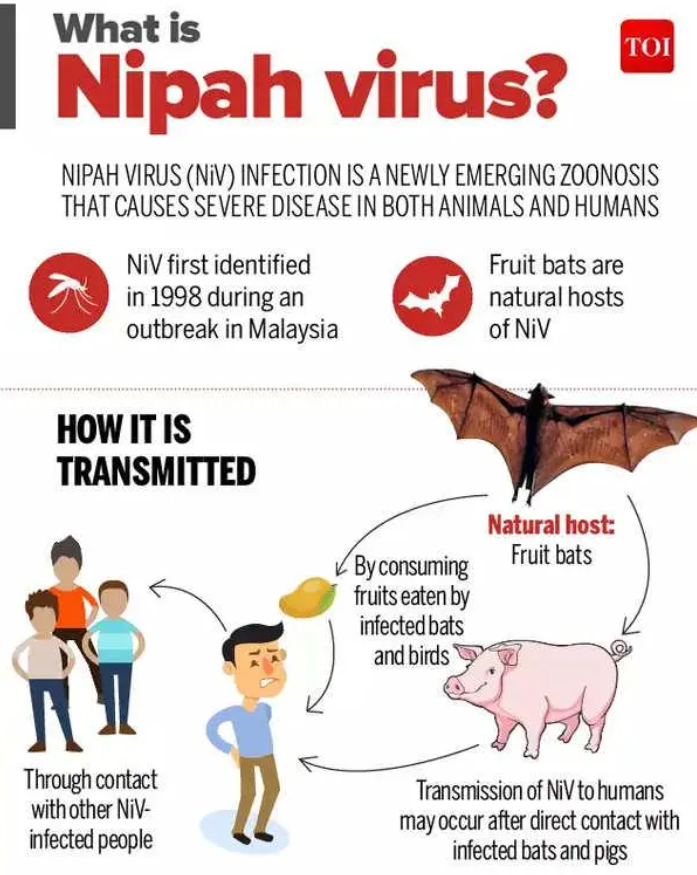
Reservoir host | Fruit bats (Pteropus species) |
Transmission | Animal-to-human (via bat-contaminated food or animals), human-to-human, and laboratory exposure |
First identified in India | 2001 (Silchar, West Bengal) |
Recent outbreaks | Kerala (2018, 2019, 2021, 2023) |
Case Fatality Rate (CFR) | 40% – 75%, depending on clinical care |
What is a monoclonal antibody?
Monoclonal antibodies are laboratory-made proteins that mimic the behaviour of antibodies produced by the immune system to protect against diseases and foreign substances.
Monoclonal antibodies are specifically designed to target certain antigens.
How do monoclonal antibodies work?
Monoclonal antibodies are specifically engineered and generated to target a disease. They are meant to attach themselves to the specific disease-causing antigen. An antigen is most likely to be a protein.
For example, most successful monoclonal antibodies during the pandemic were engineered to bind to the spike protein of the SARS-CoV-2 virus. The binding prevented the protein from exercising its regular functions, including its ability to infect other cells.

m102.4 mAb
m102.4 is a monoclonal antibody that binds itself to the immunodominant receptor-binding glycoprotein of the Nipah virus, potentially neutralising it. m102.4 neutralises Hendra and Nipah viruses both outside and inside of living organisms.
Both Hendra and Nipah viruses are a family of viruses that contain a single-strand RNA of the negative-sense genome, similar to the ones that cause diseases like measles, influenza etc., and replicate within infected cells.
Manufactured by: Australian Institute for Bioengineering and Nanotechnology (AIBN), University of Queensland.( passed phase-one clinical trials, the drug is used on a ‘compassionate use’ basis a treatment option that allows the use of an unauthorised medicine under strict conditions)
Why Monoclonal Antibodies (mAbs)?
No licensed vaccine or antiviral drug for Nipah virus currently exists.
mAbs are only feasible biomedical countermeasure at present.
mAbs can:
Neutralize the virus directly.
Prevent viral entry into cells.
Be used both therapeutically and prophylactically (PEP).
Role as Post-Exposure Prophylaxis (PEP)
Can be administered to:
Healthcare workers exposed without proper PPE.
Family members in close contact with patients.
Laboratory staff with accidental exposure.
If given early, can prevent disease onset (confirmed in animal models).
Therapeutic Benefits
When administered in early-stage infections, mAbs can:
Reduce viral load
Limit disease progression
Potentially lower fatality rates
ICMR’s Strategy
Collaboration with Indian industry partners for indigenous development.
Establishment of a national stockpile of mAbs for rapid outbreak response.
Support from ICMR-NIV (National Institute of Virology), Pune, where:
Research and development on Nipah mAbs is already at an advanced experimental stage.
ICMR and its institutes will offer:
Technical guidance
Expert oversight
R&D acceleration across all development phases
Significance
Strengthens India’s pandemic preparedness for emerging zoonotic viruses.
Promotes Atmanirbhar Bharat in biomedical countermeasures.
Enhances national biosafety and biosecurity capacity.
Prelims Practice MCQ
Q. With reference to Nipah virus, consider the following statements:
It is an RNA virus belonging to the Henipavirus genus.
Fruit bats are the natural reservoir hosts.
India has an approved vaccine for human use against Nipah virus.
Which of the statements given above are correct?
(a) 1 and 2 only
(b) 2 and 3 only
(c) 1 and 3 only
(d) 1, 2 and 3
✅ Answer: (a)
Explanation: Nipah is an RNA virus from the Henipavirus genus. Fruit bats (Pteropus) are natural hosts. There is no licensed vaccine available for human use yet.