
Human–dolphin cooperative fishing in Ashtamudi lake
Introduction
Ashtamudi Lake in Kerala is home to one of the world’s few remaining examples of active human–wildlife cooperative foraging.
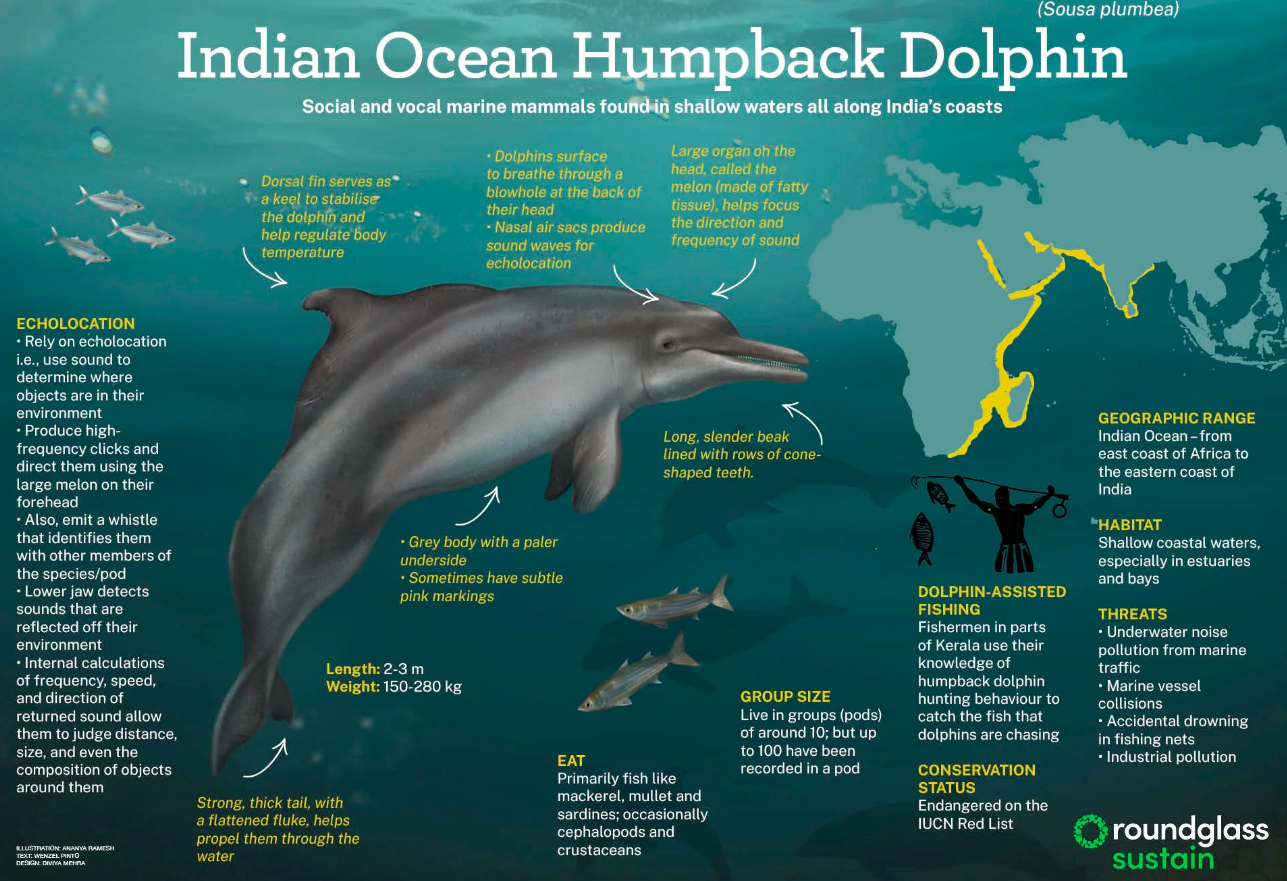
Collaboration occurs between artisanal fishers and Indo-Pacific humpback dolphins (Sousa plumbea).
Ecological features
Species characteristics
Indo-Pacific humpback dolphin (Sousa plumbea)
Found in shallow coastal and estuarine ecosystems.
Known for social intelligence and ability to engage in complex cooperative behaviour.
Mechanism of cooperation
Dolphins herd fish into shallow waters near the shoreline.
They signal fishers through tail-slaps or rolling movements.
Fishers cast nets immediately upon receiving these cues.
Mutual benefit:
Fishers get a higher catch.
Dolphins feed on scattered fish after net deployment.
Traditional ecological knowledge
Fishers possess knowledge of dolphin behaviour.
Cooperation is not accidental but a culturally maintained practice on both sides.
Indo-Pacific humpback dolphins (Sousa plumbea)
Indo-Pacific humpback dolphin (Sousa plumbea) is a coastal marine mammal found in the Indian Ocean and western Pacific region.
Known for distinctive hump-like dorsal area and high levels of social intelligence.
Often associated with shallow, turbid waters near river mouths, estuaries, lagoons, and mangrove ecosystems.
Taxonomy and classification
Genus: Sousa
Species: plumbea
Commonly referred to as the Indian Ocean humpback dolphin.
Earlier considered part of Sousa chinensis, but later classified as a distinct species.
Distribution
Coastal waters of:
East Africa to the Bay of Bengal
Arabian Sea
Coast of India (both east and west coasts)
Sri Lanka and Maldives
Prefers water depths less than 30 metres.
Habitat characteristics
Shallow coastal waters
Estuaries and river mouths
Lagoons and mangrove belts
Turbid waters with high productivity
Brackish ecosystems like Ashtamudi Lake, Kerala
Physical and behavioural characteristics
Morphology
Length: 2–2.8 metres.
Colour: Light grey to dark grey; juveniles lighter.
Distinctive hump below the dorsal fin.
Behaviour
Highly social and intelligent species.
Display complex behaviours such as:
Cooperative hunting
Tool-like use of group coordination
Acoustic communication
Synchronised foraging strategies
Diet
Feeds on fish, crustaceans, and cephalopods.
Often hunts in turbid, shallow waters where fish density is high.
Conservation status
IUCN status: Endangered.
CITES Appendix I – highest level of protection.
Indian Wildlife (Protection) Act: Schedule II species.
Threats
Coastal habitat loss and degradation
Noise pollution (ports, shipping, dredging)
Overfishing and prey depletion
Bycatch in fishing nets
Pollution: heavy metals, industrial effluents, plastics
Climate change impacts on coastal ecosystems
Conservation measures
Habitat-based conservation in lagoons, estuaries, mangroves
Reduction of bycatch through gear modification
Marine protected areas and coastal zone regulation
Community engagement for sustainable fishing
Research on behaviour, migration, and population dynamics
Indo-Pacific humpback dolphins in India
States where found
Kerala
Goa
Maharashtra
Odisha
West Bengal
Gujarat (Gulf of Kutch and Gulf of Khambhat)