
HOPE Station: India’s Analog Space Mission
Introduction
-
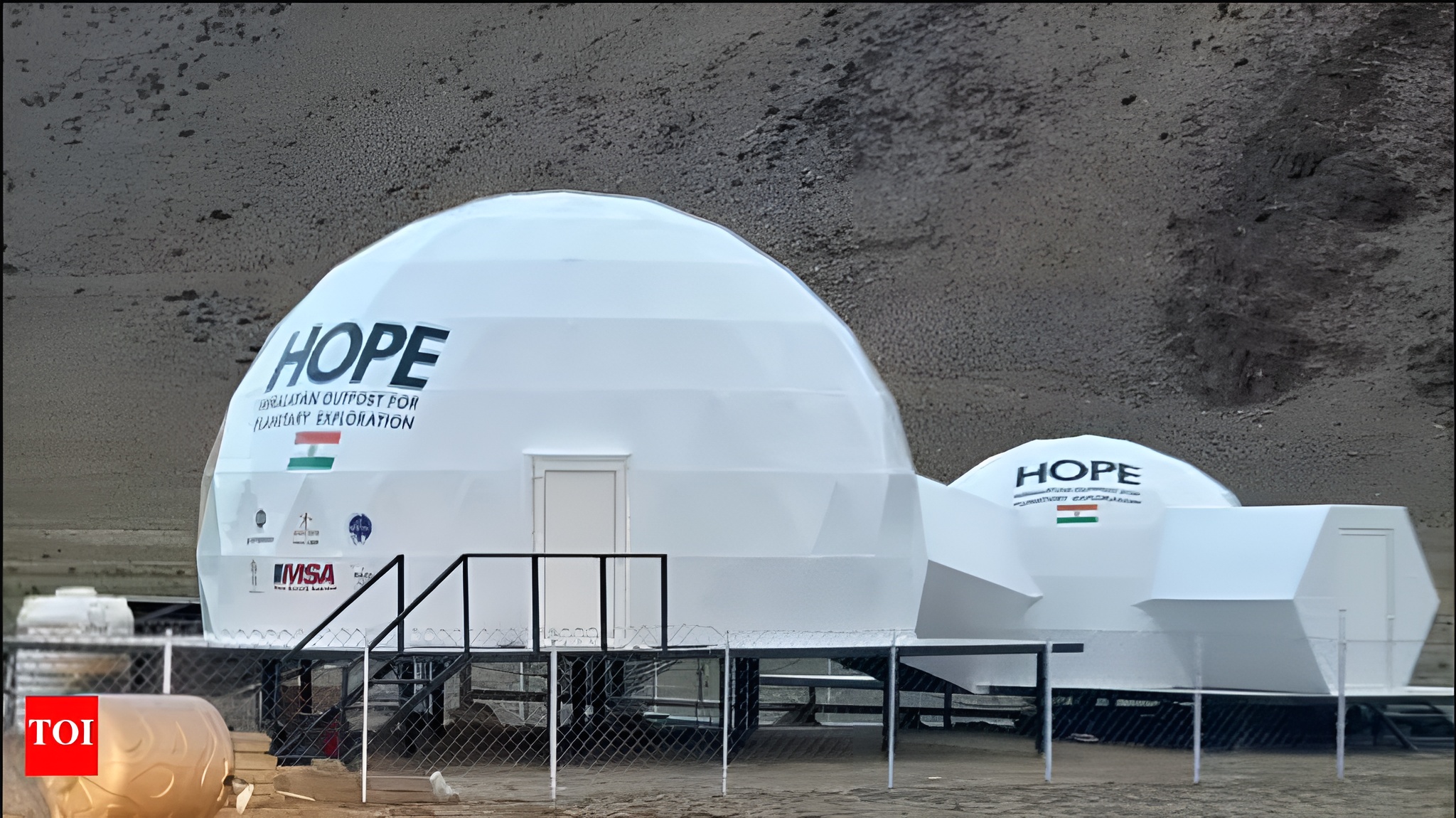
The HOPE (Human Outer Planetary Exploration) station, launched on August 1, 2025, by Protoplanet, is India’s second analog space mission.
-
Located in Tso Kar, Ladakh, it simulates life on the Moon and Mars through isolation-based human experiments.
-
The mission is conducted in collaboration with the Indian Space Research Organisation (ISRO), which partially funded the station and advised on crew selection.
Background: Analog Missions in India
-
India’s first analog mission:
-
HAB-1 (LHAM), launched in November 2024, marked the beginning of Indian efforts to simulate extraterrestrial environments on Earth.
-
-
HOPE builds on this by selecting a unique terrain — a high-altitude cold desert — for more realistic simulations of lunar and Martian conditions.
Site Selection: Tso Kar, Ladakh
-
Studied for 9 years, Tso Kar was chosen due to its:
-
Cold, arid environment
-
High altitude
-
Barren, rocky terrain that mimics extraterrestrial surfaces
-
-
Referred to as an “exceptional analogue site”, ideal for simulating geological and environmental conditions on the Moon and Mars.
Mission Design and Objectives
-
The HOPE station will host 10-day isolation missions with rotating human crews.
-
Objectives include:
-
Studying physiological, psychological, and epigenetic responses to isolation and extreme environments.
-
Developing life-support systems, behavioral protocols, and medical safeguards for long-duration space travel.
-
Building knowledge for future manned missions to the Moon and Mars.
-
Experiments
-
conduct studies related to:
-
Mental health in confinement
-
Bodily adaptation to simulated extraterrestrial settings
-
Biological changes at the gene level (epigenetics)
-
Significance
-
Part of India’s growing capacity in human spaceflight support systems.
-
Adds to India's readiness for:
-
Bharatiya Antariksh Station (by 2035)
-
Manned Moon Mission (by 2040)
-
-
Enhances private-sector participation (Protoplanet) in frontier space research.
Comparison with Global Analog Missions
-
HOPE is India's contribution to a global tradition of analog stations, such as:
-
Mars Desert Research Station – USA
-
Flashline Mars Arctic Research Station – Canada
-
BIOS-3 – Russia
| Analog Station | Country | Location | Initiating Agency | Key Features |
|---|---|---|---|---|
| HAB-1 Ladakh Human Analogue Mission (LHAM) | India | Leh, Ladakh | ISRO's Human Space Flight Centre, AAKA Space Studio, University of Ladakh and IIT Bombay in collaboration with the Ladakh Autonomous Hill Development Council, Leh | First Indian analog mission (Nov 2024); focuses on human simulation experiments |
| HOPE (Human Outer Planetary Exploration) | India | Tso Kar, Ladakh | Protoplanet + ISRO (support) | Second analog mission; high-altitude cold desert site; simulates Moon/Mars |
| Mars Desert Research Station (MDRS) | United States | Utah Desert | The Mars Society | Operated since 2001; simulates Martian surface; geology, robotics, crew studies |
| Flashline Mars Arctic Research Station (FMARS) | Canada | Devon Island, Arctic | The Mars Society | Remote cold site; studies long-duration isolation and EVA simulations |
| BIOS-3 | Russia | Krasnoyarsk, Siberia | Russian Academy of Sciences | Closed ecological system; tested long-term human survival in a sealed habitat |
Why Ladakh? – Terrain and Climatic Suitability
-
High Altitude: ~3,500 meters above sea level
-
Oxygen levels ~40% of sea level – mimics low-pressure conditions like Mars
-
-
Thermal Variations:
-
Diurnal shift from 15°C to -10°C, simulating extraterrestrial thermal challenges
-
-
Soil Conditions:
-
Sandy and rocky terrain, resembling Martian and lunar regolith
-
Ideal for rover mobility and in-situ resource utilisation (ISRU) experiments
-