
Heavier ions improve multi-ion cancer therapy
What is multi-ion cancer therapy?
Multi-ion cancer therapy is an advanced form of radiotherapy.
It uses charged particle beams such as:
Carbon ions
Oxygen ions
Neon ions
Particularly effective against:
Radiation-resistant tumors
Deep-seated cancers
Why ion beams are special
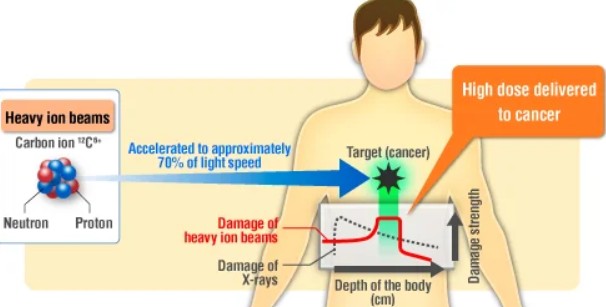
Ion beams deposit most of their energy at a specific depth inside the body, known as the Bragg peak.
Advantages:
Minimal damage to surrounding healthy tissue
High biological effectiveness against cancer cells
Challenge:
Requires extreme precision to ensure the beam stops exactly at the tumor.
The trilemma in multi-ion therapy
Researchers identified a trilemma in ion-based cancer therapy:
High treatment intensity
Needed to destroy resistant tumor cells
Target accuracy
Beam must hit only the tumor
Range uncertainty
Risk that the beam:
Stops before the tumor, or
Overshoots into healthy tissue
Among these, range uncertainty is the most serious threat.
Key scientific finding
A Japanese research team found that:
Using heavier ions (such as oxygen instead of carbon)
Reduces range uncertainty by more than 7%
Heavier ions:
Scatter less while travelling through tissue
Have more predictable stopping points
Why heavier ions help
Higher mass and charge → straighter trajectories
Less deviation due to tissue heterogeneity
Narrower error margins improve:
Tumor targeting
Patient safety
Treatment reliability
Implications for cancer treatment
Improved precision may allow:
Higher doses without increasing side effects
Better outcomes for hard-to-treat cancers
Supports the future of:
Personalised radiotherapy
Advanced particle-accelerator-based medicine
Prelims Practice MCQs
Q. Heavy-ion cancer therapy differs from conventional radiotherapy mainly because it:
A. Uses X-rays with higher penetration
B. Relies on radioactive drugs
C. Delivers maximum energy at a specific depth inside the body
D. Targets only blood cancers
Correct answer: C
Explanation:
Ion beams exhibit the Bragg peak, allowing concentrated energy delivery at the tumor site.
Q. In multi-ion cancer therapy, “range uncertainty” refers to:
A. Uncertainty in tumor diagnosis
B. Variation in radiation dose between patients
C. Risk of the ion beam stopping before or beyond the tumor
D. Instability of particle accelerators
Correct answer: C
Explanation:
Range uncertainty concerns inaccurate stopping of the beam, risking under-treatment or damage to healthy tissue.
Q. Which of the following cancers is most suited for heavy-ion therapy?
A. Superficial skin cancers
B. Radiation-sensitive tumors
C. Radiation-resistant and deep-seated tumors
D. Viral-induced cancers only
Correct answer: C
Explanation:
Heavy-ion therapy is particularly useful for resistant and deep tumors where precision is critical.