
Green Ammonia and Green Methanol Standards
Context
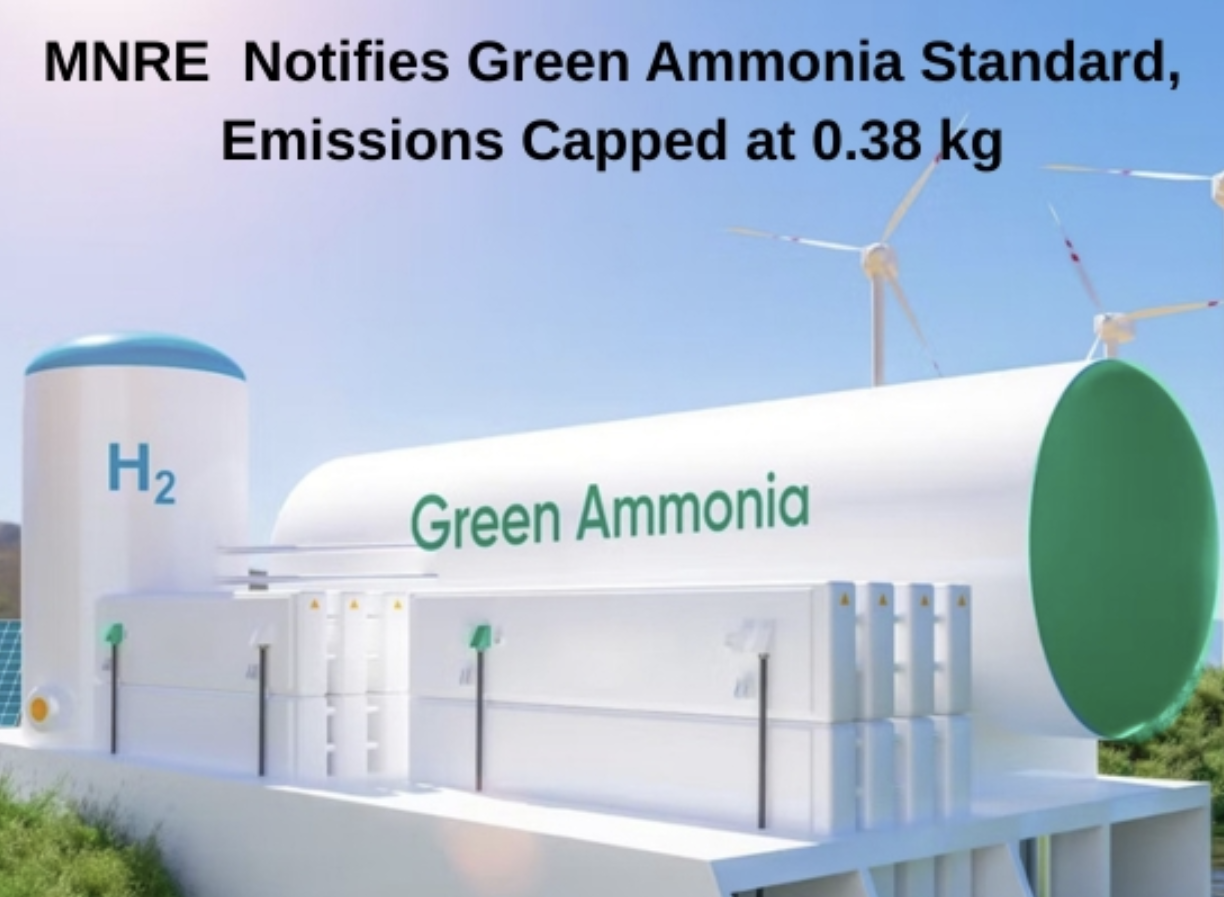
The Government of India has notified standards for Green Ammonia and Green Methanol under the National Green Hydrogen Mission.
The mission has an initial outlay of ₹19,744 crore.
Key Standards Notified by the Government
1. Green Ammonia
Maximum non-biogenic greenhouse gas emissions allowed:
≤ 0.38 kg CO₂ equivalent per kg of ammonia.Emissions calculation includes:
Hydrogen production
Ammonia synthesis
Purification
Compression
On-site storage
Emissions are calculated as an average over a 12-month period.
Ammonia must be produced using green hydrogen generated from renewable energy sources.
Uses
Marine fuel
Emerging zero-carbon shipping fuel.
Hydrogen carrier
Used to store and transport hydrogen efficiently.
Advantages
Easier to store and transport than hydrogen.
Requires less extreme temperature conditions than liquid hydrogen.
Existing global infrastructure for ammonia transport already exists.
2. Green Methanol
Maximum non-biogenic greenhouse gas emissions allowed:
≤ 0.44 kg CO₂ equivalent per kg of methanol.Emissions include:
Hydrogen production
Methanol synthesis
Purification
On-site storage
Emissions calculated over a 12-month period.
Permitted sources of CO₂ for methanol production:
Biological sources
Direct Air Capture (DAC)
Existing industrial sources
Government may revise the list of eligible CO₂ sources in future.
Key Advantages
Produces lower greenhouse gas emissions compared to fossil fuels.
Liquid at room temperature, making it easy to store and transport.
Compatible with existing fuel infrastructure with limited modifications.
Uses of Green Methanol
Marine transportation
Considered a future renewable shipping fuel.
Ships may need engine modification or new designs.
Ports must adapt storage and distribution systems.
Aviation
Used to produce e-SAF (synthetic aviation fuel).
e-SAF can be blended with conventional aviation kerosene without modifying aircraft engines.
Chemical industry
Used as a feedstock for chemicals and fuels.
Renewable Energy Conditions
Renewable energy used for producing green hydrogen may include:
Direct renewable electricity (solar, wind, etc.).
Renewable electricity that is:
Stored in energy storage systems, or
Banked with the grid under existing regulations.
Future Regulatory Framework
The Ministry of New and Renewable Energy will issue a separate framework for:
Measurement
Reporting
Monitoring
Verification
Certification (MRV system)
This will ensure traceability and credibility of green fuels.
Prelims Practice MCQs
Q. With reference to Green Ammonia standards notified by India, consider the following statements:
The emission limit is 0.38 kg CO₂ equivalent per kg of ammonia.
Emissions include hydrogen production and ammonia synthesis.
Emissions are calculated over a one-month period.
Which of the above statements are correct?
A. 1 and 2 only
B. 2 and 3 only
C. 1 and 3 only
D. 1, 2 and 3
Answer: A
Explanation:
Statements 1 and 2 are correct.
Emissions are calculated as an average over 12 months, not one month.
Q. Green Methanol under India’s new standards can use carbon dioxide from which of the following sources?
Biological sources
Direct Air Capture
Existing industrial sources
A. 1 and 2 only
B. 2 and 3 only
C. 1, 2 and 3
D. 1 only
Answer: C
Explanation:
All three sources are permitted for producing green methanol under the notified standards.