
Great Nicobar Project – Clearance Controversy
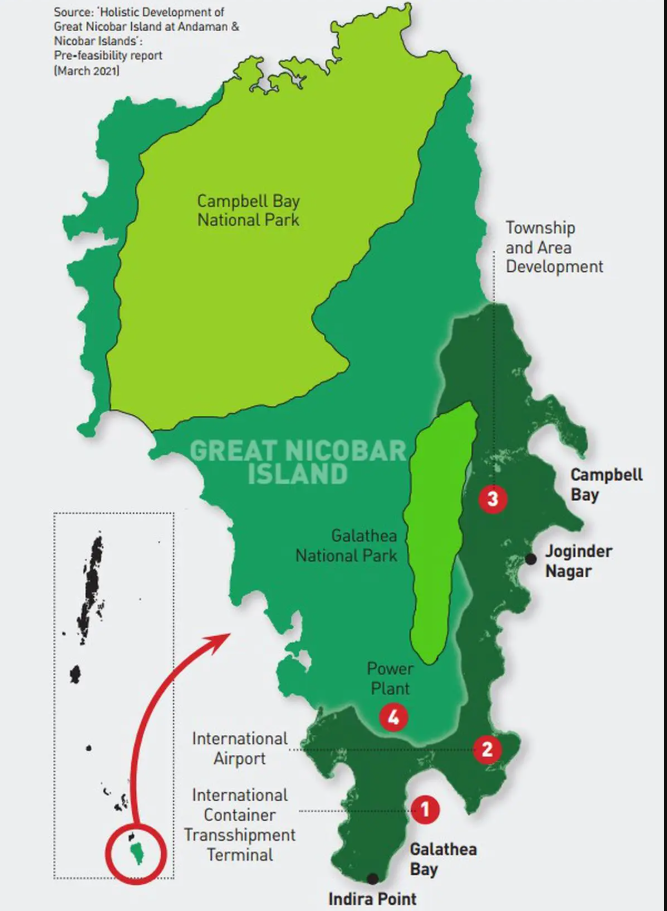
Background
-
Project Cost: ₹81,000 crore Great Nicobar Island Development & Infrastructure Project.
-
Components:
-
Trans-shipment port
-
International airport
-
Gas/coal-based power plant
-
Township
-
-
Forest Diversion: ~13,000 hectares of forestland.
-
Clearance: Stage I clearance granted with 37 conditions, including Forest Rights Act (FRA), 2006 compliance.
Core Issue
-
Allegations of violation of FRA, 2006 in obtaining consent from tribespeople.
Tribal Affairs Ministry’s Position
-
Argument: Implementation of FRA is State/UT responsibility.
-
Its 2020 No-Objection Certificate (NOC) for the project was based on facts furnished by the A&N Administration.
-
In Feb 2024, Minister Jual Oram had stated that the Ministry would look into the clearances.
Andaman & Nicobar Administration’s Position
-
Claims all FRA procedures followed.
-
Certificate (Aug 2022) claimed all rights identified & settled; consent obtained.
-
Accuses petitioner of disguising a Private Interest Litigation (PIL) as a Public Interest Litigation (PIL).
Tribal Council’s Complaint
-
Argues FRA processes not even initiated in Nicobar Islands.
-
Calls the 2022 certificate a false representation.
Environment Ministry’s Position
-
Yet to receive a compliance report on Stage I conditions, including FRA compliance.
-
Submits that land is a State subject.
-
Asserts Van (Sanrakshan Evam Samvardhan) Rules, 2023 do not override FRA.
Legal/Constitutional Dimensions
-
Forest Rights Act, 2006: Recognition and vesting of forest rights of forest-dwelling communities.
-
Article 246 & 7th Schedule: Land, forests largely State subjects; Union has role in conservation.
-
Van (Sanrakshan Evam Samvardhan) Rules, 2023: Governs diversion of forest land; but FRA primacy remains.
-
Judicial Scrutiny: HC examining if FRA procedures (Gram Sabha consent, rights settlement) were bypassed.
Ecological and Environmental Concerns
-
Biodiversity Loss
-
Island is a UNESCO Man and Biosphere Reserve (2013) and Biosphere Reserve (1989).
-
Home to the Giant Leatherback Turtle, one of the world’s largest marine turtle

-
Galathea Bay is a key nesting site, yet the Wildlife Sanctuary was denotified (2021).
-
Eco-sensitive zones of Galathea & Campbell Bay National Parks reduced to zero, opening pristine forests for construction.
Note: Globally, leatherback status according to IUCN is listed as Vulnerable, but many subpopulations (such as in the Pacific and Southwest Atlantic) are Critically Endangered.
-
-
Faulty Environmental Clearance Process
-
Public hearings rushed during COVID-19 pandemic.
-
~400 objections raised on ecology, tribal rights, and disaster risk were ignored.
-
Contradictions on compensatory afforestation: initially proposed in Madhya Pradesh, later shifted to Haryana — ecologically irrelevant to island’s tropical forests.
-
-
Disaster Vulnerability
-
Great Nicobar lies on a major fault line near the epicenter of the 2004 tsunami.
-
Over 444 earthquakes in last 10 years (Janki Andharia, TISS).
-
Indira Point permanently submerged post-2004 — showing tectonic instability.
-
Large infrastructure may face seismic and tsunami risks.
-
Tribal Rights Concerns
-
Affected Communities
-
Shompen (PVTG, ~200 people) – nomadic hunter-gatherers, highly forest-dependent.
-
Nicobarese (~1,000 people) – horticulturalists and fishers.
-
-
Forest Rights Act, 2006
-
FRA requires Gram Sabha consent before diversion of forest land.
-
Activists argue process not followed; Shompen are legally the authority for protecting their reserve.
-
Violation of FRA, 2006 and SC/ST (Prevention of Atrocities) Act flagged by researchers.
-
-
Institutional Apathy
-
A&N Directorate of Tribal Welfare admitted exemptions would be sought “whenever needed” for execution.
-
MoTA, NITI Aayog, and MHA passed responsibility among each other when RTIs were filed.
-
No consultation with National Commission for Scheduled Tribes, despite constitutional mandate.
-
Strategic vs Ecological Trade-off
-
Government’s Argument:
-
Enhances India’s presence in the Indian Ocean, countering China’s “String of Pearls”.
-
Creates new logistics hub for global trade.
-
Brings employment and infrastructure to remote islands.
-
-
Critics’ Argument:
-
Ecological destruction and displacement outweigh economic gains.
-
“Planned destruction” of fragile ecosystem and tribal culture.
-
Investment of ₹70,000+ crore may itself be in jeopardy due to seismic risk.
-
Instead of “holistic development”, it is a “mega folly” (Sekhsaria).
-