
Gerrymandering
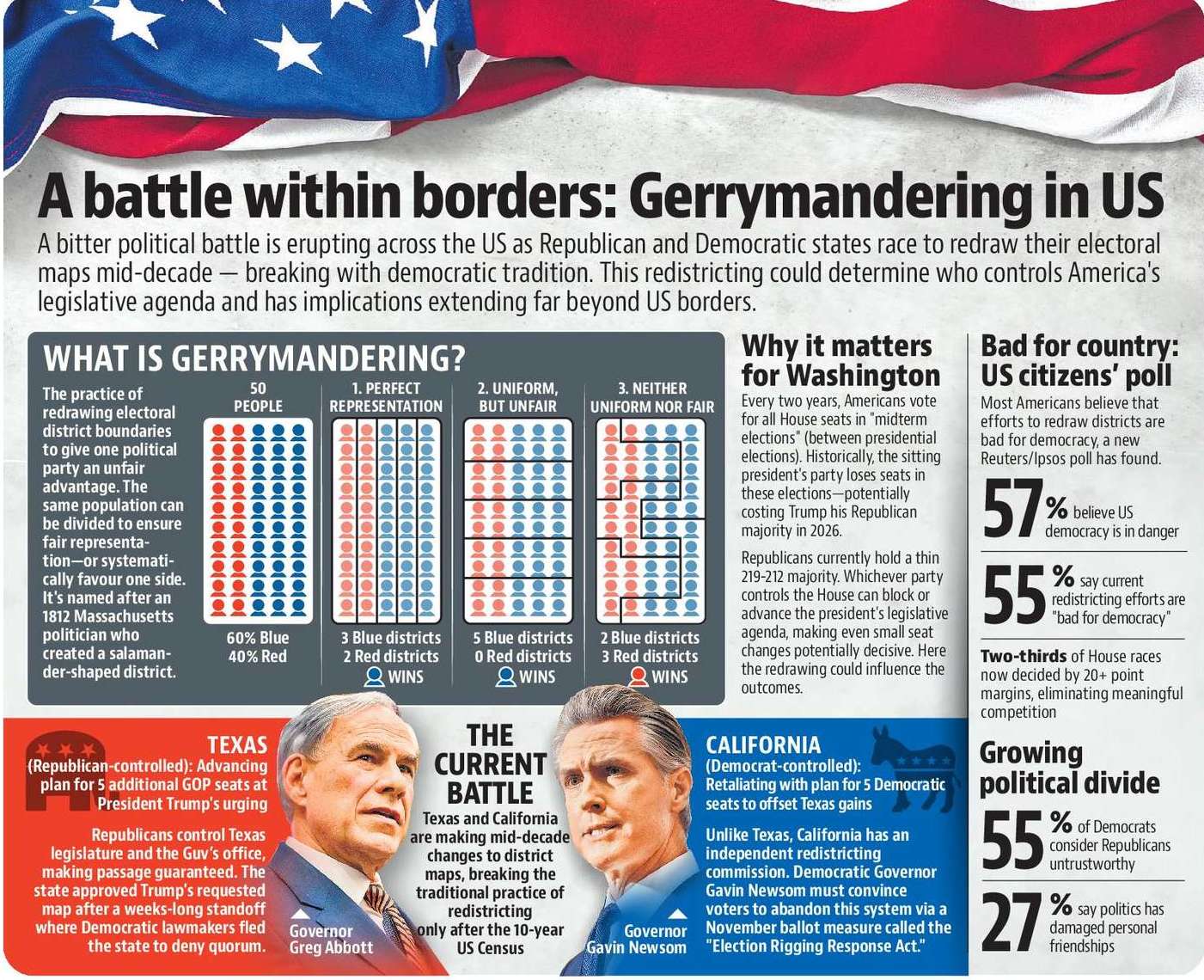
Types of Gerrymandering:
-
Cracking – Diluting the voting power of the opposition’s supporters by spreading them across many districts.
-
Packing – Concentrating opposition voters into a few districts to reduce their influence elsewhere.
-
Hijacking – Redrawing boundaries to force two opposition leaders into the same constituency.
-
Kidnapping – Moving a strong opposition leader’s home base into a district where they have less support.
Effects:
-
Distorts democratic representation.
-
Weakens fair competition.
-
Leads to voter disenfranchisement.
-
Skews legislative outcomes in favor of the ruling party.
Gerrymandering in India
Context
-
Gerrymandering means deliberate manipulation of constituency boundaries for political advantage.
-
In India, this is largely checked because the Delimitation Commission, an independent body, handles the drawing of constituencies.
-
However, political debates and accusations of gerrymandering still surface, especially regarding timing, reservation of seats, and state reorganization.
Legal and Institutional Safeguards
-
Delimitation Commission: Constituted under Delimitation Acts (1952, 1962, 1972, 2002).
-
Members include a retired Supreme Court judge, Chief Election Commissioner, and State Election Commissioners.
-
Its orders have the force of law and cannot be challenged in court.
-
-
This independence prevents direct political gerrymandering.
Instances and Allegations in India
While India has safeguards, some accusations of indirect gerrymandering exist:
-
Reservation of Constituencies
-
Delimitation decides which constituencies are reserved for SC/ST candidates.
-
Allegations that politically strategic seats are picked for reservation to weaken opponents.
-
-
Timing of Delimitation
-
Delimitation was frozen between 1976–2002 (during Indira Gandhi’s government, citing population control measures).
-
Extended again until 2026, meaning seat allocation across states is still based on the 1971 Census.
-
Southern states argue this benefits northern states (with higher population growth), amounting to a structural imbalance.
-
-
State Reorganizations
-
Redrawing of state boundaries (e.g., creation of Telangana, Jharkhand, Uttarakhand, Chhattisgarh) often sparks charges of political motivations in constituency demarcation.
-
-
Kashmir Delimitation (2022)
-
Increase of Assembly seats from 83 to 90.
-
Accusations that the redrawing disproportionately benefitted Jammu region at the expense of Kashmir Valley, favoring BJP prospects.
-
Consequences in Indian Democracy
-
Though not as rampant as in the US, structural distortions remain.
-
Debate over population-based representation vs equitable federalism is intensifying ahead of the 2026 delimitation exercise.
-
Could shift political weight further to the Hindi heartland, marginalizing southern states.
Conclusion
-
Direct gerrymandering is institutionally checked in India.
-
However, indirect political manipulation through reservation choices, delimitation freezes, and timing still has democratic consequences.
-
The 2026 Delimitation will be a critical test of India’s ability to balance fair representation with federal equity.