
FPI outflows at five-month high
Key data and trends
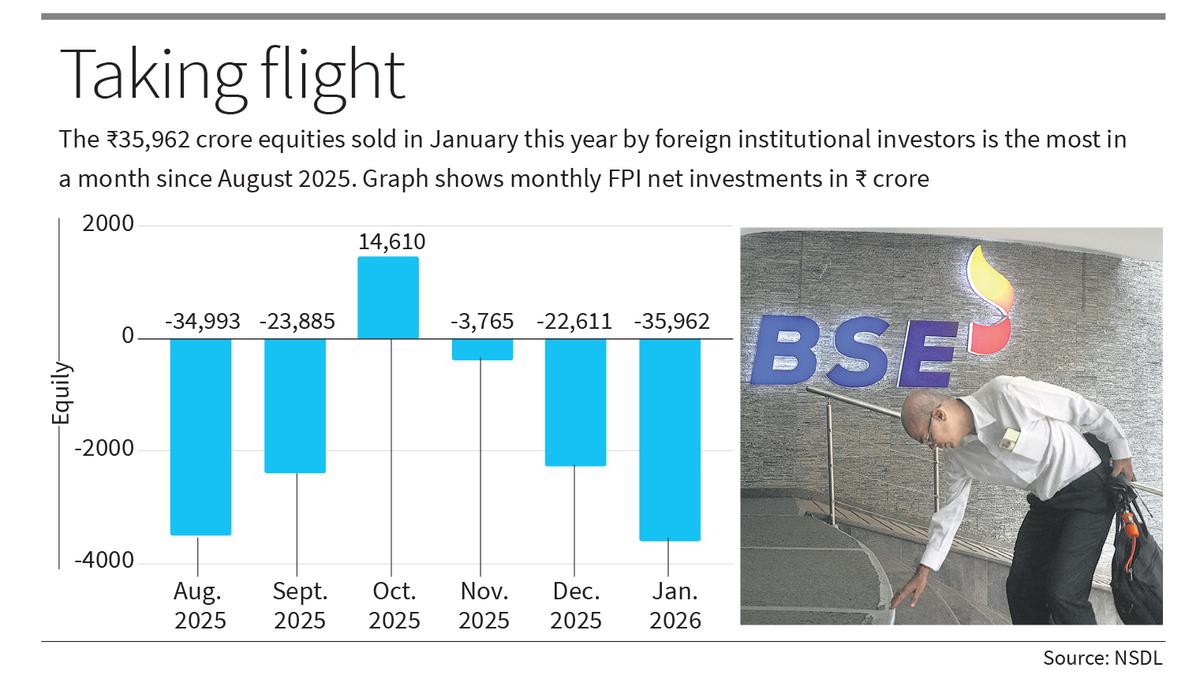
Foreign institutional investors net sold ₹35,962 crore worth of Indian equities in January, the highest since August.
This selling is based on data from National Securities and Depository Ltd.
The trend of foreign selling has continued from the previous year.
In calendar year 2025, FIIs sold ₹1,66,286 crore in Indian equities.
Divergence between equity and mutual fund flows
While FIIs sold equities directly, they were net buyers through the mutual fund route.
Over the last four months, FIIs net bought ₹312 crore via mutual funds.
Equity selling coinciding with mutual fund buying reflects a sense of caution on India rather than a complete exit.
Global emerging market context
There is a meaningful flow into global emerging market funds.
India has benefited from these broader emerging market flows, improving headline flow numbers.
Despite this, selling by India-focused funds continues.
FPI outflows: Key reasons
1. Weak corporate earnings
Slower earnings growth reduces return expectations for foreign investors.
Marginal earnings beats are insufficient to offset broader concerns on profitability.
Uncertainty about future earnings keeps foreign portfolio investors cautious.
2. Rupee depreciation
Depreciation erodes returns for foreign investors when converted into home currency.
Raises concerns over currency risk even when equity valuations appear attractive.
Encourages investors to reduce exposure or delay fresh inflows.
3. Global portfolio rebalancing
Meaningful flows into global emerging market funds lead to selective allocation.
India-focused funds continue to see withdrawals despite broader emerging market inflows.
Investors shift funds towards markets offering better risk-adjusted returns.
4. Risk aversion and volatility
Volatile global financial conditions increase preference for safer assets.
Equity market volatility leads to short-term profit booking by FPIs.
FPIs adopt a tactical rather than long-term allocation approach.
Impact of FPI outflows
1. Equity market volatility
Large-scale selling exerts downward pressure on stock prices.
Increases intraday and short-term market fluctuations.
Affects investor sentiment, especially in large-cap stocks.
2. Pressure on the rupee
Outflows reduce foreign exchange inflows.
Adds depreciation pressure on the rupee.
May necessitate intervention by the Reserve Bank of India to manage volatility.
3. Capital market liquidity
Reduced participation of FPIs lowers market liquidity.
Can widen bid-ask spreads and reduce depth in equity markets.
Domestic institutional investors often absorb part of the selling pressure.
4. Impact on investment and growth sentiment
Persistent outflows signal caution about growth prospects.
Can dampen confidence of global investors and corporates.
May delay capital raising plans through equity markets.
5. Policy and macroeconomic implications
Sustained volatility in flows complicates monetary and exchange rate management.
Reinforces the need for strong macroeconomic fundamentals and earnings growth.
Highlights the importance of stable currency and predictable policy environment.
National Securities Depository Limited (NSDL)
Basic profile
National Securities Depository Limited is an Indian central securities depository.
Headquarters: Mumbai, Maharashtra.
Established in 1996.
It was the first electronic securities depository in India with national coverage.
Operates under the jurisdiction of the Ministry of Finance, Government of India.
Listed on BSE in August 2025.
Legal and institutional background
The enactment of the Depositories Act, December 1995 paved the way for the establishment of NSDL.
Created to enable dematerialisation and electronic settlement of securities.
Core functions and services
Provides depository services to:
Investors
Stock brokers
Custodians
Issuer companies
Key services include:
Dematerialisation of securities
Transfer of securities
Settlement of securities
Operates through a network of Depository Participants and digital platforms.
Scale and significance
NSDL holds assets worth about ₹398 lakh crore in demat accounts as of end-2023.
It contributes to the majority of settlements in Indian securities markets.
Accounts for more than 89 percent of the total value of assets held in demat form in India.
Has over 2.80 crore demat accounts.
Ownership structure
Major shareholders include:
IDBI Bank
National Stock Exchange
HDFC Bank
SUUTI
Ownership reflects a mix of banking and market infrastructure institutions.
IPO details
NSDL IPO launched in July 2025.
Structure: Offer for sale by existing shareholders.
Issue size: ₹4,012 crore.
Shares listed on BSE on 6 August 2025.
Group structure
NSDL Group includes:
National Securities Depository Limited
NSDL Database Management Limited
NSDL Payments Bank Limited
NDML and NSDL Payments Bank are subsidiaries of NSDL.
Importance for Indian financial markets
Enables paperless securities holding, reducing fraud and settlement risks.
Improves efficiency, transparency, and speed of capital market transactions.
Plays a critical role in tracking foreign portfolio investment flows, including FPI inflows and outflows.
Acts as a backbone institution for India’s market infrastructure.
Prelims Practice MCQs
Q. The divergence between FII equity selling and mutual fund buying primarily signifies which of the following sentiments?
A. Strong bullish outlook on Indian equities
B. Complete withdrawal from Indian markets
C. Tactical allocation due to caution on India
D. Shift from equity to debt instruments
Correct answer: C
Explanation:
The article notes that selling in equities coinciding with buying through mutual funds signifies a sense of caution on India. This indicates selective and tactical exposure rather than a full exit or aggressive bullish stance.