
Flue Gas Desulphurisation (FGD) systems
Why in news : 78% of Thermal Power Plants Exempted from Installing FGD Systems
The Union Environment Ministry has exempted 78% of thermal power plant (TPP) units in India from mandatorily installing Flue Gas Desulphurisation (FGD) systems, which are used to reduce sulphur dioxide (SO₂) emissions — a key contributor to air pollution and secondary particulate matter (PM2.5).
India has about 600 thermal power plant units. Under the new categorisation policy:
-
Category A (11%): Plants within 10 km of National Capital Region (NCR) or cities with over 1 million people (Census 2011) must install FGDs by December 30, 2027.
-
Category B (11%): Plants within 10 km of Critically Polluted Areas (CPA) or Non-Attainment Cities (NAC) (131 such cities) may install FGDs based on expert committee advice; deadline: December 30, 2028.
-
Category C (78%): All other plants are now fully exempted from installing FGDs.
Only about 8% of India's TPPs currently have FGD systems.
Justifications by Government/ committee led by India's Principal Scientific Advisor :
-
SO₂ levels across India are 10–20 µg/m³, below the national limit of 80 µg/m³.
-
Indian coal is naturally low in sulphur.
-
Cities with FGD-equipped plants did not show significantly lower SO₂ levels.
-
Analysis of 5,792 PM samples showed low elemental sulphur content (max 8 µg/m³), considered insignificant for PM removal benefits.
Criticism and Expert Opinions:
-
Environmental experts warn of transboundary pollution, with emissions affecting areas up to 200 km away.
-
Tall chimneys used as a dispersion measure do not eliminate pollution, only relocate it to higher altitudes, where it can form toxic fine particles.
-
CEEW and Centre for Research on Energy and Clean Air (CREA) argue the exemption ignores the real role of TPPs in PM2.5 formation and risks millions of lives by increasing exposure to lung and heart disease risks.
Flue Gas Desulphurisation (FGD)
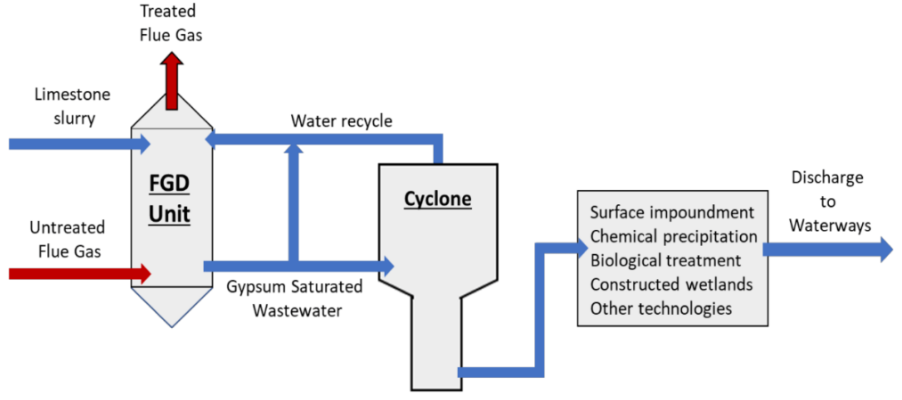
FGD is a technology used to remove sulphur dioxide (SO₂) from the exhaust (flue) gases emitted by coal-fired power plants, industrial boilers, and other combustion sources.
Working
When coal is burned, it releases sulphur dioxide (SO₂), which is harmful to human health and contributes to acid rain.
FGD systems scrub these gases, typically using a slurry of limestone (calcium carbonate) or lime (calcium oxide).
The SO₂ reacts with the slurry to form gypsum (calcium sulphate), a by-product that can be used in construction.
- Most Indian coal, particularly that from the Gondwana coalfields, has a low sulfur content, generally less than 0.5%.
- Some tertiary coals, especially in Assam, may have higher sulfur concentrations.
- Indian coal is characterized by a high ash content, ranging from 10% to 50%. This is due to the drift origin of the coal deposits in India.