
First Commercial Coal Mine in Arunachal Pradesh — Namchik–Namphuk Block
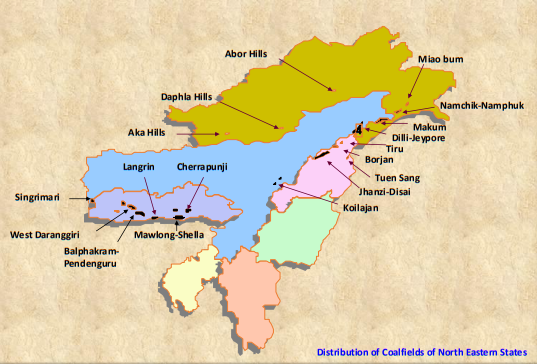
Context
Arunachal Pradesh is set to begin its first commercial coal mining operations at the Namchik–Namphuk coal block in Changlang district.
The mine was initially allocated in 2003 but remained non-functional due to legal, environmental, and policy hurdles.
It was revived through a transparent auction process in 2022, symbolising the entry of the private sector in Arunachal’s mining landscape.
The initiative reflects the Prime Minister’s EAST vision – Empower, Act, Strengthen, Transform – for Northeast India.
Project
Coal Reserves: 1.5 crore tonnes
Operator: Central Public Private Limited (CPPL)
Expected Annual Revenue: ₹100 crore for Arunachal Pradesh
Employment: Substantial job creation for local youth
Ceremonial Events: Bhoomi Poojan, lease handover, equipment flag-off, and a 100-tree plantation initiative.
Economic and Strategic Significance
Integrates Arunachal Pradesh into India’s coal economy, the world’s second-largest coal producer, with record 1 billion tonnes output in 2024–25.
Promotes Atmanirbhar Bharat by utilising local resources for local development.
Ends decades of illegal mining and resource leakages, ensuring transparency, accountability, and formalisation.
Expected to trigger ancillary growth in logistics, local trade, and skill development.
Mineral Development in Northeast
Alongside coal, critical mineral blocks (2 in Arunachal, 5 in Assam) have been put up for auction.
These include strategic minerals essential for electronics, EVs, defence and green technologies, supporting India’s technology and national security needs.
Ecological and Social Commitments
The Government emphasised a “No-Compromise with Ecology” policy.
Mission Green Coal Regions:
57,000 hectares already reclaimed.
16,000 hectares more to be reclaimed by 2030.
Promotes sustainable, community-centric mining through Jan Bhagidaari.
Focus on environmental restoration, afforestation, and water conservation.
Coal in North-East India (Tertiary Coalfields)
Overview
The North-Eastern region of India contains Tertiary coal deposits (15–60 million years old), differing markedly from the Gondwana coal of Peninsular India.
These coals are found mainly in Assam, Meghalaya, Nagaland, Arunachal Pradesh, and Sikkim.
Their marine depositional environment gives them high organic sulphur and volatile matter, along with relatively low ash content.
Geological and Environmental Characteristics
Feature | Description |
Age | Tertiary (Eocene–Oligocene period) |
Depositional Environment | Marine or deltaic – rich in sulphur compounds |
Quality | High volatile matter, low ash, high organic sulphur |
Type of Coal | Sub-bituminous to bituminous; mostly non-coking |
Challenges | High sulphur limits use in metallurgy; causes SO₂ emissions during combustion |
State-wise Distribution
1. Assam
Major Coalfields: Makum, Nazira, Mikir Hills, Dilli–Jeypore.
Location: Mainly in Tinsukia and Sivasagar districts.
Makum Coalfield (near Margherita): Largest and most developed; produces sub-bituminous coal with high sulphur.
Used for thermal generation and gasification rather than coking.
2. Meghalaya
Coal Belts: Garo Hills, Khasi Hills, Jaintia Hills.
Characteristics: Small, scattered seams of good heating value; high moisture and sulphur.
Issues: Unscientific rat-hole mining (banned by NGT due to safety and pollution concerns).
3. Nagaland
Contains Tertiary coal with exceptionally high organic sulphur content.
Found in Kohima, Mokokchung, and Mon districts.
Suitable for local power generation, not metallurgical use.
4. Arunachal Pradesh
Namchik–Namphuk Coal Block: Located in Changlang district; continuation of the Upper Assam coal belt.
Notable as the first commercial coal mine of Arunachal Pradesh (operations resumed recently).
Coal has high volatiles and sulphur, typical of marine influence.
5. Sikkim
Rangit Valley Coalfield: Contains modest but notable reserves.
Coal is of low ash and high volatile matter, suitable for limited local consumption.
Key Coalfields and Features
Coalfield / Block | State | Notable Features |
Makum | Assam | High volatile, low ash, high sulphur; near Margherita |
Dilli–Jeypore | Assam | Sub-bituminous type; moderate heating value |
Garo–Khasi–Jaintia Hills | Meghalaya | Numerous small deposits; unscientific mining concerns |
Namchik–Namphuk | Arunachal Pradesh | First commercial mine in NE India; high sulphur |
Rangit Valley | Sikkim | Smaller field; low ash, high volatile coal |
Nagaland Belt | Nagaland | High organic sulphur; limited industrial use |
Distinctive Features of North-East Coal
Characteristic | Description / Cause |
Tertiary Origin | Formed in Eocene–Oligocene epoch; unlike Gondwana (Permian age) |
Marine Influence | Deposited under shallow marine conditions → high sulphur content |
High Volatile Matter | Indicates younger, less compacted formation |
Low Ash Content | Cleaner combustion, but offset by sulphur emissions |
Environmental Issue | Burning releases SO₂ and particulates, causing acid rain risk |
Economic Limitation | Not ideal for steel industry; better for local power generation and gasification |