
First altermagnet
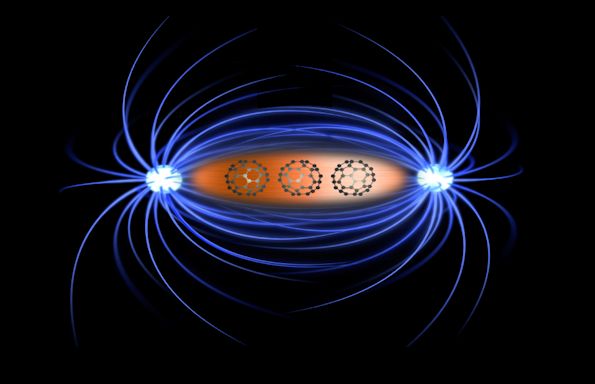
Context : Researchers from S.N. Bose National Centre and the Indian Association for the Cultivation of Science have discovered that chromium-antimony (CrSb), a stable and easily synthesizable magnetic compound, exhibits direction-dependent conduction polarity (DDCP). This means it conducts electrons along one direction and holes along another, allowing it to act as both n-type and p-type material in devices.
This marks CrSb as the first-known altermagnet—a newly identified magnetic class—showing DDCP. Altermagnets have no overall magnetism due to cancelling spins but show spin-dependent charge behaviour, making them promising for spintronics and thermoelectric devices.
Additionally, 2% vanadium doping turned CrSb uniformly p-type, aligning with theoretical predictions. This dual-polarity and tunability of CrSb opens avenues for compact, multifunctional electronics using a single crystal.
What are n-type and p-type materials?
-
n-type materials conduct electricity using electrons (which are negative).
-
p-type materials conduct using “holes” (which act like positive charges).
Direction-Dependent Conduction Polarity (DDCP)
-
Definition: A material property where charge carriers (electrons or holes) dominate in one direction but not in others.
-
Normal Materials:
-
Conduct electricity using either:
-
Electrons (n-type)
-
Holes (p-type)
-
-
This property is usually uniform in all directions.
-
-
DDCP Materials:
-
Electron-dominant in one direction (e.g., along the plane)
-
Hole-dominant in another direction (e.g., vertical axis)
-
Acts as both n-type and p-type in the same crystal depending on the direction.
-
Significance of DDCP Materials
-
Can function as both halves of a p-n junction in electronic or thermoelectric devices without needing two different materials.
-
Useful in miniaturized and multifunctional electronics.
Discovery & Material Used
Chromium-Antimony (CrSb)
-
Nature: A magnetic compound made from common and inexpensive elements.
-
Discovery: By researchers from:
-
S.N. Bose National Centre for Basic Sciences
-
Indian Association for the Cultivation of Science
-
-
Crystal Growth: Single crystals of CrSb were synthesized using chemical vapor transport in sealed quartz tubes.
Testing Techniques
(a) Hall Effect
-
Used to detect the dominant charge carrier in a material.
-
When a magnetic field is applied, it bends the path of charge carriers.
-
Helps identify if electrons (negative) or holes (positive) are carrying the current.
(b) Seebeck Effect
-
Occurs when there is a temperature gradient across a material, causing a voltage to appear.
-
Sign of the voltage indicates whether electrons or holes are the majority carriers.
-
CrSb showed:
-
Electrons dominate along the plane
-
Holes dominate along the vertical axis
-
Altermagnets:
What is an Altermagnet?
-
A recently discovered magnetic state.
-
Atomic spins are arranged in such a way that they cancel out each other (net magnetic moment is zero).
-
Despite no overall magnetism, electrons with different spins behave differently due to crystal structure.
-
Key for spintronics: a field that uses electron spin (not just charge) to store and process data.
CrSb: First Altermagnet with DDCP
-
First material discovered that is both an altermagnet and exhibits DDCP.
-
Easily synthesizable and stable, unlike previous DDCP materials.
Implications & Future Applications
-
Electronics & Thermoelectrics:
-
A single CrSb crystal could replace traditional p-n junctions.
-
-
Spintronic Devices:
-
Use spin behavior for faster and more efficient memory and logic devices.
-
Tuning the Material:
-
Replacing 2% of Cr with Vanadium (V):
-
Turned the whole crystal into p-type.
-
Matched with theoretical predictions.
-
Shows that the material's properties are tunable.
-