
Expert panel norms for religious sites in wildlife sanctuaries
Context
An apex expert body under the Ministry of Environment, Forest and Climate Change (MoEFCC) has framed guidelines on diversion of forest land inside wildlife sanctuaries and national parks for religious structures.
Triggered by a first-of-its-kind proposal involving religious land use inside a protected area.
Guidelines are notified at the expert level and are still under consideration by State governments.
Institutional framework
The decision-making body is the Standing Committee of the National Board for Wildlife (SCNBWL).
SCNBWL functions under the Ministry of Environment, Forest and Climate Change.
Chaired by the Union Environment Minister (Bhupendra Yadav).
Case that led to formulation of guidelines
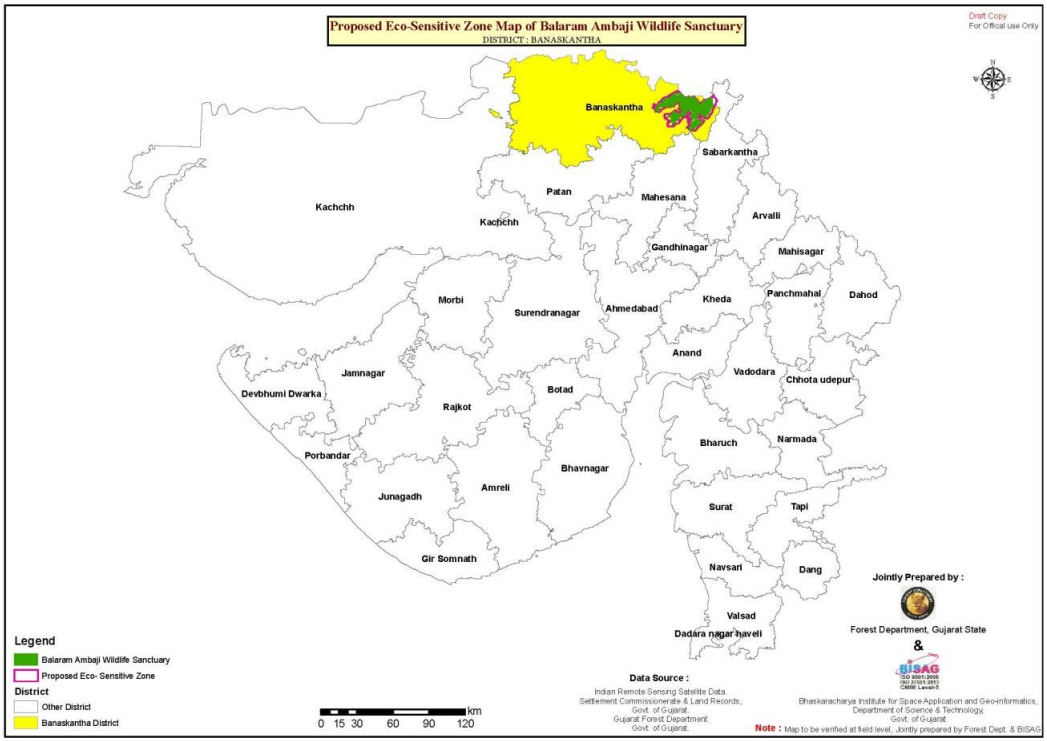
In early 2024, a proposal sought diversion of forest land inside the Balaram Ambaji Wildlife Sanctuary, Gujarat.
The State government cited the presence of two historical temples (Balaram and Ambaji) within the sanctuary.
In July 2024:
SCNBWL cleared use of 0.35 hectares of forest land.
Clearance was based on State approval and the claim that the establishment predated forest rights settlement.
In October 2024:
Clearance was revoked after objections.
Concern raised that rights of the religious trust were not recorded in forest settlement reports or government records.
Warning issued about the precedent effect for other protected areas.
Balaram Ambaji Wildlife Sanctuary is located at Banaskantha, Gujarat, India. It covers 542 km2, and falls in the catchment area of Banas and Sabarmati rivers,and is a part of the Khathiar-Gir dry deciduous forests' ecoregion. The sanctuary borders Rajasthan and close to mount abu. | ||
Core issue highlighted
Many sanctuaries across India have unfinished or incomplete settlement of forest rights and claims.
This creates legal ambiguity regarding:
Religious structures
Traditional sacred sites
Community usage inside protected areas.
Key principles of the new guidelines
General rule:
Any construction or expansion on forest land after 1980 is to be treated as encroachment.
Rationale:
1980 marks the enforcement of the Forest (Conservation) Act, 1980.
Exceptional cases:
If a State government issues a reasoned, documented order justifying regularisation,
Such cases may be referred to the Union Ministry for case-by-case consideration.
No blanket regularisation or automatic permission for religious structures.
Proposed procedural response
Suggestion to frame a Standard Operating Procedure (SOP) for applications involving religious institutions.
A dedicated expert panel proposed, including:
Dr. H. S. Singh
Dr. R. Sukumar
Objective: ensure consistency, legal clarity, and ecological safeguards.
Prelims Practice MCQs
Q. With reference to the Standing Committee of the National Board for Wildlife (SCNBWL), consider the following statements:
It is a statutory body under the Ministry of Environment, Forest and Climate Change.
It grants approvals for diversion of forest land inside wildlife sanctuaries and national parks.
It is chaired by the Prime Minister of India.
Which of the statements given above are correct?
(a) 1 and 2 only
(b) 2 and 3 only
(c) 1 and 3 only
(d) 1, 2 and 3
Correct answer: (a)
Explanation:
Statements 1 and 2 are correct: The Standing Committee of the National Board for Wildlife functions under the Ministry of Environment, Forest and Climate Change and examines proposals for diversion of land inside protected areas.
Statement 3 is incorrect: The SCNBWL is chaired by the Union Environment Minister, not the Prime Minister.