
Eight States with international borders, 0.13% of exports
Context:
India’s export economy is highly concentrated in a few western and southern States, leaving the Northeast and Hindi-belt States marginalised. U.S. tariffs exposed this weakness, showing how trade disruptions affect neglected regions like Assam (tea, oil) more severely.
Key Points
Export Concentration
70% of India’s exports come from 4 States: Gujarat, Maharashtra, Tamil Nadu, Karnataka.
Gujarat alone contributes 33%.
Uttar Pradesh, Bihar, Madhya Pradesh: only ~5% combined.
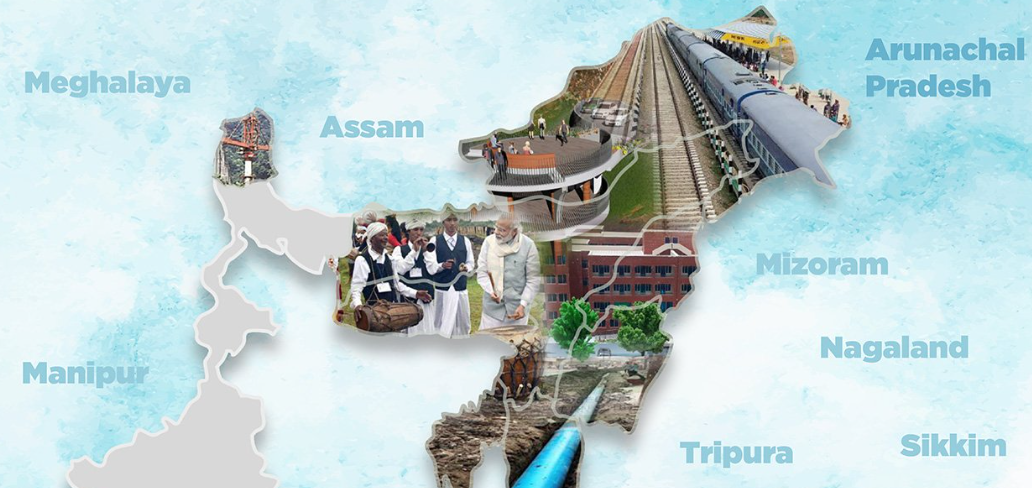
Northeast (8 States, 5,400 km international borders): just 0.13% of exports.
Marginalisation of the Northeast
No proper trade corridors or logistics infrastructure.
Institutions like PM’s Economic Advisory Council and Board of Trade have no NE representation.
Export-linked schemes like RoDTEP, PLI largely bypass the region.
Strategic export plans often omit NE altogether.
Sectoral Stress
Tea (Assam & Dooars): Over half of India’s tea comes from the region, but remains low-value bulk CTC exports, lacking branding and packaging.
US tariffs and stagnant EU demand threaten viability.
Labour shortages, low wages, and falling margins already hurt estates.
Oil & Refinery (Numaligarh, Assam): Expanding to 9 MTPA, increasingly reliant on Russian crude imports.
Vulnerable to US sanctions and shipping restrictions.
Border Trade Issues
India–Myanmar trade collapsing after 2021 coup.
Gateways (Zokhawthar in Mizoram, Moreh in Manipur) reduced to securitised outposts, not trade hubs.
Free Movement Regime scrapped (2024) → loss of local cross-border economies.
Surveillance replaces commerce; infrastructure is missing.
Strategic Concerns
China strengthening control in northern Myanmar with infrastructure, militias, and intelligence networks.
India’s Act East Policy corridors remain unfinished or non-functional (e.g., IMT Highway).
NE stays a security zone, not a trade zone.
Structural Weakness
India’s export architecture is over-dependent on a few enclaves.
A flood in Gujarat or strike in Tamil Nadu can cripple national exports.
NE remains excluded “by design, not oversight.”
True resilience requires dispersion of trade hubs across geography.
There are 17 Indian states that share a border with an international country. These states are located across India's northern and eastern borders and share land borders with neighbors like Pakistan, China, Nepal, Bhutan, Bangladesh, and Myanmar.
Pakistan: Gujarat, Rajasthan, Punjab
China: Himachal Pradesh, Uttarakhand, Sikkim, Arunachal Pradesh
Nepal: Uttarakhand, Uttar Pradesh, Bihar, West Bengal, Sikkim
Bhutan: Sikkim, West Bengal, Assam, Arunachal Pradesh
Bangladesh: West Bengal, Assam, Meghalaya, Tripura, Mizoram
Myanmar: Arunachal Pradesh, Nagaland, Manipur, Mizoram
Sikkim, Arunachal Pradesh, Ladakh and West Bengal share a border with 3 countries.
Ladakh shares its boundaries with Pakistan, Afghanistan, and China.
Sikkim shares an international boundary with Bhutan in the east, Nepal in the west, and China in the north.
Arunachal shares an international boundary with China in the north, Myanmar in the east, and Bhutan in the west.
West Bengal shares an international boundary with Nepal in the north, Bangladesh in the east, and Bhutan in the northeast.
There is a total of 17 Indian States that are located on the international border.
There is a total of 28 States in India, and it is the seventh-largest country in the world.
India shares land borders with 7 countries: Bangladesh, China, Bhutan, Afghanistan, Nepal, Pakistan, and Myanmar; and sea borders with the Maldives, Sri Lanka, and Indonesia.