
Deep-Sea Exploration off Poompuhar (Kaveripoompattinam) Coast
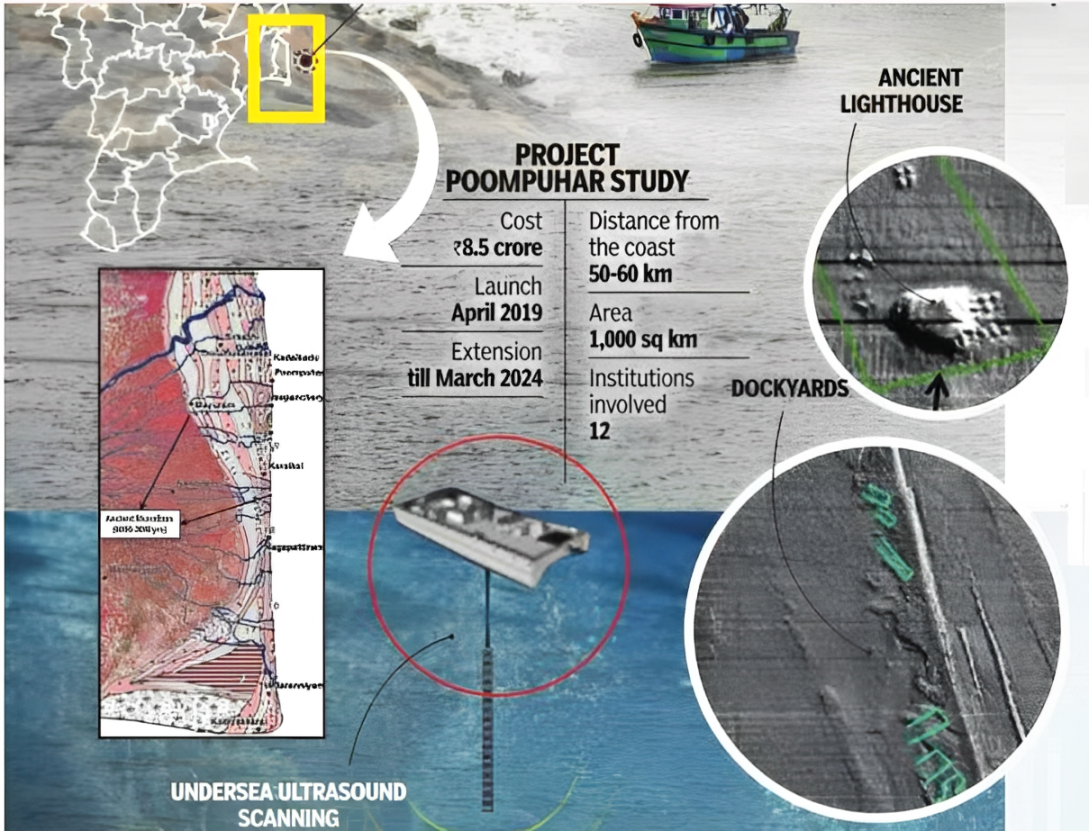
Context
-
Announced in TN Budget 2025–26 by Finance & Archaeology Minister Thangam Thennarasu.
-
Agencies involved:
-
Tamil Nadu State Department of Archaeology
-
Indian Maritime University (IMU) (Estd. 2008 public central university in chennai directly under the Ministry of Ports, Shipping and Waterways )
-
National Institute of Ocean Technology (NIOT) (Estd. 1993 as an autonomous society under the Ministry of Earth Sciences in CHENNAI,India )
-
National Institute of Oceanography (NIO) (Estd.1966 as one of 38 constituent laboratories of the CSIR, is a self-governing research organisation in Goa,India, studies north indian ocean)
-
-
Clearance awaited from Central Advisory Board of Archaeology.
-
Survey scheduled: Second week of September 2025 (after monsoon conditions improve).
Historical Significance of Region
-
Poompuhar (Kaveripoompattinam):
-
Capital of early Cholas.
-
Prominent Sangam-era port city, celebrated in works like Pattinappalai and Silappadikaram.
-
Major hub of Indian Ocean trade.
Sangam Tamil literature infer that the city, located 30 km from the existing Poompuhar town in southern TN, was submerged due to “kadalkol” or rising sea levels.
-
-
Nagapattinam:
-
Flourished during medieval Chola period.
-
Strong maritime links with Southeast Asia (Sri Lanka, Srivijaya, Khmer Empire).
-
Known for Buddhist contacts and overseas trade.