
Decoding Animal Communication
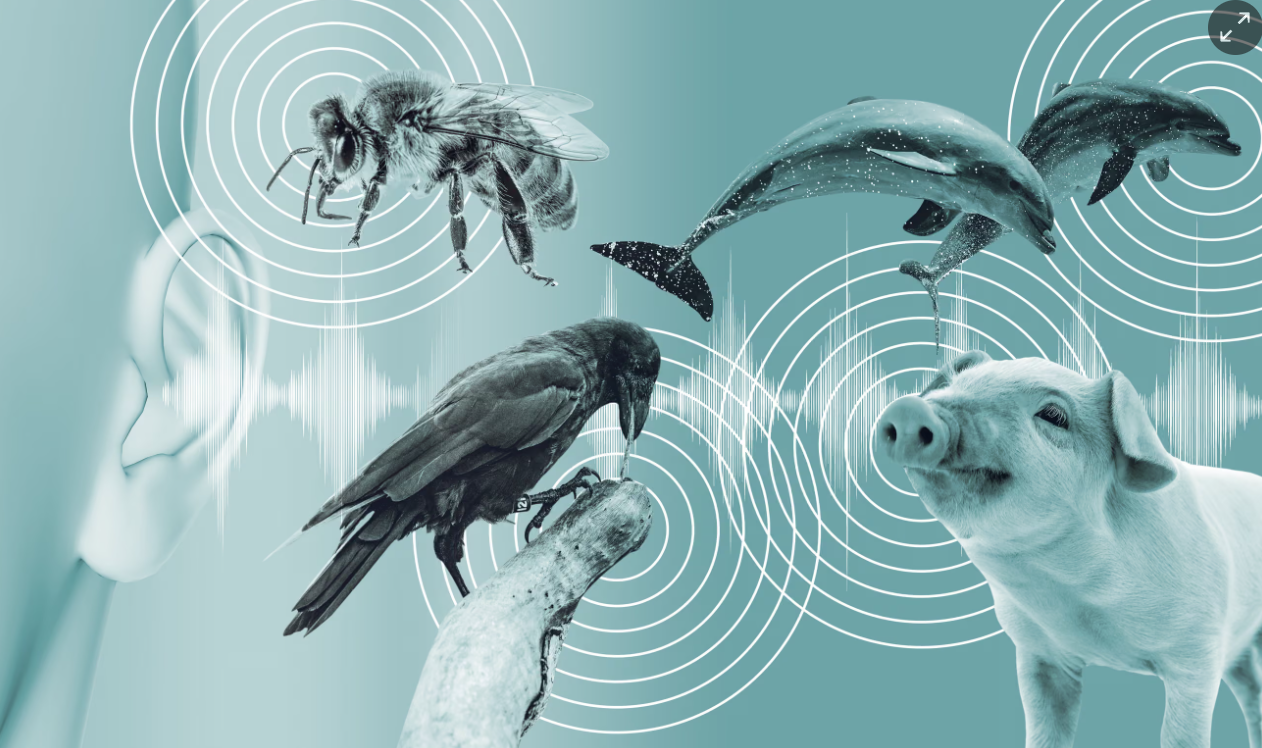
Context
-
Earlier Assumption: Humans believed they were the only “speaking” species; animal sounds were thought to be instinctive background noise.
-
Breakthrough (1900s): Karl von Frisch showed honeybees use a dance language to convey food source locations.
-
1960s: Researchers established that animals’ calls vary by context (warning, mating, summons).
-
1970 milestone: Roger & Katy Payne + Scott McVay released Songs of the Humpback Whale album — made whale communication globally famous.
Recent Discoveries in Animal Communication
a) Whales
- Whale song patterns follow Zipfian distribution (same statistical pattern as human languages).
- Suggests whale songs are structured, meaningful communication, not just reflexive noise.
b) Elephants
- Findings: elephants use unique “names” for specific individuals.
- Playback experiments: elephants responded to their own “names.”
c) Sperm Whales
-
Project CETI : Cetacean Translation Initiative
-
Using AI to decode sperm whale “coda” clicks (like Morse code).
-
Aim: eventually “speak back” in whale language.
-
d) Dolphins
- Identified 2 with specific functions: alarm + query.
- Suggests possible language-like system.
-
DeepMind’s DolphinGemma (May 2025):
-
A large language model trained on dolphin signals to help decode “dolphin-speak.”
Role of Technology
-
AI & Machine Learning: Accelerating breakthroughs (pattern detection, decoding signals).
-
Collaborative Science: Linguists, ecologists, marine biologists working together.
Challenges & Limits
-
Functional Limits:
-
Most animals signal (food, danger, mate), not abstract reasoning.
-
Communication ≠ human-style language (limited syntax, vocabulary).
-
-
Multi-modal Signals:
-
Animals use sound + visual + chemical + mechanical cues.
-
Humans cannot easily replicate these layered systems.
-
-
“Speaking Back”: Even if decoding succeeds, meaningful two-way dialogue remains unlikely.
Significance
-
Scientific: Expands understanding of animal cognition, social behaviour, and communication systems.
-
Ethical: Deepens appreciation of animal sentience → could influence wildlife protection, conservation, animal rights debates.
-
Technological: AI is becoming a key enabler of bioacoustics research and cross-species communication attempts.