
China and Rare Earth Elements (REEs)
Overview
-
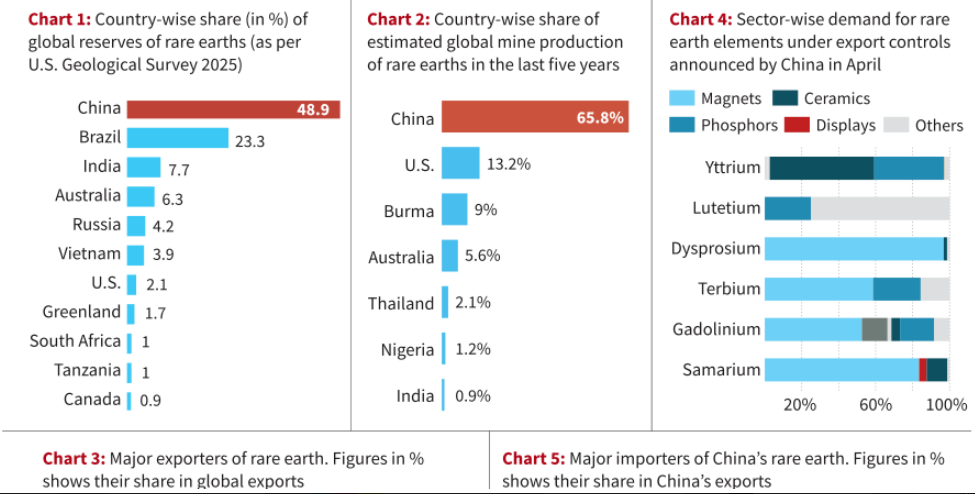
China is the world’s largest producer of rare earths, contributing >60% of global production.
-
Dominates the value chain: ~92% of global refining capacity, largest exporter (~30% of global demand).
-
Rare earths are vital for clean energy, defense, and high-tech industries (EVs, wind turbines, smartphones, hard drives).
-
China holds ~50% of global REE reserves.
Rare Earth Elements (17 metals)
| Type | Examples |
|---|---|
| Light REEs (LREEs) | Lanthanum, Cerium, Praseodymium, Neodymium, Samarium, Europium |
| Heavy REEs (HREEs) | Gadolinium, Terbium, Dysprosium, Holmium, Erbium, Thulium, Ytterbium, Lutetium, Scandium, Yttrium |
| Not included | Promethium (radioactive, not mineable) |
China’s Measures and Controls
-
April 2025: Export restrictions on 7 rare earth elements (including NdFeB magnets).
-
Companies must operate under government-set quotas and obtain approval for trade.
-
Previous measures:
-
Ban on exporting extraction/separation tools and methods
-
Ban on processing technology exports (Dec 2023)
-
Global Dependence

-
U.S.: Second-largest importer; heavily reliant on China.
-
India: >75% of rare earth imports from China since 2021.
-
Other REE-rich countries: Brazil, Australia, India (deposits exist but production/refining limited).
Reasons for China’s Dominance
-
Resource availability: Holds half of global reserves.
-
Refining & production capacity: 92% of global refining.
-
Research strength: ~30% of global REE research publications.
-
U.S. & Japan: ~10% each
-
India: ~6%
-
-
High investment in exploration: ~$14 billion/year since 2022 (highest in past decade).
Strategic Importance
-
Rare earths critical for:
-
Electric vehicles, wind turbines (clean energy)
-
Defense applications (missiles, electronics)
-
High-tech devices (smartphones, computers)
-
-
China’s export controls highlight geopolitical leverage in global supply chains.