
Bumerangue Oil Discovery in Brazil’s Santos Basin
Context
-
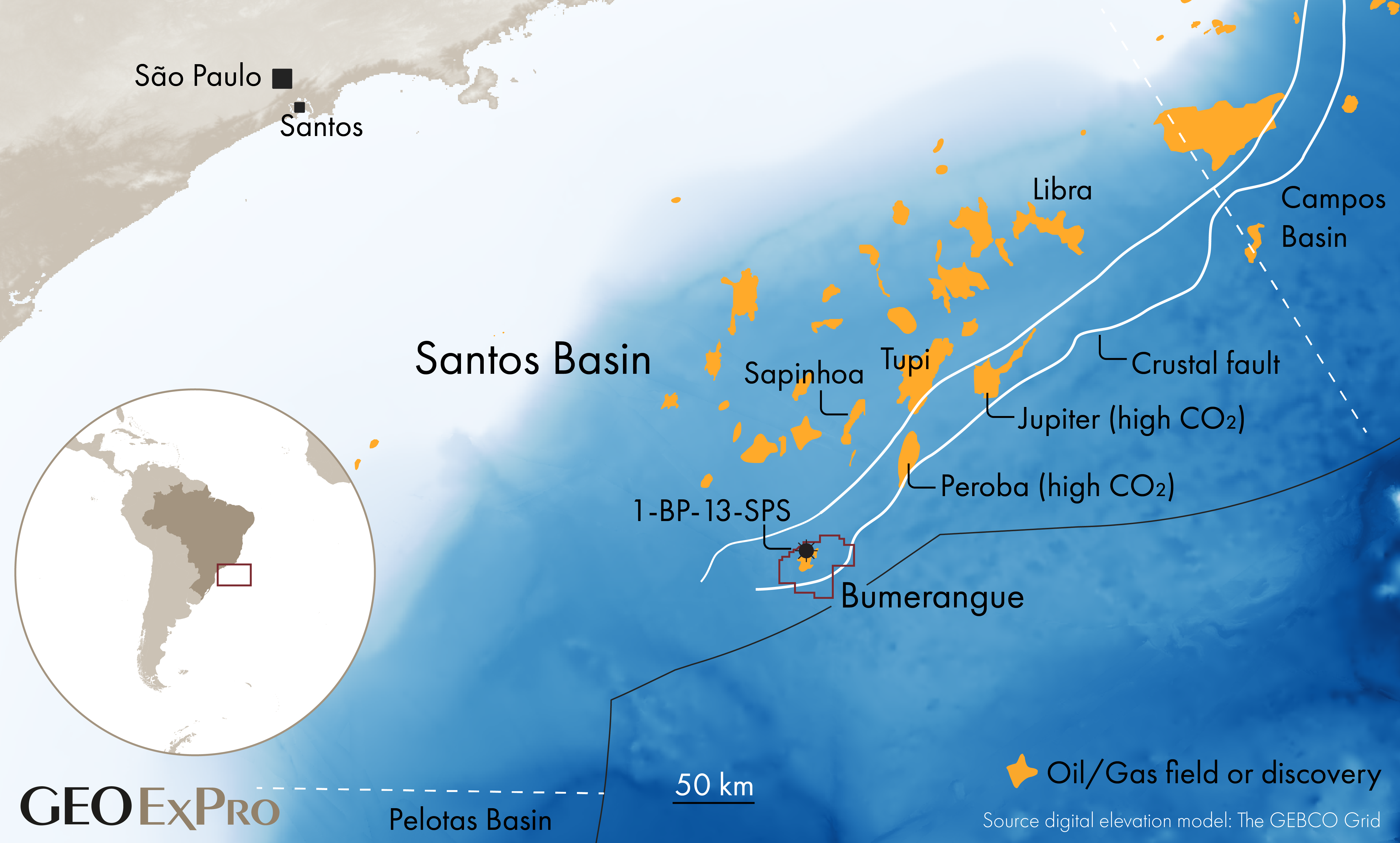
In August 2025, BP announced its biggest discovery in 25 years – the Bumerangue pre-salt oilfield in the Santos Basin, offshore Brazil.
-
Reported features:
-
500m oil column discovered, located 500m below the crest of the structure.
-
Large areal extent (~300 km²).
-
High-quality carbonate reservoir.
-
Geological & Technical Challenges
-
Complex Structural Setting
-
Santos Basin = one of the most geologically complex areas.
-
Formed in a transitional zone between volcanically active Pelotas Basin and less active Espirito Santo Basin.
-
Lower Cretaceous tectonics: rotation of crustal blocks (~90°) led to highly faulted and fragmented subsurface.
-
Faults act as conduits for mantle-derived CO₂ → risk of high CO₂ in associated gas.
-
-
High CO₂ Content Risk
-
Neighbouring fields:
-
Libra: ~40% CO₂ (developed).
-
Jupiter: ~80% CO₂ (undeveloped, prohibitive).
-
Peroba: also high CO₂.
-
-
Brazilian regulations prohibit venting of CO₂; requires costly CCS (Carbon Capture & Storage).
-
Uncertainty whether Bumerangue will have manageable levels (~20–30%) or prohibitive levels (>70%).
-
-
Compartmentalisation
-
The discovery area lies between two major crustal fault zones.
-
Likely field compartmentalisation → would need more production wells → raises CAPEX.
Pre-salt reservoirs :
-
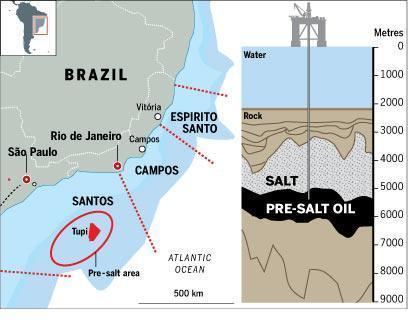
Deep under the ocean floor, there are layers of rock that can trap oil and gas.
-
In some places like Brazil’s offshore basins, a thick layer of salt (sometimes several kilometers thick) lies between the seabed and older rock layers that contain oil and gas.
-
The oil and gas trapped below this salt layer are called pre-salt reservoirs (because they were formed before the salt layer was deposited millions of years ago).
Why they matter:
-
These reservoirs are usually very large and contain high-quality oil.
-
But drilling into them is very expensive and technologically challenging, because companies need to drill through the thick salt, which is tricky since salt can move and distort seismic images.
Economic & Strategic Implications
-
Positive:
-
Adds to BP’s portfolio amid its 10 discoveries in 2025.
-
Potential for large reserves if CO₂ is moderate.
-
BP sole owner of the licence → no revenue-sharing with partners.
-
-
Concerns:
-
Development costs could escalate due to extra wells and CO₂ handling.
-
Uncertainty over commercial viability until appraisal drilling confirms CO₂ levels.
-
Timing of announcement (just before BP’s Q2 results) raises questions on corporate signalling.
-