
Black-hole “morsels” and quantum gravity
Context:
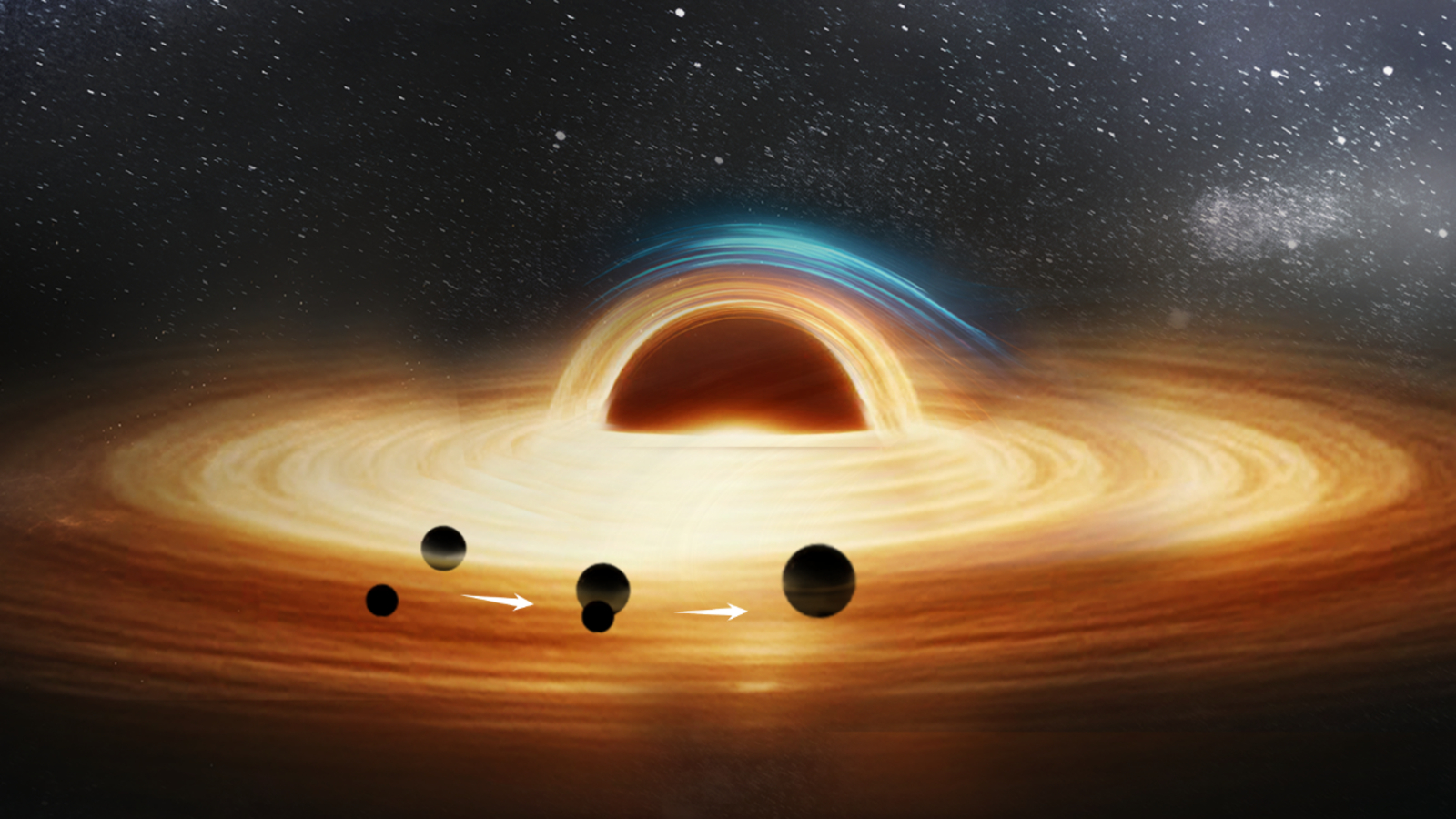
A theoretical proposal suggests that tiny micro-black holes “black-hole morsels” (mass comparable to asteroids) could be pinched off during violent black-hole mergers; they would be hot, evaporate rapidly by Hawking radiation, and produce detectable high-energy bursts (gamma rays, neutrinos), offering a rare observational window into quantum gravity.
Background
General relativity vs quantum mechanics: Gravity is described classically by General Relativity; other forces are successfully quantized. Merging these frameworks (quantum gravity) remains an open problem.
Hawking radiation: Quantum field effects near an event horizon cause black holes to emit thermal radiation. Smaller black holes are hotter and evaporate faster.
Black-hole mergers: When two astrophysical black holes coalesce, gravitational waves are emitted (detected by LIGO–Virgo–KAGRA). The merger creates extreme, dynamical spacetime conditions.
Black-hole morsels: Hypothetical tiny black holes, formed as compact remnants or “pinched off” pockets of spacetime during mergers. Their small mass → high Hawking temperature → strong high-energy emission before evaporation.
Expected observational signature
Delayed high-energy burst: A short (milliseconds → years depending on mass) delayed burst of very high-energy gamma rays and possibly neutrinos following a gravitational-wave-detected merger.
Spectrum and isotropy: Emission would be broadband and higher in energy than typical astrophysical GRBs; predicted to be more isotropic (less beamed) than classical gamma-ray bursts.
Timing correlation: Correlation with a previously observed merger event (gravitational-wave trigger) and a specific delay time that scales with morsel mass.
Distinct ringdown / multimode features: If morsel formation affects merger dynamics, subtle signatures might appear in the gravitational-wave signal’s post-merger behaviour.
Instruments and searches
Gravitational-wave network: LIGO (USA), Virgo (Italy), KAGRA (Japan) — provide triggers and source localization.
High-energy observatories (used for follow-up / searches):
Fermi Gamma-ray Space Telescope (space)
HESS (ground, Namibia)
HAWC (ground, Mexico)
LHAASO (ground, China)
Observational strategy: follow LIGO/Virgo/KAGRA triggers, search for delayed, high-energy gamma bursts temporally and spatially consistent with merger localization.
Theoretical/empirical advances claimed
Theoretical models show morsels would radiate strongly via Hawking radiation, producing observable signatures i`n favourable conditions.
Analysis of existing follow-up data (for some mergers) can place upper limits on masses of morsels that could have been created (first observational constraints).
A clear detection would test quantum aspects of gravity: e.g., spectral deviations from pure Hawking black-body, or other imprints of microscopic spacetime structure.
Scientific significance
Direct probe of quantum gravity: Hawking radiation spectrum carries information about microscopic spacetime behaviour — ordinarily inaccessible experimentally.
Natural “cosmic accelerators”: Provide energies and curvature scales far beyond terrestrial accelerators.
Test of fundamental theorems: Could complement tests of area theorems, no-hair theorems, Kerr solution behaviour, and quantum corrections to classical GR predictions.
Multi-messenger astronomy: Leverages gravitational waves + electromagnetic / neutrino follow-ups for new kinds of observations.
Caveats and open questions
Speculative status: Formation of morsels is a theoretical possibility; not yet observed. Conditions for pinch-off are not established by full numerical relativity simulations.
Model uncertainties: Formation probability, mass distribution, spin, lifetime and emission spectrum depend strongly on unknown high-energy/quantum-gravity physics.
Detection challenges: Backgrounds, localization uncertainty of GW events, and limited sensitivity of current gamma/neutrino instruments reduce detection probability.
Alternative explanations: Any high-energy transient must be carefully distinguished from astrophysical gamma-ray bursts, magnetar flares, or instrumental artifacts.
Terminology
Hawking radiation: quantum emission predicted in 1974–75; smaller black holes → higher temperature.
Morsel mass scale: proposed to be comparable to asteroids (model-dependent); lifetimes from milliseconds to years.
Signature: delayed, isotropic, very-high-energy gamma-ray burst associated with a gravitational-wave merger.
Relevant detectors: LIGO, Virgo, KAGRA (GW); Fermi, HESS, HAWC, LHAASO (gamma rays).
Practice Prelims MCQ
Q. Hawking radiation from a black hole is predicted to be:
A. Purely classical electromagnetic radiation emitted when matter falls in.
B. Thermal radiation arising from quantum effects near the event horizon.
C. Emission of gravitational waves only.
D. Synchrotron radiation from charged particles near the black hole.
Answer: B. Thermal radiation arising from quantum effects near the event horizon.
Explanation: Hawking radiation is a quantum effect; it produces a thermal spectrum.
Q. A proposed “black-hole morsel” would most likely be:
A. A large supermassive black hole formed in galactic centres.
B. A tiny, hot black hole formed as a remnant in extreme merger dynamics that evaporates quickly.
C. A neutron star formed during a merger.
D. A stable micro black hole produced in particle colliders.
Answer: B. A tiny, hot black hole formed as a remnant in extreme merger dynamics that evaporates quickly.