
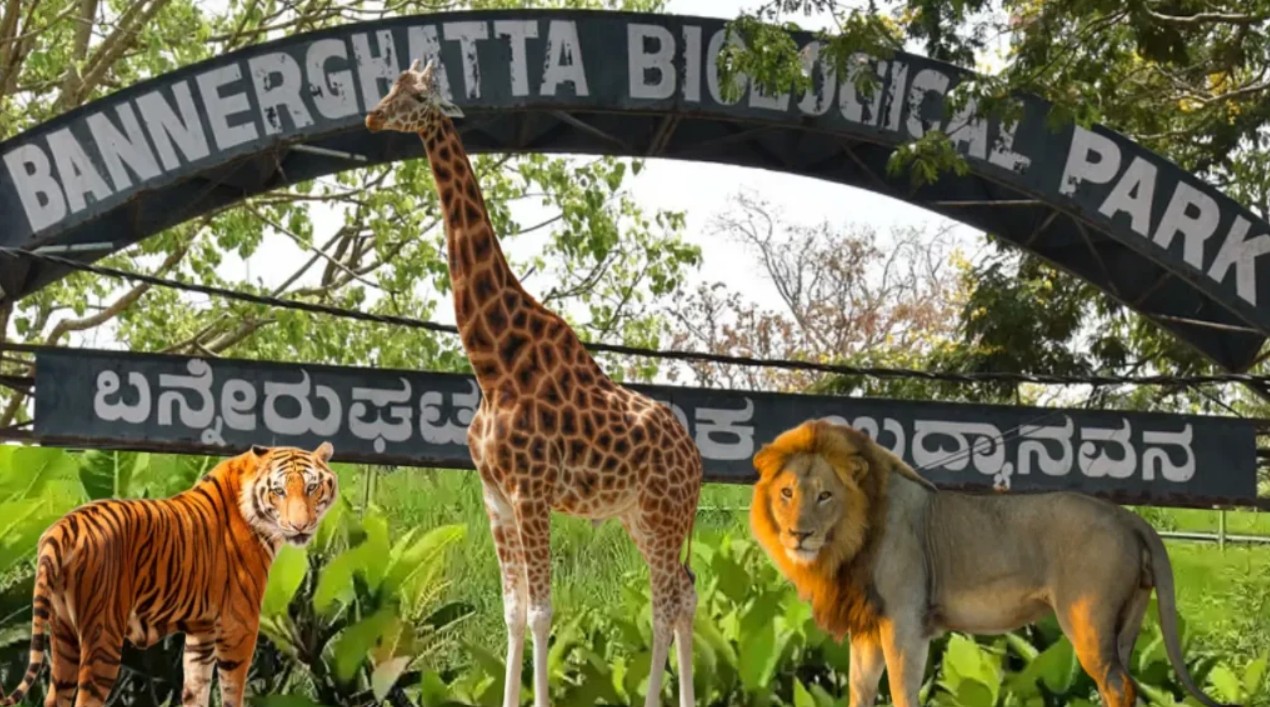
Bannerghatta National Park
Context
Bannerghatta National Park (BNP) lies in Bengaluru South, adjoining an intensely urbanising landscape.
Karnataka:
Highest elephant population in India: 6,013
High human casualties due to elephant conflict (20 deaths in 2025–26).
Despite this, the Eco-Sensitive Zone (ESZ) around BNP has been progressively reduced by successive governments.
Why ESZs matter
Definition
As per Ministry of Environment, Forest and Climate Change and National Environment Policy, 2006:
ESZs are areas with high environmental value requiring special conservation attention.
They function as:
Buffers / shock absorbers for Protected Areas (PAs)
Transition zones from high protection to lower protection
Barriers against anthropogenic pressure
Extent
As per MoEFCC guidelines, ESZs can extend up to 10 km, depending on ecological assessment.
Eco-Sensitive Zones (ESZs) or Ecologically Fragile Areas (EFAs) are declared and notified by the Ministry of Environment, Forest and Climate Change (MoEF&CC) under the Environment (Protection) Act, 1986. These zones are established around Protected Areas, such as National Parks and Wildlife Sanctuaries, to act as a "shock absorber" to minimize the impact of human activities on the environment. | ||
Ecological importance of BNP
Elephant corridors
BNP contains three elephant corridors:
Karadikal–Mahadeshwara
Thally–Bilikal
Bilikal–Jawalagiri
Resident elephants: ~150
Migratory elephants: 200–300
Landscape connectivity
BNP acts as the northern terminal of the Mysore Elephant Reserve.
Provides continuity between:
Cauvery Wildlife Sanctuary (Karnataka)
Krishnagiri and Hosur Forest Divisions (Tamil Nadu)
Nilgiri Biosphere landscape (Western Ghats)
Habitat and ecosystem services
Dry deciduous and scrub forests
Riverine and moist deciduous valleys
Important watershed feeding tributaries of the Cauvery
Keystone species:
Elephant, leopard, wild dog, gaur, sloth bear, sambar, chital, slender loris
Tigers observed since 2015, migrating from Cauvery Wildlife Sanctuary.
Prelims Practice MCQs
Q. Eco-Sensitive Zones (ESZs) are primarily intended to:
A. Promote eco-tourism around national parks
B. Act as shock absorbers and transition zones around protected areas
C. Facilitate urban expansion in peri-forest regions
D. Replace the need for wildlife corridors
Correct answer: B
Explanation:
ESZs buffer protected areas from anthropogenic pressure and provide graded protection.
Q. With reference to Bannerghatta National Park, consider the following statements:
It forms part of the Mysore Elephant Reserve landscape.
It connects elephant movement between Karnataka and Tamil Nadu forests.
It lies entirely within the Western Ghats biodiversity hotspot.
Which of the statements given above are correct?
A. 1 and 2 only
B. 2 and 3 only
C. 1 and 3 only
D. 1, 2 and 3
Correct answer: A
Explanation:
BNP is the northern terminal of Mysore Elephant Reserve.
It connects to Tamil Nadu forests.
It is not entirely within the Western Ghats hotspot.