
Autonomy of Tribal Councils in India
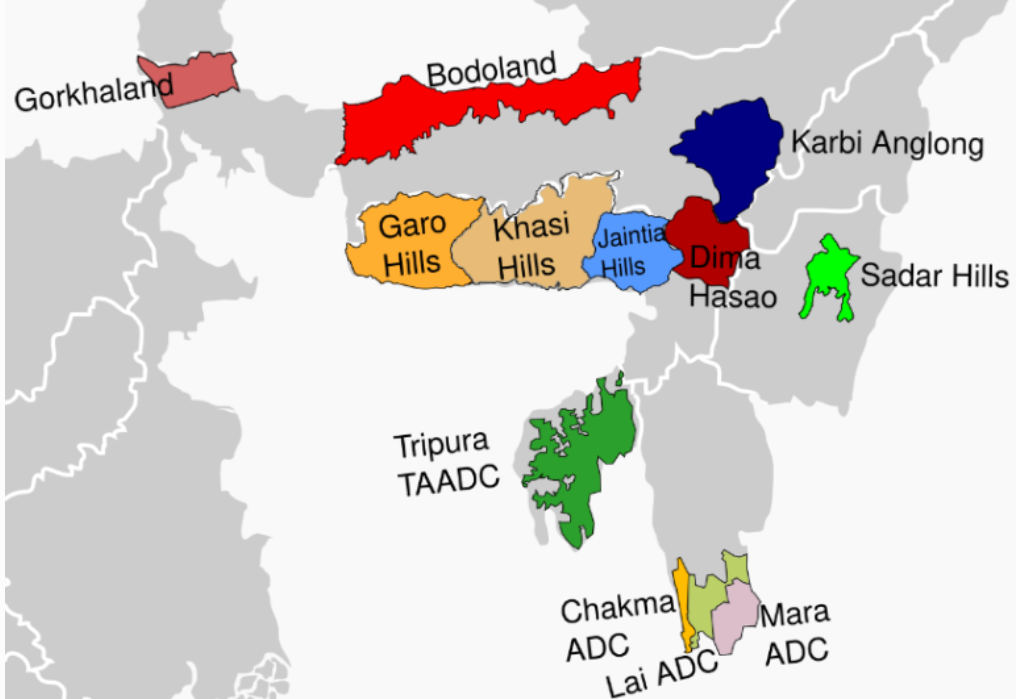
Autonomy of Tribal Councils in India
1. Constitutional and Legal Basis
(a) Sixth Schedule (Articles 244(2) and 275(1))
-
Applicable to: Assam, Meghalaya, Tripura, Mizoram.
-
Provides for Autonomous District Councils (ADCs) with legislative, executive, and judicial powers.
-
Councils can legislate on subjects like:
-
Land
-
Forests (not under Reserved Forests)
-
Customary law
-
Village administration
-
Inheritance of property
-
Marriage and social customs
- The laws passed by ADCs require the assent of the Governor to come into effect.
Governor’s role:
-
The Governor may return a law for reconsideration.
-
However, they cannot modify or annul a law on their own once passed and sent for assent.
-
Any withholding or reservation of assent must be constitutionally valid and not arbitrary.
If the Governor acts beyond constitutional limits, ADC laws can be challenged in court.
-
Councils can establish courts, collect land revenue, and manage natural resources.
(b) Fifth Schedule (Article 244(1))
-
Applicable to tribal areas in states other than those under Sixth Schedule (e.g., Jharkhand, Odisha, Chhattisgarh, Maharashtra, etc.).
-
Provides for Tribes Advisory Councils (TACs) in each state with Scheduled Areas.
-
TACs advise governors on matters related to welfare and advancement of STs.
-
Governor has wide-ranging powers including declaring Scheduled Areas and modifying central/state laws in these areas.
(c) PESA Act, 1996 (Panchayats Extension to Scheduled Areas Act)
-
Empowers Gram Sabhas in Fifth Schedule Areas.
-
Recognizes customary law, traditional dispute resolution, control over minor forest produce, and management of land and water resources.
-
Seeks to decentralize governance to tribal hamlets and protect tribal culture and land.
2. Functional Autonomy of Tribal Councils
| Aspect | Sixth Schedule (ADCs) | Fifth Schedule (TACs + PESA) |
|---|---|---|
| Legislative powers | Extensive – for local subjects | Advisory in nature |
| Executive powers | Implement schemes, regulate local matters | Implementation via state machinery |
| Judicial powers | Can set up village courts for tribal disputes | Customary practices recognized under PESA |
| Resource Control | Power to regulate land, forests, minerals (not always absolute) | Gram Sabha consent mandatory for land acquisition, resettlement |
3. Key Issues and Challenges
-
Limited Implementation of PESA: Many states have not fully aligned their laws with PESA (e.g., Chhattisgarh, Jharkhand).
-
Bureaucratic Overreach: State control often undermines tribal autonomy.
-
Lack of Financial Autonomy: Councils depend on state and central grants.
-
Conflict with State Development Projects: Infrastructure, mining, and displacement dilute tribal authority.
-
Political Marginalization: Tribal councils are often ignored in state decision-making.
4. Judicial Pronouncements
-
Samatha vs State of Andhra Pradesh (1997): Supreme Court upheld tribal rights over land in Scheduled Areas; declared transfer of land to non-tribals as unconstitutional.
-
Orissa Mining Corporation vs Ministry of Environment (2013): SC upheld Gram Sabha’s rights over forest land in the Niyamgiri Hills (Dongria Kondh case).
5. Reform Suggestions (For Mains Enrichment)
-
Full Implementation of PESA and Sixth Schedule provisions.
-
Strengthen financial autonomy through dedicated budgetary allocations.
-
Capacity-building of tribal councils for effective governance.
-
Democratic decentralization with adequate safeguards for tribal customs.
-
Ensure Gram Sabha's consent for all developmental and land acquisition activities.