
AstroSat – India’s First Space Observatory completes a decade
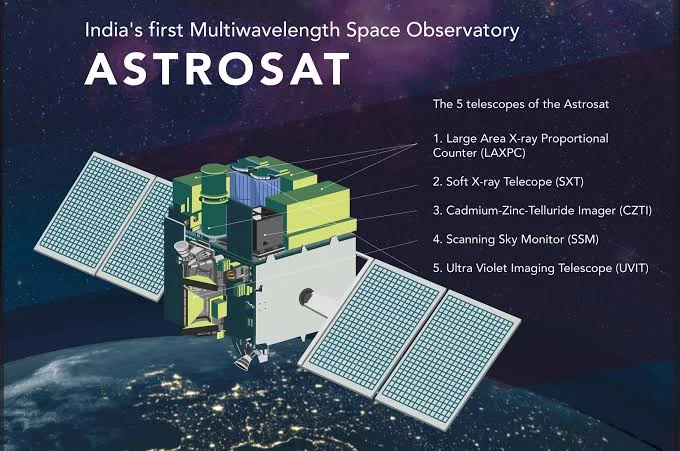
Context: India’s first dedicated space astronomy observatory, AstroSat, completed a decade of operations.
Launch & Mission
Launched: 28 September 2015 by PSLV-C30 (XL configuration) from Sriharikota.
India became the fourth country after the United States, Russia, and Japan to launch a multi-wavelength space observatory with the ASTROSAT mission
Designed Mission Life: 5 years; completing a decade.
First dedicated multi-wavelength space observatory of India.
The payloads cover the energy bands of Ultraviolet (Near and Far), limited optical and X-ray regime (0.3 keV to 100keV).
One of the unique features of AstroSat mission is that it enables the simultaneous multi-wavelength observations of various astronomical objects with a single satellite.
Scientific Significance
Observes the universe in UV, visible, low-energy X-ray, and high-energy X-ray regions simultaneously.
Enabled studies from black holes to neutron stars, nearby stars like Proxima Centauri, and galaxies up to 9.3 billion light years away.
Notable achievement: First-time detection of Far-Ultraviolet (FUV) photons from distant galaxies.
Five Payloads
UVIT (Ultra Violet Imaging Telescope) – UV and visible range imaging.
LAXPC (Large Area X-ray Proportional Counter) – high time resolution studies of X-ray sources.
CZTI (Cadmium-Zinc-Telluride Imager) – hard X-ray imaging and polarization.
SXT (Soft X-ray Telescope) – soft X-ray spectral studies.
SSM (Scanning Sky Monitor) – monitors sky for transient X-ray sources.
Collaborations
Realised by ISRO with contributions from:
IUCAA (Pune), TIFR (Mumbai), IIA (Bengaluru), Raman Research Institute (Bengaluru).
International partners: Canada & United Kingdom institutions.
Importance
Put India in the league of space-faring nations with advanced astronomical observatories.
Complements ground-based astronomy by providing continuous, simultaneous multi-band data.
Strengthened India’s capability in astrophysics, stellar evolution, black hole studies, and high-energy cosmic phenomena.