
Astronomers Spot “Extreme Nuclear Transients” – The Biggest Explosions Since the Big Bang
Context
Astronomers from the University of Hawaii’s Institute for Astronomy (IfA) have identified a new category of cosmic events, termed Extreme Nuclear Transients (ENTs).
Findings published in Science Advances suggest ENTs are more powerful than gamma-ray bursts (GRBs), which until now were considered the brightest explosions since the Big Bang.
What are ENTs?
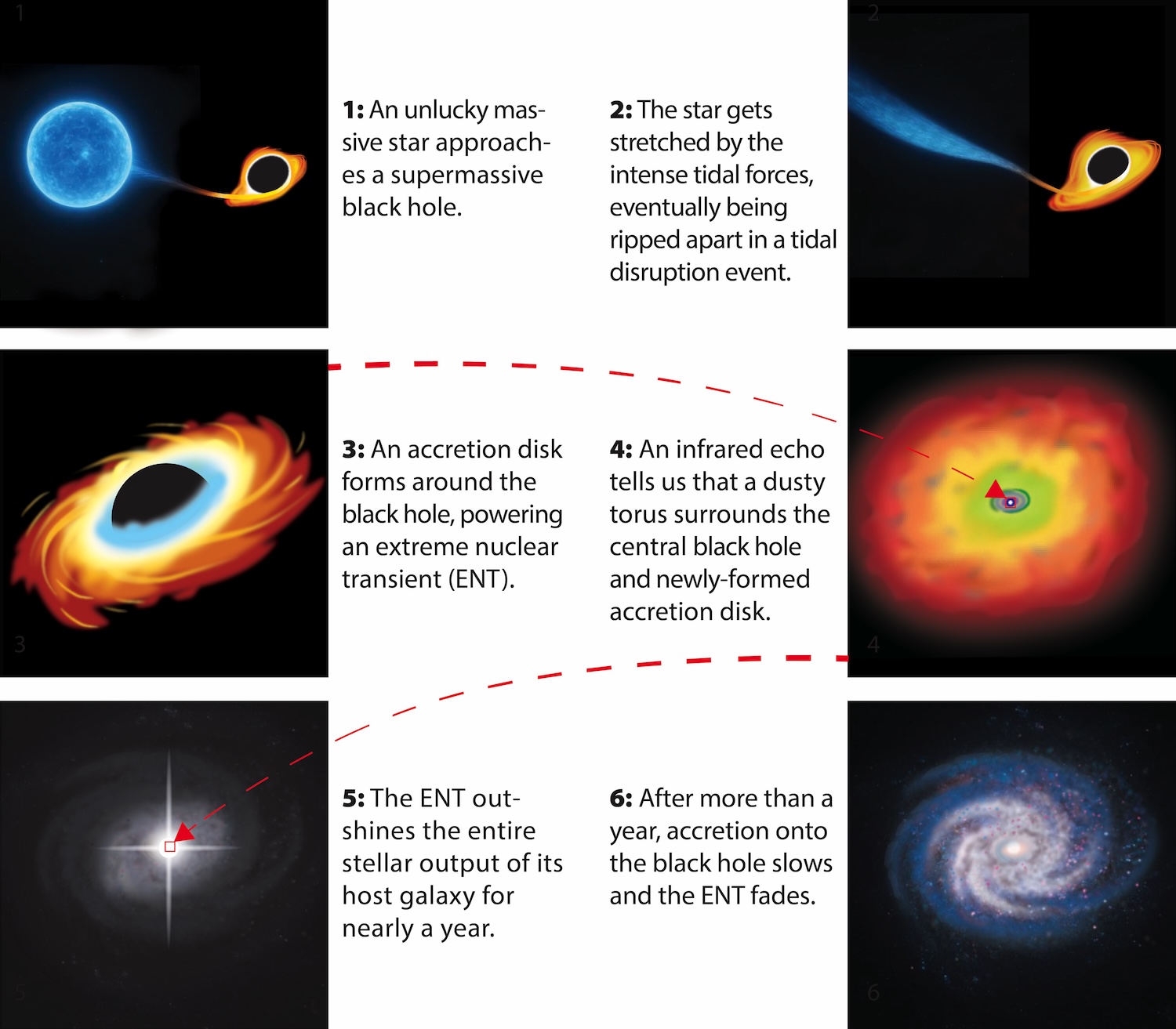
ENTs occur when a supermassive black hole (SMBH) at the center of a galaxy rips apart a massive star (≥ 3 times the Sun’s mass).
The star, when nearing the event horizon, undergoes spaghettification — stretched into a long stream by tidal forces.
The debris falls into the SMBH, releasing enormous electromagnetic radiation, far exceeding GRBs.
Key Features:
Emit 10x more energy than GRBs.
Remain luminous in radio wavelengths for years, allowing long-term study.
Extremely rare and usually associated with very massive galaxies hosting huge black holes.
Comparison with Other Cosmic Events
Gamma-Ray Bursts (GRBs)
Extremely bright, short-lived events from black hole formation or neutron star mergers.
Travel vast distances, making them observable across the universe.
ENTs are even more energetic and longer lasting.
Tidal Disruption Events (TDEs)
Similar process of stars being ripped apart by Supermassive black holes (SMBHs).
ENTs are considered rare TDEs of massive stars with larger host galaxies and heavier black holes.
Fast X-ray Transients (FXTs)
Short bursts of X-rays, less energetic and fleeting.
Recently linked to supernova particle jets trapped within stars.
Unlike ENTs, FXTs are short-lived, weaker X-ray phenomena.
Importance of Discovery
Scientific Value: ENTs provide insights into:
Growth and behavior of supermassive black holes.
Cosmic evolution and star–black hole interactions in the early universe.
Astronomical Tool: Their extreme luminosity allows study of distant, non-accreting black holes otherwise invisible.
Technology Boost: Future observatories like the Vera C. Rubin Observatory (Chile) and Nancy Grace Roman Space Telescope (launch in 2027) will enhance ENT detection using AI-driven data analysis.
Mythological Parallel
Researchers liken ENTs to the myth of Icarus — stars wandering too close to the cosmic “sun” (black hole), only to be destroyed.