
Arsenic-Methylating Microbes and Straighthead Disease in Rice
1. Context
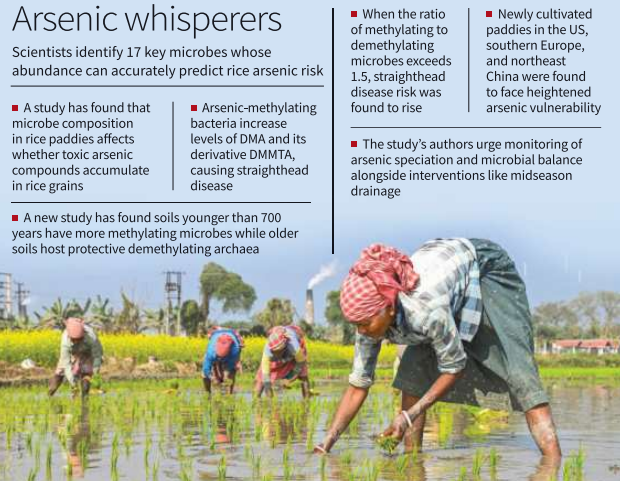
A recent study published in Proceedings of the National Academy of Sciences (PNAS) identified that microbial communities in rice paddies determine the accumulation of toxic arsenic compounds in rice grains.
It highlights a growing link between microbial ecology, arsenic speciation, and agricultural productivity.
2. Key Findings of the Study
Conducted by Nanjing Agricultural University, China.
Analysed 801 paddy soil microbiomes globally.
Found that the balance between arsenic-methylating bacteria and demethylating archaea governs arsenic speciation.
Microbial Interactions
Type of Microbe | Function | Effect on Arsenic |
Methylating bacteria | Convert inorganic arsenic into organic methylated forms (DMA, DMMTA) | Increases toxicity & uptake by rice |
Demethylating archaea | Break down methylated arsenic compounds | Reduces toxicity & accumulation |
3. Straighthead Disease in Rice
Nature: A physiological disorder (not caused by pathogens).
Symptoms:
Erect, green panicles with unfilled grains.
Yield loss up to 70% in severe cases.
Healthy rice shows drooping, filled grains due to maturation.
Causative Compounds:
Dimethylarsinic acid (DMA)
Dimethylated monothioarsenate (DMMTA) — more toxic derivative.
4. Soil Age and Microbial Composition
Younger paddy soils (<700 years):
Dominated by methylating bacteria.
Higher risk of toxic arsenic buildup and straighthead outbreaks.
Older paddy soils (>700 years):
Dominated by demethylating archaea.
Lower accumulation of DMA and DMMTA.
5. Global and Indian Relevance
High-risk regions: Newly cultivated paddy zones — southern Europe, northeast China, U.S.
Relatively safer regions: Ancient paddy areas in South and Southeast Asia with balanced microbial communities.
India’s risk areas:
India is the world’s second-largest producer and consumer of rice. While much of the farming occurs in old, legacy paddies with relatively balanced microbial communities, several States have had new or reclaimed paddy fields established in the last few decades.
These fields may be at greater risk, per the new study
West Bengal and Bangladesh — reported cases earlier.
6. Climate Change Linkages
Warming temperatures and altered flooding regimes can:
Increase total arsenic mobilization.
Disturb microbial balance — favouring methylating microbes.
Implications for food security as rice provides ~40% of caloric intake in India.
7. Agronomic and Policy Interventions
Field-level Measures
Agronomic Interventions to Reduce Arsenic Accumulation in Rice
Mid-season Drainage
Temporarily draining flooded paddy fields re-introduces oxygen into the soil.
The presence of oxygen suppresses arsenic-methylating anaerobic bacteria, which are mainly responsible for converting inorganic arsenic into more toxic methylated forms (DMA, DMMTA).
Result: Reduction in toxic arsenic species and lower incidence of straighthead disorder.
Silicon Fertilisation
Application of silicon fertilisers (e.g., calcium silicate) strengthens plant cell walls and reduces arsenic uptake by competing with arsenate for absorption pathways in rice roots.
Promotes healthier panicle development and improves yield.
Crop Rotation Strategies
Continuous rice cropping favours anaerobic microbial dominance.
Introducing rotations with upland or legume crops helps re-balance the microbial community, maintaining equilibrium between methylating and demethylating organisms.
Prevents long-term arsenic buildup in soil ecosystems.
Intervention | Mechanism | Effect |
Mid-season drainage | Oxygenation of soil | Suppresses methylating microbes |
Silicon fertilisation | Chemical competition with arsenic | Reduces arsenic uptake |
Crop rotation | Microbial balance restoration | Limits arsenic accumulation |
Policy-level Measures
Monitor arsenic speciation — not just total arsenic levels.
Revise food safety standards — current FAO Codex focuses only on inorganic arsenic, ignoring methylated forms (DMA, DMMTA).
Incorporate microbial profiling into agricultural risk assessments.
8. Key Data Points
Yield loss: Up to 70% in affected fields.
Microbial ratio threshold: When methylating to demethylating microbes ratio > 1.5 → sharp increase in disease risk.
Sample size: Global survey of 801 paddy soil microbiomes.
9. Broader Significance
Links microbial ecology with agricultural sustainability and food safety.
Supports shift from “chemical monitoring” to “biological risk assessment” in crop management.
Reinforces need for climate-resilient, microbially balanced paddy systems.
Prelims Practice MCQ
Q. “Straighthead disease” in rice is best described as:
A) A bacterial infection spread through irrigation water
B) A physiological disorder induced by toxic arsenic compounds
C) A fungal disease affecting the panicle stage
D) A viral disorder leading to stunted growth
Answer: B
Explanation: Straighthead disease is a physiological disorder, not caused by pathogens, resulting from accumulation of methylated arsenic compounds like DMA and DMMTA.
Q. Which of the following compounds are associated with arsenic-induced straighthead disease in rice?
Dimethylarsinic acid (DMA)
Dimethylated monothioarsenate (DMMTA)
Arsenite (As³⁺)
Arsenate (As⁵⁺)
Select the correct answer using the code below:
A) 1 and 2 only
B) 1, 2 and 3 only
C) 2, 3 and 4 only
D) 1, 2, 3 and 4
Answer: A
Explanation: The toxic methylated arsenic species—DMA and DMMTA—are responsible for straighthead symptoms. Arsenite and arsenate are inorganic forms but not the direct cause here.
Q. Which of the following interventions can help mitigate arsenic-induced straighthead disease in rice crops?
Midseason drainage of paddy fields
Silicon fertilisation
Crop rotation management
Application of heavy metal chelators
Select the correct answer using the code below:
A) 1 and 2 only
B) 1, 2 and 3 only
C) 2, 3 and 4 only
D) 1, 3 and 4 only
Answer: B
Explanation: Draining fields midseason introduces oxygen that suppresses methylating microbes; silicon fertilisation limits arsenic uptake; and crop rotation stabilises microbial balance. Chelators are not recommended.