
Almond Cultivation in India
1. Major Varieties (Commercially Grown & Traded)
-
Indian & Kashmiri Varieties
-
Shalimar – pointed, large-size nuts
-
Mukdoom, Pranyaj – traditional Kashmiri types
-
-
Introduced/High-selling Varieties
-
California Paper Shells – large, thin shell, sweet
-
Merced – flat, light brown, mid-to-late season
-
Nonpareil – elongated, pale-brown shell (most popular export variety worldwide)
-
Drake, IXL – widely cultivated
-
-
Other Commercial Varieties
-
Primorskii, Ne Plus Ultra, Thompson, Butte, Monterey, Ruby, Fritz, Sonora, Padre, Le Grand, Peerless, Carmel, Price
-
2. Technical Factors for Cultivation
Agro-Climatic Conditions
-
Best at 30–35°C summers; blossoms survive short cold spells (–2.2°C to –3.3°C).
-
Sensitive to prolonged frost during flowering.
Soil
-
pH 7.0–8.5, deep loamy soil, well-drained, drought-tolerant.
-
Requires Farm Yard Manure FYM (20–25 kg/tree/year) + scheduled fertilisers.
Planting
-
Season: Feb–March (pit dug in Sept–Oct).
-
Spacing: 6m × 6m (square system).
-
Bamboo supports for young plants.
Mixed Cropping (Pre-bearing stage)
-
Pulses, peas (soil fertility)
-
Mustard, turnip (boost pollination)
-
Aromatic/medicinal crops (lavender, garlic – pest repellent).
Irrigation
-
Critical during flowering (Feb–Mar) and fruit development (Apr–Jun).
-
Drip irrigation best for water-use efficiency.
Harvesting
-
Trees bear fruit in 3 years, full yield in 6–7 years.
-
Ready after 8 months of flowering (Aug–Sept).
-
Indicators: pod splits, shell visible → manual shaking.
-
Nuts dried (sun/air-polytunnels) to 5–7% moisture before hulling.
Yield
-
1,400–2,600 lbs/acre with proper management.
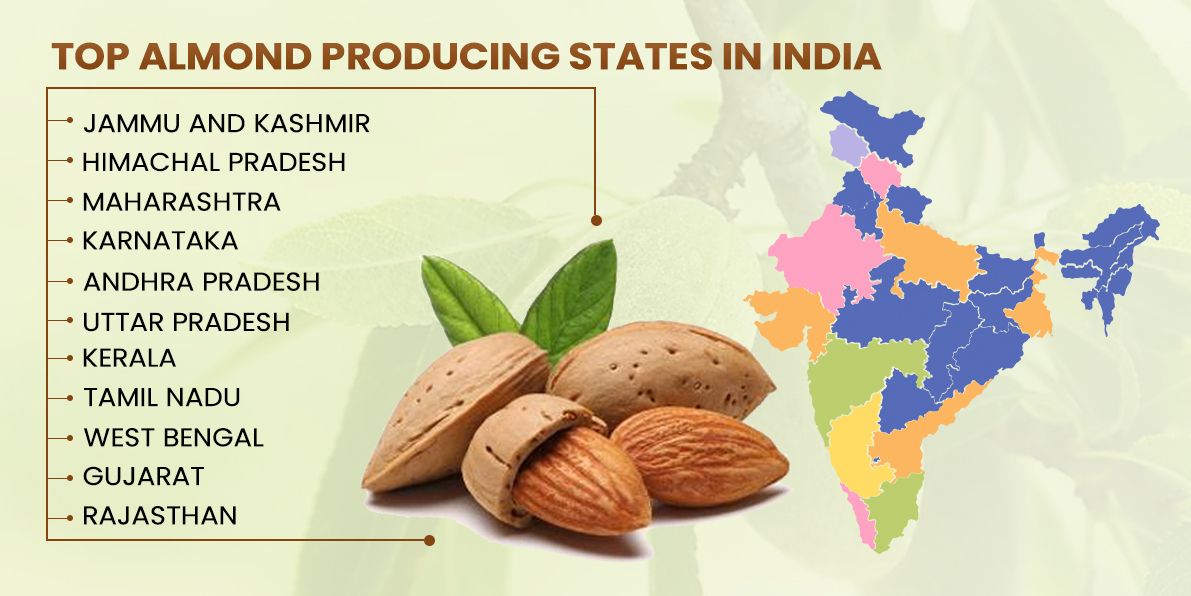
3. Almond-Producing States in India
-
Jammu & Kashmir – largest producer (91.26% of total, ~12.9k tonnes).
-
Himachal Pradesh – second (~0.76k tonnes).
-
Maharashtra – hot-climate adapted cultivation.
-
Karnataka – Bangalore, Hubli, Belgaum, Davangere, Mangalore.
-
Andhra Pradesh – rising market-based cultivation.
-
Uttar Pradesh – scaling up new orchards.
-
Kerala – adopting for health-product market.
-
Tamil Nadu – favourable pockets.
-
West Bengal – moderate contribution.
-
Gujarat – small but emerging via agri-tech adoption.
-
Rajasthan – suitable agro-climatic zones (sweet & bitter almond).
4. Challenges
-
Climate variability (frost, erratic rains).
-
High water demand → environmental sustainability concerns.
-
Competition from low-cost imported almonds.
-
Lack of modern post-harvest infrastructure.
-
Bee mortality due to pollination stress.
5. Significance
-
Almonds = nutritious, high-value cash crop → boosts farmer income.
-
Strong domestic demand for sweets, beverages (kehwa, milk, desserts).
-
Expanding role in nutraceuticals & plant-based milk industry.