
Afghanistan Earthquake
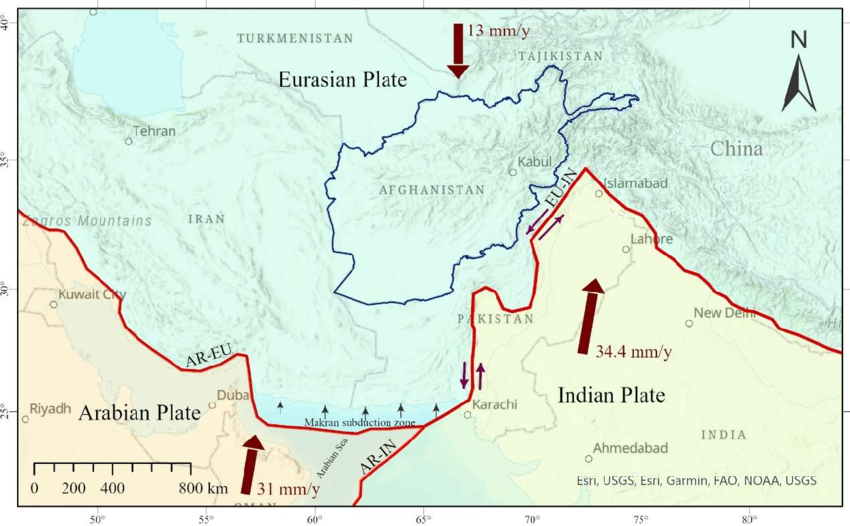
Afghanistan’s Tectonic Setting and Seismicity
Tectonic Setting
Afghanistan lies at the collision zone of the Indian Plate and Eurasian Plate, making it highly seismically active.
Fault lines: Chaman Fault, Herat Fault/Hari rud fault, and other active thrust faults.
Type: Shallow-focus earthquake (8 km depth) → more destructive as seismic energy travels a shorter distance to the surface.
-
Afghanistan sits at the triple interaction zone of the Indian, Eurasian, and Arabian plates.
-
The Indian Plate moves northwards at ~5 cm/year, colliding with the Eurasian Plate, while the Arabian Plate also pushes northwards.
-
This convergence generates immense compressional stress.
2. Crustal Deformation and Mountain Building
-
Continuous collision leads to faulting, folding, and uplift.
-
The Hindu Kush, Pamir Knot, and Central Afghan ranges are western extensions of the Himalayan orogeny.
-
The Kabul Block and other micro-blocks act as tectonic fragments squeezed between colliding plates.
3. Seismic Characteristics
-
Shallow-focus earthquakes: Linked to strike-slip and thrust faults across Afghanistan (high destruction potential).
-
Intermediate- to deep-focus earthquakes: Particularly in the Hindu Kush, where lithosphere is underthrust and breaks at depth (~200 km).
-
One of the few global zones with such deep seismicity outside subduction trenches.
4. Seismic Hazard Profile
-
Frequent moderate-to-major quakes (M5–7.5).
-
Examples: 1998 Takhar (M6.1, ~4,000 deaths); 2002 Hindu Kush; 2022 Paktika (M5.9, >1,000 deaths); 2023 Herat series.
-
Vulnerability amplified by:
-
High population density in mountainous valleys.
-
Weak housing structures (mud-brick, non-engineered).
-
Limited disaster preparedness.
-
5. Broader Geographic Implications
-
Afghanistan is part of the Alpide seismic belt (extending from the Mediterranean to Southeast Asia).
-
The seismicity links it directly to processes shaping the Himalayas, Zagros, and Central Asian ranges.
-
Earthquakes also trigger landslides, avalanches, and river blockages, compounding risks.

