
Abhidhamma Divas (Abhidhamma Day) 2025
1. Context and Occasion
Event: International Abhidhamma Day (Śharada Pūrṇimā / Full Moon Day)
Dates: 6–7 October 2025
Venue: Gautam Buddha University (GBU), Greater Noida, Uttar Pradesh
Organized by:
International Buddhist Confederation (IBC) (under the Ministry of Culture, GoI)
Gautam Buddha University (GBU)
Antarrashtriya Baudh Shodh Sansthan (Lucknow)
Ministry of Culture, Government of India
Theme of the International Conference:
“The Relevance of Abhidhamma in Understanding Buddhist Thought: Text, Tradition, and Contemporary Perspectives.”
2. Historical & Religious Background
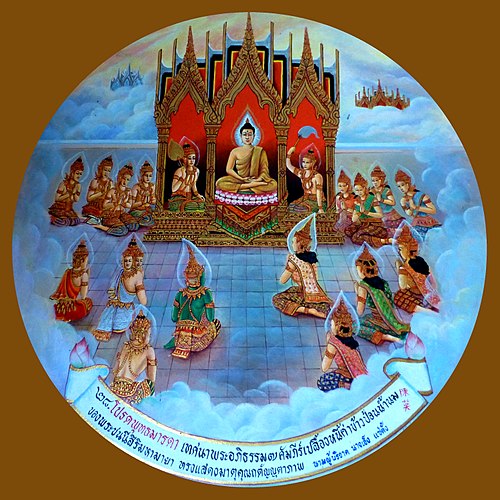
Abhidhamma Day commemorates the occasion when Lord Buddha preached the Abhidhamma to the deities of Tavatimsa Heaven, led by his mother Mahamaya, and later imparted the teachings to his disciple Arahant Sariputta.
Celebrated on the Full Moon Day of Sharada Purnima (around October) in India;
in Myanmar, it falls on the Full Moon of the 7th month of the Burmese lunar year (end of Rains Retreat).The Abhidhamma Pitaka is one of the three Pitakas (Tripitaka) — the canonical scriptures of Theravada Buddhism, focusing on philosophical and psychological analysis of mind and matter.
3. About Abhidhamma
Known as the “Higher Teaching” (Dhamma) — a systematized philosophical and psychological interpretation of the Buddha’s teachings.
Often described as “Dharma ka Vishesh Prakash” or special enlightenment, providing deeper insight into mental states (Citta), phenomena (Dhamma), and consciousness (Vijnana).
Forms the Abhidhamma Pitaka, one of the Tripitaka components alongside:
Vinaya Pitaka – Monastic discipline
Sutta Pitaka – Discourses of the Buddha
Abhidhamma Pitaka – Philosophical and analytical exposition

Abhidhamma Pitaka — Core of Buddhist Philosophy
The Abhidhamma Pitaka is the third and final division of the Tipitaka (Pali Canon), the authoritative scripture of Theravada Buddhism.
It represents the philosophical and psychological systematization of the Buddha’s teachings, distinct from the narrative or rule-based nature of the other two Pitakas.
The Three Pitakas (Tripitaka / Tipitaka)
Pitaka | Meaning & Focus | Description |
Vinaya Pitaka | “Book of Discipline” | Lays down monastic rules and ethical codes for monks and nuns of the Sangha. |
Sutta Pitaka | “Book of Discourses” | Contains sermons (suttas) delivered by the Buddha and his close disciples, emphasizing moral and spiritual guidance. |
Abhidhamma Pitaka | “Book of Higher Doctrine” | Provides systematic analysis of the mind, matter, and laws of phenomena; considered the philosophical and metaphysical foundation of Buddhism. |
Nature and Purpose of Abhidhamma
Represents the scholastic, analytical, and philosophical exposition of Buddha’s teachings.
Explores psychology, epistemology, ontology, ethics, and metaphysics in Buddhist thought.
Attempts to categorize and define all mental and material phenomena (dhammas) that constitute existence.
Described as “Dhamma ka Vishesh Prakash” or “special enlightenment.”
Structure of the Abhidhamma Pitaka (Seven Books)
No. | Book | Meaning / Focus |
1. | Dhammasangani | Enumeration and classification of phenomena (mental and physical). |
2. | Vibhanga | Analytical exposition or “Book of Treatises.” |
3. | Dhatukatha | Discussion of elements; relations between phenomena and aggregates. |
4. | Puggalapanatti | Description and classification of personality types. |
5. | Kathavatthu | Points of controversy; debates between early Buddhist schools. |
6. | Yamaka | Logical pairs and reasoning patterns. |
7. | Patthana | The “Book of Relations,” explaining causal laws and conditional relations. |