
Aadhaar as Voter Identity
Context:
-
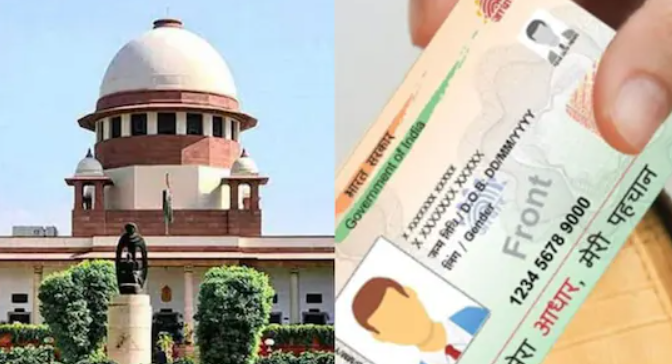
The Supreme Court is hearing petitions challenging the Election Commission’s (EC) Special Intensive Revision (SIR) of electoral rolls in Bihar.
-
Central issue: Whether Aadhaar can be accepted as proof for voter verification and inclusion/exclusion from rolls.
Supreme Court Observations
-
Aadhaar as Statutory Proof
-
A Bench of Justices Surya Kant and Joymalya Bagchi observed that Aadhaar is part of the statute under Section 23(4), Representation of the People Act, 1950.
-
This section allows Aadhaar to be used for authentication of voter entries in rolls.
-
-
12th Document
-
Court reaffirmed its earlier order (Aug 8, 2025) declaring Aadhaar as the 12th valid document voters can use, in addition to the 11 already notified by EC.
-
-
Nature of Aadhaar
-
Petitioner argued: Aadhaar is not proof of age, citizenship, residence, or domicile—anyone (including non-citizens) can obtain it.
-
Court’s query: If Aadhaar is not proof of these, what is it then? Petitioner replied it is a “simple proof of identity.”
-
-
Counterpoint
-
Court questioned whether documents like land records (already listed) could be considered more valid than Aadhaar.
-
Justices stressed EC has the statutory power to differentiate between citizens and infiltrators.
-
Legal & Constitutional Angle
-
Representation of the People Act, 1950: Governs preparation of electoral rolls.
-
Section 23(4): Explicitly allows linking Aadhaar with voter rolls for authentication.
-
SC Position : Aadhaar is a legitimate document under the law, but cannot override eligibility criteria (citizenship, residence, age).
Significance
-
Electoral Integrity vs Identity Proof: Balancing ease of verification with safeguarding against non-citizens entering rolls.
-
Citizenship Question: Aadhaar’s limitation (not proof of citizenship) creates tension with voter eligibility requirements.
-
Judicial Oversight: SC’s decision will affect how EC conducts future nationwide voter roll revisions.