
A-G on Governor’s Discretionary Powers
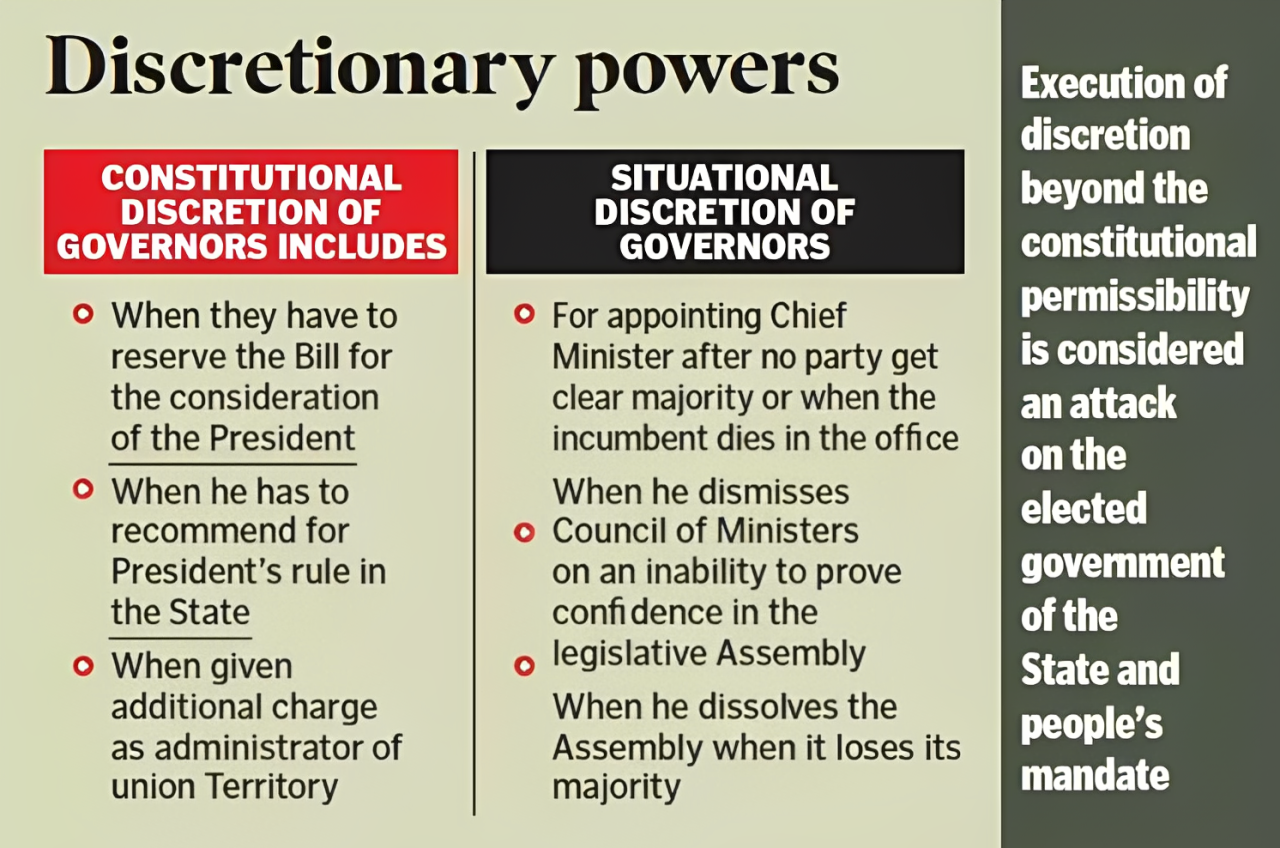
Context: Hearing before a five-judge Constitution Bench headed by CJI B. R. Gavai.
Key Submissions by Attorney-General R. Venkataramani
-
Governor’s independence
-
Withholding assent to a State law is an independent act, not bound by the aid and advice of the Council of Ministers.
-
This power may even operate contrary to the mandate of the State Legislature/Cabinet.
-
Involves personal independent judgment, though guided by constitutional principles and settled law.
-
-
Constitutional Basis
The 42nd Amendment made Article 74(1) explicit that the President ‘shall… act in accordance with’ the Cabinet advice. But Article 163 (Governors) was not amended to match Article 74
-
Unconstitutionality safeguard
-
A Governor cannot be expected to give assent if the proposed State law is unconstitutional.
-
-
Judicial Reference
-
Invoked Article 145(3): substantial questions of constitutional law should be heard by a Constitution Bench.
-
Had earlier urged the 2-judge Bench (Justice J. B. Pardiwala) to refer the Tamil Nadu Governor case.
Article 145(3) – Constitution Bench
Provision:
-
Article 145(3) of the Indian Constitution states that any case involving a “substantial question of law as to the interpretation of the Constitution” must be heard by a bench of not less than five judges of the Supreme Court.
Key Points
-
Minimum Judges:
-
A minimum of five judges must sit to hear such cases.
-
-
Constitution Bench:
-
A bench of five or more judges constituted under Article 145(3) is known as a Constitution Bench.
-
-
Purpose:
-
To ensure thorough consideration of significant constitutional issues.
-
To maintain uniformity and consistency in constitutional interpretation.
-
-
Reference to Larger Bench:
-
If a smaller bench (say 2 or 3 judges) faces a substantial constitutional question, they must refer it to a Constitution Bench.
-
After the Constitution Bench gives its interpretation, the smaller bench disposes of the appeal accordingly.
-
-
Presidential Reference:
-
Article 145(3) also applies to references made by the President under Article 143 (advisory jurisdiction of the Supreme Court).
-
Examples of Constitution Bench Usage
-
Kesavananda Bharati v. State of Kerala (1973) – 13-judge bench (basic structure doctrine).
-
Indira Nehru Gandhi v. Raj Narain (1975) – 5-judge bench.
-
NJAC Judgment (2015) – 5-judge bench (struck down 99th Constitutional Amendment).