
3I/ATLAS
3I/ATLAS – An Ancient Interstellar Comet in the Solar System
Why in news:
On July 1, 2025, astronomers using the ATLAS survey telescope in Chile discovered a new interstellar object, named 3I/ATLAS. It is only the third confirmed interstellar object observed in our solar system after 1I/ʻOumuamua (2017) and 2I/Borisov (2019).
Key Scientific Highlights:
1. Interstellar Nature Confirmed
-
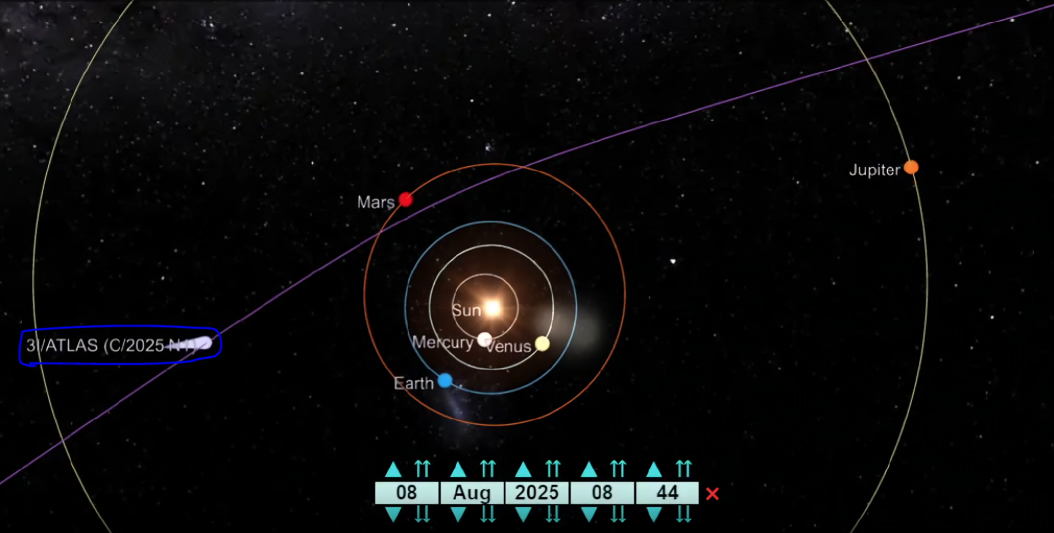
Highly elliptical and hyperbolic orbit, indicating it is not gravitationally bound to the sun.
-
Speed: Traveling at approximately 57–68 km/s relative to the sun.
-
Trajectory traced back to the constellation Sagittarius, suggesting origin from outside the solar system.
2. Timeline of Movement
-
Closest approach to Earth: ~270 million km (no threat).
-
Closest approach to the Sun: October 29–30, 2025, at ~210 million km, just inside Mars’s orbit.
-
Will eventually exit the solar system permanently after perihelion.
3. Physical and Chemical Characteristics
-
Identified as an active comet with a visible coma (cloud of dust and ice).
-
May develop a tail as it nears the sun.
-
Photometric analysis shows a reddish hue and a spectral slope of 1.3% per 100 nm, indicating:
-
Presence of complex organic molecules
-
Abundant water ice on the surface
-
-
Estimated size of nucleus: 10–30 km — larger than both 1I/ʻOumuamua and 2I/Borisov.
-
Composition and rotation are under global investigation using ground-based telescopes.
4. Possible Oldest Observed Comet
-
Likely predates the solar system by over 3 billion years.
-
May have originated in the Milky Way’s thick disk or from a long-dead star system in the galactic thin disk.
-
Offers a rare opportunity to study primordial material from another star system.
Scientific and Astronomical Importance
-
Could provide crucial insights into early galactic and planetary formation processes.
-
Offers an opportunity to understand the building blocks of planets and organic chemistry in alien environments.
-
Potential to study star system evolution, composition of interstellar objects, and extrasolar material.
International Collaboration and Monitoring
-
Global observatories are actively monitoring the object’s:
-
Composition
-
Activity
-
Orbital dynamics
-
-
Visibility: May be observable by amateur astronomers with small telescopes by late 2025 to early 2026.
The discovery of 3I/ATLAS marks a major milestone in interstellar research. As the oldest known interstellar comet, it opens a new chapter in understanding the cosmic origins of matter, organic compounds, and planetary formation, offering rare insights before it vanishes from view forever.