
32nd Meeting of the Financial Stability and Development Council (FSDC) Sub-Committee
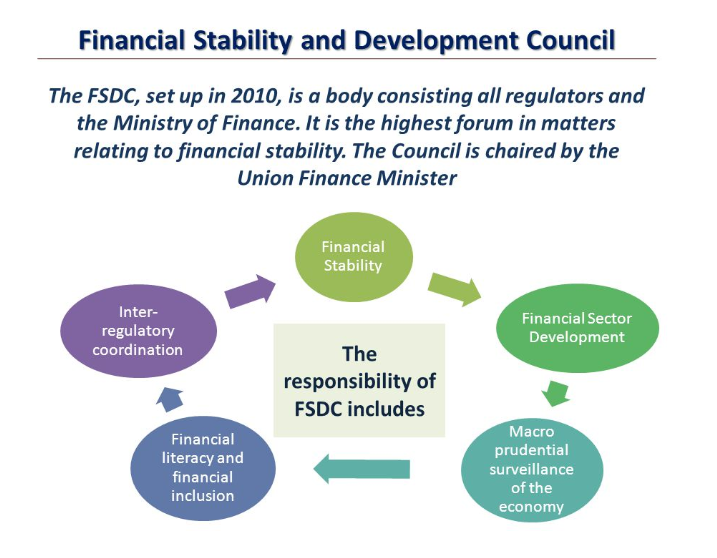
Financial Stability and Development Council (FSDC) & Sub-Committee
Background
-
Constituted: 2010 by then Finance Minister Pranab Mukherjee.
-
Idea Origin: Raghuram Rajan Committee (2008) on financial sector reforms recommended a super-regulatory body for systemic risk management.
-
Nature: Apex-level body to oversee macro-prudential regulation and financial stability.
-
Not a statutory body (no separate funds allocated).
-
Context of creation: Global Financial Crisis (2007–08) → need for stronger financial stability mechanisms.
Composition of FSDC
Chairperson: Union Finance Minister.
Members:
-
Governor, RBI
-
Finance Secretary &/or Secretary, Department of Economic Affairs (DEA)
-
Secretary, Department of Financial Services (DFS)
-
Secretary, Ministry of Corporate Affairs
-
Secretary, Ministry of Electronics & IT
-
Chief Economic Adviser (CEA)
-
Chairpersons of SEBI, IRDAI, PFRDA, IBBI
-
Additional Secretary (DEA) as Secretary of the Council
-
Special invitees as deemed necessary.
Responsibilities of FSDC
-
Financial Stability – monitoring risks & preventing crises.
-
Financial Sector Development – deepening capital markets, insurance, pensions.
-
Inter-Regulatory Coordination – resolving overlaps between RBI, SEBI, IRDAI, PFRDA.
-
Macro-Prudential Supervision – oversight of large financial conglomerates.
-
Financial Inclusion & Literacy – unique mandate compared to global counterparts.
-
Coordination of India’s interface with global financial bodies – FATF, FSB, IMF, etc.
Structural & Functional Aspects
-
Sub-Committee of FSDC (FSDC-SC):
-
Headed by Governor, RBI.
-
Replaced the High-Level Coordination Committee on Financial Markets.
-
Focuses on operational issues, inter-regulatory coordination, and monitoring systemic risks.
-
-
Regulators’ autonomy protected – FSDC provides coordination, not control.
32nd Meeting of FSDC Sub-Committee
-
Venue: Reserve Bank of India, Mumbai.
-
Chair: Shri Sanjay Malhotra, Governor, RBI.
- It includes all FSDC members, four RBI Deputy Governors, and the Department of Economic Affairs (DEA) Additional Secretary.
Key Discussions:
-
Global & Domestic Macroeconomic Developments – impact of trade uncertainty & geopolitical frictions.
-
Inter-Regulatory Issues:
-
Simplification of KYC processes.
-
Special drives for financial inclusion.
-
Review of State-Level Coordination Committees (SLCCs).
-
Activities of various technical groups.
-
-
National Strategy for Financial Inclusion (NSFI) 2025–30 – deliberated.
-
Commitment: Enhance financial sector resilience through coordination.
Significance
-
Strengthens India’s macro-prudential framework against financial shocks.
-
Addresses regulatory fragmentation across multiple agencies.
-
Supports financial inclusion goals through national strategies.
-
Provides early warning mechanism for systemic risks.
-
Enhances India’s credibility in global financial governance (FATF, FSB).