
20th session of the Intergovernmental Committee for Safeguarding Intangible Cultural Heritage.
Context
India will host the 20th session of the UNESCO Intergovernmental Committee for Safeguarding of the Intangible Cultural Heritage (ICH) from 8–13 December 2025.
Venue: Red Fort, New Delhi (UNESCO World Heritage Site).
First time India is hosting the ICH Committee session.
Chair: H.E. Vishal V. Sharma, India’s Permanent Delegate to UNESCO.
Coincides with 20th anniversary of India’s ratification of the 2003 Convention (ratified in 2005).
India has served three terms on the ICH Committee.
15 Indian elements are currently inscribed on UNESCO’s Representative List.
India has nominated Chhath Mahaparva and Diwali for upcoming inscription.
Note: “The Ministry of Culture has appointed the Sangeet Natak Akademi, an autonomous organisation under the Ministry of Culture, as nodal office for matters relating to the intangible cultural heritage including for preparation of the nomination dossiers for the Representative List of UNESCO.”
Understanding Intangible Cultural Heritage (ICH)
Includes practices, knowledge, expressions, objects, and spaces regarded by communities as part of their cultural identity.
Living heritage passed across generations; evolves with time.
Strengthens cultural identity and appreciation for diversity.

Historical Background: 2003 Convention
Adopted on 17 October 2003, at UNESCO’s 32nd General Conference in Paris.
Objective: protect threatened cultural traditions due to globalisation, social change, and resource constraints.
Places communities, groups, and practitioners at the centre of safeguarding efforts.
Highlights:
Interdependence of tangible and intangible heritage.
Global cooperation & awareness for younger generations.
Establishes mechanisms such as ICH Lists and frameworks for international assistance.
Purposes of the Convention
Safeguard intangible cultural heritage.
Ensure respect for communities, groups, and individuals concerned.
Raise awareness at all levels and ensure mutual appreciation.
Provide for international cooperation and assistance.
Intergovernmental Committee: Functions
Advances objectives and ensures implementation of the 2003 Convention.
Monitors & guides safeguarding practices.
Recommends best practices and measures for ICH protection.
Prepares draft plans for use of the ICH Fund.
Mobilises resources for the Fund.
Drafts and proposes operational directives.
Examines periodic reports from States Parties and summarises them for the General Assembly.
Evaluates State requests for:
Inscription on ICH Lists
International assistance (Articles 16, 17, 18)
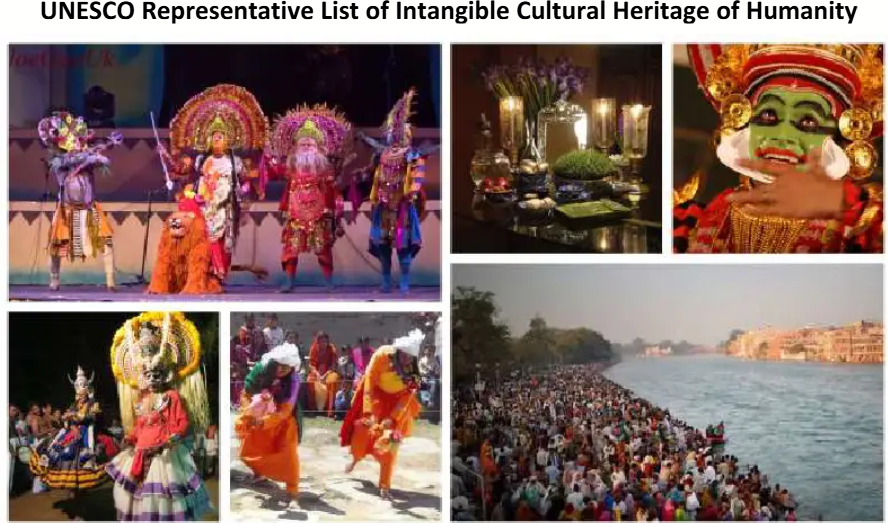
Indian Elements on UNESCO ICH List (15 elements)
2008
Kutiyattam – Sanskrit theatre of Kerala
Vedic Chanting – oral tradition of Vedas
Ramlila – traditional performance of the Ramayana
2009
Ramman – religious festival and ritual theatre of Uttarakhand
Kalbelia Folk Songs and Dances – Rajasthan
Mudiyettu – ritual theatre and dance drama of Kerala
Chhau Dance – eastern India (Odisha, West Bengal, Jharkhand)
2013
Sankirtana – ritual singing, drumming and dancing of Manipur
2014
Traditional Brass and Copper Craft of the Thatheras of Jandiala Guru, Punjab
2016
Nawrouz / Novruz – multi-national inscription (India included)
Yoga – ancient physical, mental, spiritual tradition
2018
Kumbh Mela – mass Hindu pilgrimage
2021
Durga Puja – festival and cultural practices of West Bengal
2023
Garba – ritual dance tradition of Gujarat
2024
Buddhist Chanting of Ladakh
(Inscribed in 2024; India’s 15th element on the Representative List.)
Conclusion
Hosting the 20th ICH Committee session is a landmark in India’s global cultural leadership.
Allows India to showcase its safeguarding model and promote international cooperation.
Strengthens global heritage governance and India’s soft power.
Reinforces India’s long-term commitment to protecting living cultural traditions for future generations.
Prelims Practice MCQs
Q. The 2003 UNESCO Convention for Safeguarding of the Intangible Cultural Heritage was adopted during:
A. 30th General Conference, Paris
B. 31st General Conference, Washington
C. 32nd General Conference, Paris
D. 33rd General Conference, Geneva
Answer: C
Explanation: Adopted on 17 October 2003 in Paris during the 32nd General Conference.
Q. Consider the following pairs of ICH elements and their states:
Ramman – Uttarakhand
Kalbelia dance – Rajasthan
Chhau – West Bengal, Jharkhand, Odisha
Thatheras’ metal craft – Uttar Pradesh
Which of the above pairs are correctly matched?
A. 1 and 2 only
B. 1, 2 and 3 only
C. 2, 3 and 4 only
D. 1, 2, 3 and 4
Answer: B
Pair 4 is incorrect; Thatheras is from Punjab, not UP.
Q. Which of the following ICH elements involves ritual singing, drumming and dancing?
Sankirtana of Manipur
Buddhist Chanting of Ladakh
Chhau
Select the correct answer:
A. 1 only
B. 1 and 2 only
C. 1 and 3 only
D. 1, 2 and 3
Answer: A
Sankirtana = ritual singing + drumming + dancing
Buddhist chanting = monastic liturgical chanting
Chhau = martial dance style, not ritual singing